The query has to be between 2 and 50 characters

Advertisement
Advertisement

Current special Clicks - Valid from 25.02 to 05.03 - Page nb 69

Advertisement
Advertisement
Advertisement
Advertisement
Special Clicks 25.02.2026 - 05.03.2026
Special Boxer - Atlyn Mall Liquor Grand Opening 25 May, 2026 - 7 Jun, 2026
Boxer - Atlyn Mall Liquor Grand Opening
25 May, 2026 - 7 Jun, 2026
Special Boxer - GP May ME 25 May, 2026 - 7 Jun, 2026
Boxer - GP May ME
25 May, 2026 - 7 Jun, 2026
Special Boxer - GP May ME 25 May, 2026 - 7 Jun, 2026
Boxer - GP May ME
25 May, 2026 - 7 Jun, 2026
Special Boxer - Atlyn Mall Liquor Grand Opening 22 May, 2026 - 7 Jun, 2026
Boxer - Atlyn Mall Liquor Grand Opening
22 May, 2026 - 7 Jun, 2026
See next flyer
Advertisement
Advertisement
Advertisement

Products in this catalogue

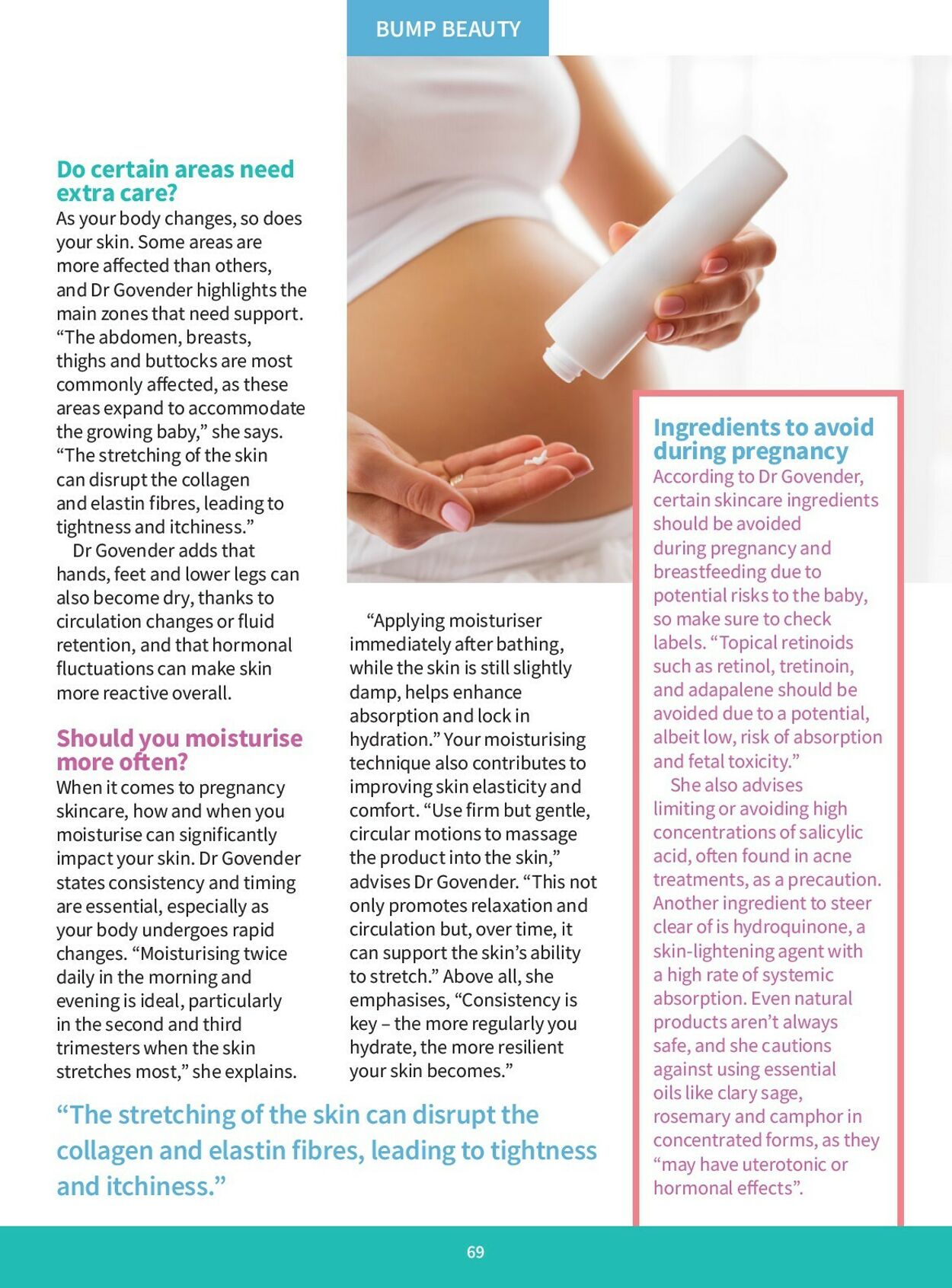
Do certain areas need extra care? As your body changes, so does your skin. Some areas are more affected than others, and Dr Govender highlights the main zones that need support. “The abdomen, breasts, thighs and buttocks are most commonly affected, as these areas expand to accommodate the growing baby,” she says. “The stretching of the skin can disrupt the collagen and elastin fibres, leading to tightness and itchiness.” Dr Govender adds that hands, feet and lower legs can also become dry, thanks to circulation changes or fluid retention, and that hormonal fluctuations can make skin more reactive overall. Should you moisturise more often? When it comes to pregnancy skincare, how and when you moisturise can significantly impact your skin. Dr Govender states consistency and timing are essential, especially as your body undergoes rapid changes. “Moisturising twice daily in the morning and evening is ideal, particularly in the second and third trimesters when the skin stretches most,” she explains. BUMP BEAUTY “Applying moisturiser immediately after bathing, while the skin is still slightly damp, helps enhance absorption and lock in hydration.” Your moisturising technique also contributes to improving skin elasticity and comfort. “Use firm but gentle, circular motions to massage the product into the skin,” advises Dr Govender. “This not only promotes relaxation and circulation but, over time, it can support the skin’s ability to stretch.” Above all, she emphasises, “Consistency is key - the more regularly you hydrate, the more resilient your skin becomes.” “The stretching of the skin can disrupt the collagen and elastin fibres, leading to tightness and itchiness.” Ingredients to avoid during pregnancy According to Dr Govender, certain skincare ingredients should be avoided during pregnancy and breastfeeding due to potential risks to the baby, so make sure to check labels. “Topical retinoids such as retinol, tretinoin, and adapalene should be avoided due to a potential, albeit low, risk of absorption and fetal toxicity.” She also advises limiting or avoiding high concentrations of salicylic acid, often found in acne treatments, as a precaution. Another ingredient to steer clear of is hydroquinone, a skin-lightening agent with a high rate of systemic absorption. Even natural products aren’t always safe, and she cautions against using essential oils like clary sage, rosemary and camphor in concentrated forms, as they “may have uterotonic or hormonal effects”.


Latest specials

Advertisement
Do certain areas need extra care? As your body changes, so does your skin. Some areas are more affected than others, and Dr Govender highlights the main zones that need support. “The abdomen, breasts, thighs and buttocks are most commonly affected, as these areas expand to accommodate the growing baby,” she says. “The stretching of the skin can disrupt the collagen and elastin fibres, leading to tightness and itchiness.” Dr Govender adds that hands, feet and lower legs can also become dry, thanks to circulation changes or fluid retention, and that hormonal fluctuations can make skin more reactive overall. Should you moisturise more often? When it comes to pregnancy skincare, how and when you moisturise can significantly impact your skin. Dr Govender states consistency and timing are essential, especially as your body undergoes rapid changes. “Moisturising twice daily in the morning and evening is ideal, particularly in the second and third trimesters when the skin stretches most,” she explains. BUMP BEAUTY “Applying moisturiser immediately after bathing, while the skin is still slightly damp, helps enhance absorption and lock in hydration.” Your moisturising technique also contributes to improving skin elasticity and comfort. “Use firm but gentle, circular motions to massage the product into the skin,” advises Dr Govender. “This not only promotes relaxation and circulation but, over time, it can support the skin’s ability to stretch.” Above all, she emphasises, “Consistency is key - the more regularly you hydrate, the more resilient your skin becomes.” “The stretching of the skin can disrupt the collagen and elastin fibres, leading to tightness and itchiness.” Ingredients to avoid during pregnancy According to Dr Govender, certain skincare ingredients should be avoided during pregnancy and breastfeeding due to potential risks to the baby, so make sure to check labels. “Topical retinoids such as retinol, tretinoin, and adapalene should be avoided due to a potential, albeit low, risk of absorption and fetal toxicity.” She also advises limiting or avoiding high concentrations of salicylic acid, often found in acne treatments, as a precaution. Another ingredient to steer clear of is hydroquinone, a skin-lightening agent with a high rate of systemic absorption. Even natural products aren’t always safe, and she cautions against using essential oils like clary sage, rosemary and camphor in concentrated forms, as they “may have uterotonic or hormonal effects”.

Advertisement
Advertisement

If you continue to browse this website, you accept the use of cookies.

Name Details