The query has to be between 2 and 50 characters

Advertisement
Advertisement

Current special Clicks - Valid from 25.02 to 05.03 - Page nb 61

Advertisement
Advertisement
Advertisement
Advertisement
Special Clicks 25.02.2026 - 05.03.2026
Special Boxer - Atlyn Mall Liquor Grand Opening 22 May, 2026 - 7 Jun, 2026
Boxer - Atlyn Mall Liquor Grand Opening
22 May, 2026 - 7 Jun, 2026
Special Boxer - Atlyn Mall Liquor Grand Opening 22 May, 2026 - 7 Jun, 2026
Boxer - Atlyn Mall Liquor Grand Opening
22 May, 2026 - 7 Jun, 2026
Special Boxer - GP May ME Liquor Special Stores 25 May, 2026 - 7 Jun, 2026
Boxer - GP May ME Liquor Special Stores
25 May, 2026 - 7 Jun, 2026
Special Boxer - GP May ME Liquor 25 May, 2026 - 7 Jun, 2026
Boxer - GP May ME Liquor
25 May, 2026 - 7 Jun, 2026
See next flyer
Advertisement
Advertisement
Advertisement

Products in this catalogue

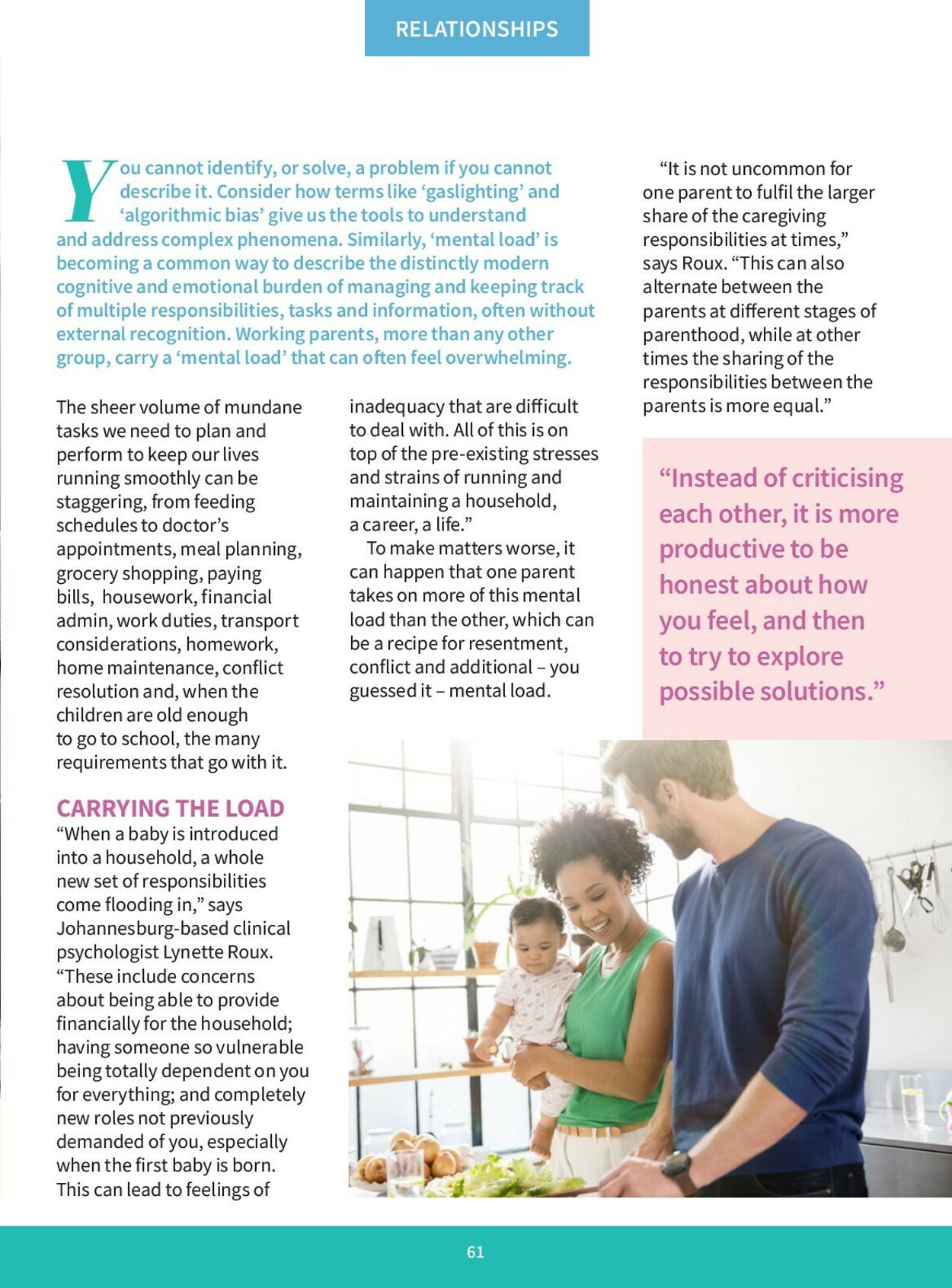
RELATIONSHIPS } 7 ou cannot identify, or solve, a problem if you cannot describe it. Consider how terms like ‘gaslighting’ and ‘algorithmic bias’ give us the tools to understand and address complex phenomena. Similarly, ‘mental load’ is becoming a common way to describe the distinctly modern cognitive and emotional burden of managing and keeping track of multiple responsibilities, tasks and information, often without external recognition. Working parents, more than any other group, carry a ‘mental load’ that can often feel overwhelming. The sheer volume of mundane tasks we need to plan and perform to keep our lives running smoothly can be staggering, from feeding schedules to doctor’s appointments, meal planning, grocery shopping, paying bills, housework, financial admin, work duties, transport considerations, homework, home maintenance, conflict resolution and, when the children are old enough to go to school, the many requirements that go with it. CARRYING THE LOAD “When a baby is introduced into a household, a whole new set of responsibilities come flooding in,” says Johannesburg-based clinical psychologist Lynette Roux. “These include concerns about being able to provide financially for the household; having someone so vulnerable being totally dependent on you for everything; and completely new roles not previously demanded of you, especially when the first baby is born. This can lead to feelings of inadequacy that are difficult to deal with. All of this is on top of the pre-existing stresses and strains of running and maintaining a household, acareer, a life.” To make matters worse, it can happen that one parent takes on more of this mental load than the other, which can be arecipe for resentment, conflict and additional - you guessed it - mental load. “It is not uncommon for one parent to fulfil the larger share of the caregiving responsibilities at times,” says Roux. “This can also alternate between the parents at different stages of parenthood, while at other times the sharing of the responsibilities between the parents is more equal.” “Instead of criticising each other, it is more productive to be honest about how you feel, and then to try to explore possible solutions.”


Latest specials

Advertisement
RELATIONSHIPS } 7 ou cannot identify, or solve, a problem if you cannot describe it. Consider how terms like ‘gaslighting’ and ‘algorithmic bias’ give us the tools to understand and address complex phenomena. Similarly, ‘mental load’ is becoming a common way to describe the distinctly modern cognitive and emotional burden of managing and keeping track of multiple responsibilities, tasks and information, often without external recognition. Working parents, more than any other group, carry a ‘mental load’ that can often feel overwhelming. The sheer volume of mundane tasks we need to plan and perform to keep our lives running smoothly can be staggering, from feeding schedules to doctor’s appointments, meal planning, grocery shopping, paying bills, housework, financial admin, work duties, transport considerations, homework, home maintenance, conflict resolution and, when the children are old enough to go to school, the many requirements that go with it. CARRYING THE LOAD “When a baby is introduced into a household, a whole new set of responsibilities come flooding in,” says Johannesburg-based clinical psychologist Lynette Roux. “These include concerns about being able to provide financially for the household; having someone so vulnerable being totally dependent on you for everything; and completely new roles not previously demanded of you, especially when the first baby is born. This can lead to feelings of inadequacy that are difficult to deal with. All of this is on top of the pre-existing stresses and strains of running and maintaining a household, acareer, a life.” To make matters worse, it can happen that one parent takes on more of this mental load than the other, which can be arecipe for resentment, conflict and additional - you guessed it - mental load. “It is not uncommon for one parent to fulfil the larger share of the caregiving responsibilities at times,” says Roux. “This can also alternate between the parents at different stages of parenthood, while at other times the sharing of the responsibilities between the parents is more equal.” “Instead of criticising each other, it is more productive to be honest about how you feel, and then to try to explore possible solutions.”

Advertisement
Advertisement

If you continue to browse this website, you accept the use of cookies.

Name Details