The query has to be between 2 and 50 characters

Advertisement
Advertisement

Current special Baby City - Valid from 01.10 to 31.10 - Page nb 5

Advertisement
Advertisement
Advertisement
Advertisement
Special Baby City 01.10.2025 - 31.10.2025
Special Boxer - GP May ME Liquor Special Stores 25 May, 2026 - 7 Jun, 2026
Boxer - GP May ME Liquor Special Stores
25 May, 2026 - 7 Jun, 2026
Special Game - Game : Winter Warmers (21 April - 31 July 2026) — www.guzzle.co.za 21 Apr, 2026 - 31 Jul, 2026
Game - Game : Winter Warmers (21 April - 31 July 2026) — www.guzzle.co.za
21 Apr, 2026 - 31 Jul, 2026
Special Boxer - GP May ME Liquor 25 May, 2026 - 7 Jun, 2026
Boxer - GP May ME Liquor
25 May, 2026 - 7 Jun, 2026
Special Boxer - GP May ME Special Stores 25 May, 2026 - 7 Jun, 2026
Boxer - GP May ME Special Stores
25 May, 2026 - 7 Jun, 2026
See next flyer
Advertisement
Advertisement
Advertisement

Products in this catalogue

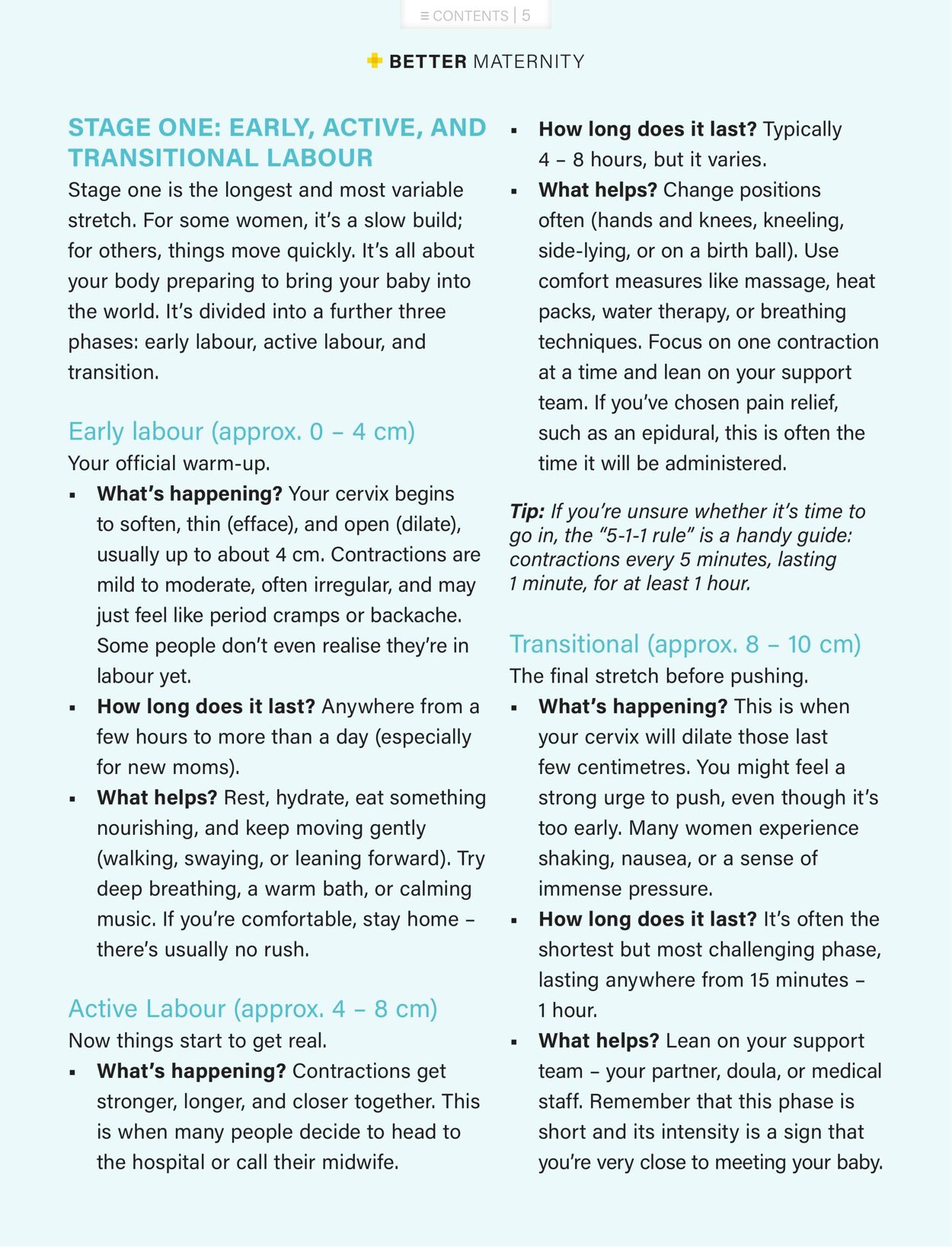
“» BETTER MATERNITY STAGE ONE: EARLY, ACTIVE, AND TRANSITIONAL LABOUR Stage one is the longest and most variable stretch. For some women, it’s a slow build; for others, things move quickly. It's all about your body preparing to bring your baby into the world. It's divided into a further three phases: early labour, active labour, and transition. Early labour (approx. 0 - 4 cm) Your official warm-up. » What’s happening? Your cervix begins to soften, thin (efface), and open (dilate), usually up to about 4 cm. Contractions are mild to moderate, often irregular, and may just feel like period cramps or backache. Some people don’t even realise they're in labour yet. « How long does it last? Anywhere from a few hours to more than a day (especially for new moms). «= What helps? Rest, hydrate, eat something nourishing, and keep moving gently (walking, swaying, or leaning forward). Try deep breathing, a warm bath, or calming music. If you're comfortable, stay home - there's usually no rush. Active Labour (approx. 4 - 8 cm) Now things start to get real. «= What’s happening? Contractions get stronger, longer, and closer together. This is when many people decide to head to the hospital or call their midwife. = How long does it last? Typically 4 - 8 hours, but it varies. = What helps? Change positions often (hands and knees, kneeling, side-lying, or on a birth ball). Use comfort measures like massage, heat packs, water therapy, or breathing techniques. Focus on one contraction at a time and lean on your support team. If you've chosen pain relief, such as an epidural, this is often the time it will be administered. Tip: If you're unsure whether it’s time to go in, the “5-1-1 rule” is a handy guide: contractions every 5 minutes, lasting 1 minute, for at least 1 hour. Transitional (approx. 8 - 10 cm) The final stretch before pushing. » What's happening? This is when your cervix will dilate those last few centimetres. You might feel a strong urge to push, even though it's too early. Many women experience shaking, nausea, or a sense of immense pressure. = How long does it last? It's often the shortest but most challenging phase, lasting anywhere from 15 minutes - 1 hour. » What helps? Lean on your support team - your partner, doula, or medical staff. Remember that this phase is short and its intensity is a sign that you're very close to meeting your baby.


Latest specials

Advertisement
“» BETTER MATERNITY STAGE ONE: EARLY, ACTIVE, AND TRANSITIONAL LABOUR Stage one is the longest and most variable stretch. For some women, it’s a slow build; for others, things move quickly. It's all about your body preparing to bring your baby into the world. It's divided into a further three phases: early labour, active labour, and transition. Early labour (approx. 0 - 4 cm) Your official warm-up. » What’s happening? Your cervix begins to soften, thin (efface), and open (dilate), usually up to about 4 cm. Contractions are mild to moderate, often irregular, and may just feel like period cramps or backache. Some people don’t even realise they're in labour yet. « How long does it last? Anywhere from a few hours to more than a day (especially for new moms). «= What helps? Rest, hydrate, eat something nourishing, and keep moving gently (walking, swaying, or leaning forward). Try deep breathing, a warm bath, or calming music. If you're comfortable, stay home - there's usually no rush. Active Labour (approx. 4 - 8 cm) Now things start to get real. «= What’s happening? Contractions get stronger, longer, and closer together. This is when many people decide to head to the hospital or call their midwife. = How long does it last? Typically 4 - 8 hours, but it varies. = What helps? Change positions often (hands and knees, kneeling, side-lying, or on a birth ball). Use comfort measures like massage, heat packs, water therapy, or breathing techniques. Focus on one contraction at a time and lean on your support team. If you've chosen pain relief, such as an epidural, this is often the time it will be administered. Tip: If you're unsure whether it’s time to go in, the “5-1-1 rule” is a handy guide: contractions every 5 minutes, lasting 1 minute, for at least 1 hour. Transitional (approx. 8 - 10 cm) The final stretch before pushing. » What's happening? This is when your cervix will dilate those last few centimetres. You might feel a strong urge to push, even though it's too early. Many women experience shaking, nausea, or a sense of immense pressure. = How long does it last? It's often the shortest but most challenging phase, lasting anywhere from 15 minutes - 1 hour. » What helps? Lean on your support team - your partner, doula, or medical staff. Remember that this phase is short and its intensity is a sign that you're very close to meeting your baby.

Advertisement
Advertisement

If you continue to browse this website, you accept the use of cookies.

Name Details