The query has to be between 2 and 50 characters

Advertisement
Advertisement

Current special Baby City - Valid from 01.10 to 31.10 - Page nb 34

Advertisement
Advertisement
Advertisement
Advertisement
Special Baby City 01.10.2025 - 31.10.2025
Special Boxer - GP May ME Special Stores 25 May, 2026 - 7 Jun, 2026
Boxer - GP May ME Special Stores
25 May, 2026 - 7 Jun, 2026
Special Boxer - GP May ME Liquor 25 May, 2026 - 7 Jun, 2026
Boxer - GP May ME Liquor
25 May, 2026 - 7 Jun, 2026
Special Boxer - GP May ME 25 May, 2026 - 7 Jun, 2026
Boxer - GP May ME
25 May, 2026 - 7 Jun, 2026
Special Boxer - GP May ME Special Stores 25 May, 2026 - 7 Jun, 2026
Boxer - GP May ME Special Stores
25 May, 2026 - 7 Jun, 2026
See next flyer
Advertisement
Advertisement
Advertisement

Products in this catalogue

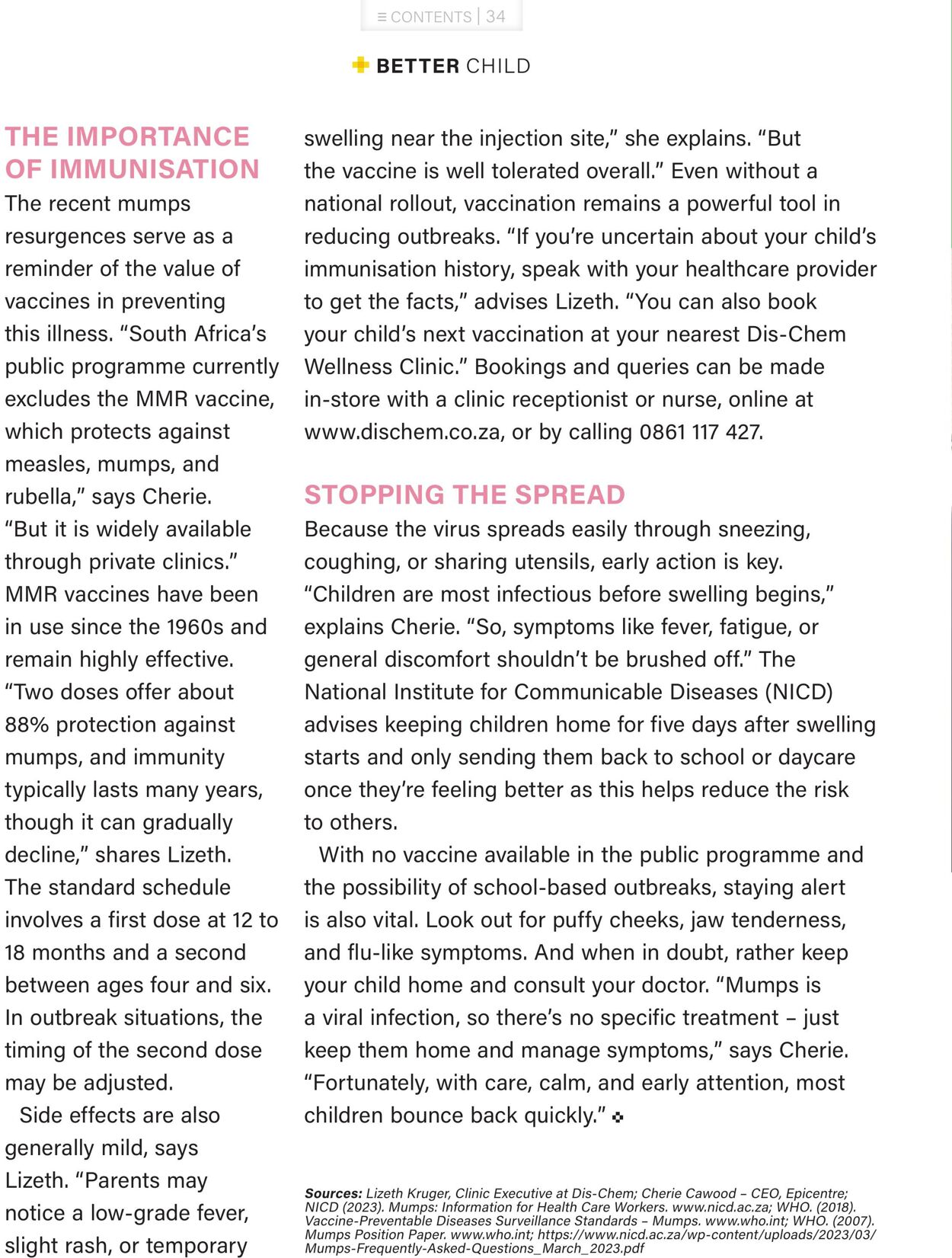
THE IMPORTANCE OF IMMUNISATION The recent mumps resurgences serve as a reminder of the value of vaccines in preventing this illness. “South Africa's public programme currently excludes the MMR vaccine, which protects against measles, mumps, and rubella,” says Cherie. “But it is widely available through private clinics.” MMR vaccines have been in use since the 1960s and remain highly effective. “Two doses offer about 88% protection against mumps, and immunity typically lasts many years, though it can gradually decline,” shares Lizeth. The standard schedule involves a first dose at 12 to 18 months and a second between ages four and six. In outbreak situations, the timing of the second dose may be adjusted. Side effects are also generally mild, says Lizeth. “Parents may notice a low-grade fever, slight rash, or temporary “© BETTER CHILD swelling near the injection site,” she explains. “But the vaccine is well tolerated overall.” Even without a national rollout, vaccination remains a powerful tool in reducing outbreaks. “If you're uncertain about your child's immunisation history, speak with your healthcare provider to get the facts,” advises Lizeth. “You can also book your child’s next vaccination at your nearest Dis-Chem Wellness Clinic.” Bookings and queries can be made in-store with a clinic receptionist or nurse, online at www.dischem.co.za, or by calling 0861 117 427. STOPPING THE SPREAD Because the virus spreads easily through sneezing, coughing, or sharing utensils, early action is key. “Children are most infectious before swelling begins,” explains Cherie. “So, symptoms like fever, fatigue, or general discomfort shouldn't be brushed off.” The National Institute for Communicable Diseases (NICD) advises keeping children home for five days after swelling starts and only sending them back to school or daycare once they're feeling better as this helps reduce the risk to others. With no vaccine available in the public programme and the possibility of school-based outbreaks, staying alert is also vital. Look out for puffy cheeks, jaw tenderness, and flu-like symptoms. And when in doubt, rather keep your child home and consult your doctor. “Mumps is a viral infection, so there's no specific treatment - just keep them home and manage symptoms,” says Cherie. “Fortunately, with care, calm, and early attention, most children bounce back quickly.” Sources: Lizeth Kruger, Clinic Executive at Dis-Chem; Cherie Cawood - CEO, Epicentre; NICD (2023). Mumps: Information for Health Care Workers. www.nicd.ac.za; WHO, (2018). Vaccine-Preventable Diseases Surveillance Standards - Mumps. www.who.int; WHO. (2007). Mumps Position Paper. www.who.int; https://www.nicd.ac.za/wp-content/uploads/2023/03/ Mumps-Frequently-Asked-Questions_March_2023.pdf


Latest specials

Advertisement
THE IMPORTANCE OF IMMUNISATION The recent mumps resurgences serve as a reminder of the value of vaccines in preventing this illness. “South Africa's public programme currently excludes the MMR vaccine, which protects against measles, mumps, and rubella,” says Cherie. “But it is widely available through private clinics.” MMR vaccines have been in use since the 1960s and remain highly effective. “Two doses offer about 88% protection against mumps, and immunity typically lasts many years, though it can gradually decline,” shares Lizeth. The standard schedule involves a first dose at 12 to 18 months and a second between ages four and six. In outbreak situations, the timing of the second dose may be adjusted. Side effects are also generally mild, says Lizeth. “Parents may notice a low-grade fever, slight rash, or temporary “© BETTER CHILD swelling near the injection site,” she explains. “But the vaccine is well tolerated overall.” Even without a national rollout, vaccination remains a powerful tool in reducing outbreaks. “If you're uncertain about your child's immunisation history, speak with your healthcare provider to get the facts,” advises Lizeth. “You can also book your child’s next vaccination at your nearest Dis-Chem Wellness Clinic.” Bookings and queries can be made in-store with a clinic receptionist or nurse, online at www.dischem.co.za, or by calling 0861 117 427. STOPPING THE SPREAD Because the virus spreads easily through sneezing, coughing, or sharing utensils, early action is key. “Children are most infectious before swelling begins,” explains Cherie. “So, symptoms like fever, fatigue, or general discomfort shouldn't be brushed off.” The National Institute for Communicable Diseases (NICD) advises keeping children home for five days after swelling starts and only sending them back to school or daycare once they're feeling better as this helps reduce the risk to others. With no vaccine available in the public programme and the possibility of school-based outbreaks, staying alert is also vital. Look out for puffy cheeks, jaw tenderness, and flu-like symptoms. And when in doubt, rather keep your child home and consult your doctor. “Mumps is a viral infection, so there's no specific treatment - just keep them home and manage symptoms,” says Cherie. “Fortunately, with care, calm, and early attention, most children bounce back quickly.” Sources: Lizeth Kruger, Clinic Executive at Dis-Chem; Cherie Cawood - CEO, Epicentre; NICD (2023). Mumps: Information for Health Care Workers. www.nicd.ac.za; WHO, (2018). Vaccine-Preventable Diseases Surveillance Standards - Mumps. www.who.int; WHO. (2007). Mumps Position Paper. www.who.int; https://www.nicd.ac.za/wp-content/uploads/2023/03/ Mumps-Frequently-Asked-Questions_March_2023.pdf

Advertisement
Advertisement

If you continue to browse this website, you accept the use of cookies.

Name Details