The query has to be between 2 and 50 characters

Advertisement
Advertisement

Current special Baby City - Valid from 22.08 to 22.09 - Page nb 10

Advertisement
Advertisement
Advertisement
Advertisement
Special Baby City 22.08.2025 - 22.09.2025
Special Boxer - GP May ME Special Stores 25 May, 2026 - 7 Jun, 2026
Boxer - GP May ME Special Stores
25 May, 2026 - 7 Jun, 2026
Special Boxer - GP May ME 25 May, 2026 - 7 Jun, 2026
Boxer - GP May ME
25 May, 2026 - 7 Jun, 2026
Special Boxer - GP May ME Liquor 25 May, 2026 - 7 Jun, 2026
Boxer - GP May ME Liquor
25 May, 2026 - 7 Jun, 2026
Special Boxer - GP May ME Liquor Special Stores 25 May, 2026 - 7 Jun, 2026
Boxer - GP May ME Liquor Special Stores
25 May, 2026 - 7 Jun, 2026
See next flyer
Advertisement
Advertisement
Advertisement

Products in this catalogue

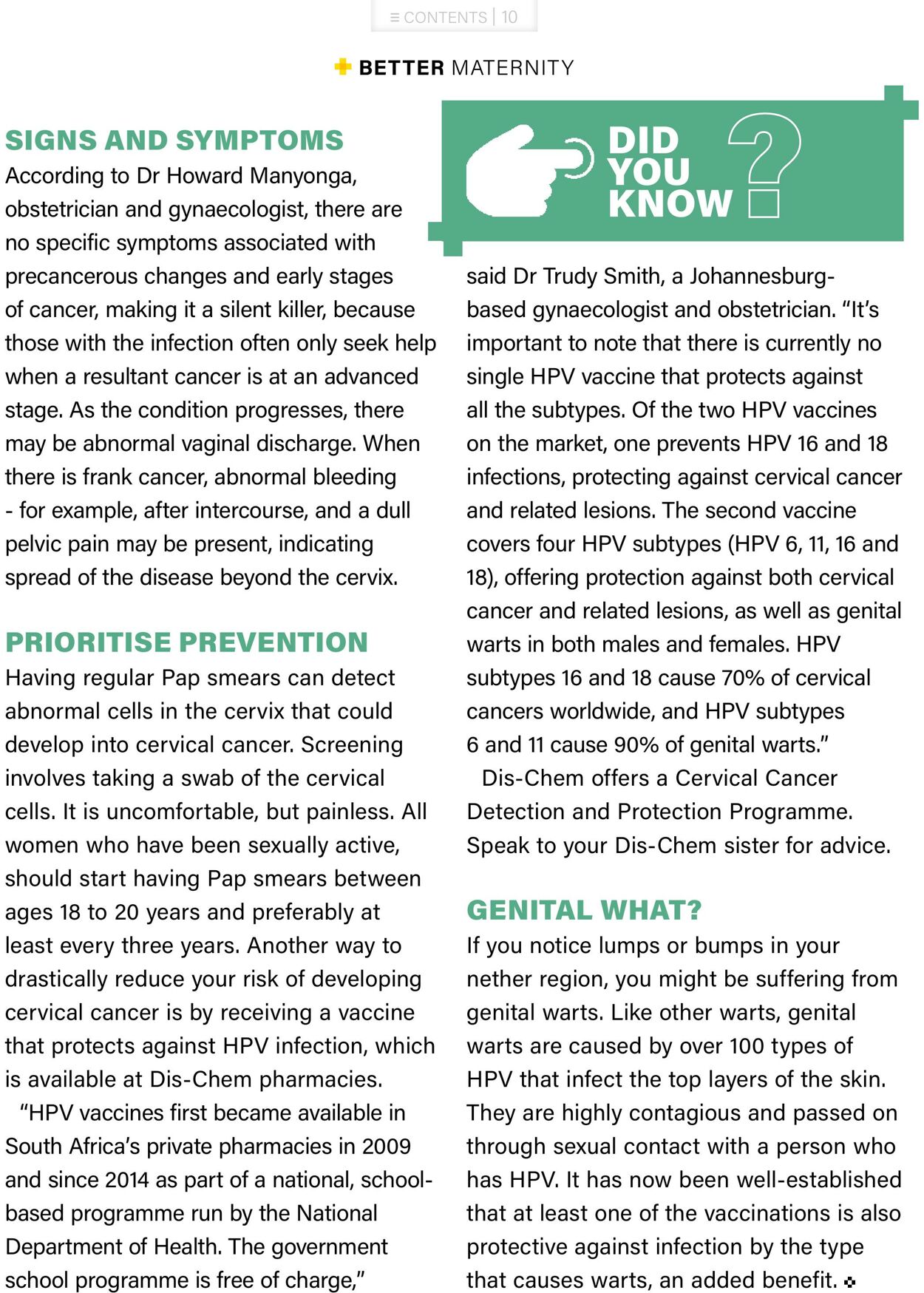
“© BETTER MATERNITY E2730 KNOW |_| SIGNS AND SYMPTOMS According to Dr Howard Manyonga, obstetrician and gynaecologist, there are no specific symptoms associated with precancerous changes and early stages of cancer, making it a silent killer, because those with the infection often only seek help when a resultant cancer is at an advanced stage. As the condition progresses, there may be abnormal vaginal discharge. When there is frank cancer, abnormal bleeding - for example, after intercourse, and a dull pelvic pain may be present, indicating spread of the disease beyond the cervix. PRIORITISE PREVENTION Having regular Pap smears can detect abnormal cells in the cervix that could develop into cervical cancer. Screening involves taking a swab of the cervical cells. It is uncomfortable, but painless. All women who have been sexually active, should start having Pap smears between ages 18 to 20 years and preferably at least every three years. Another way to drastically reduce your risk of developing cervical cancer is by receiving a vaccine that protects against HPV infection, which is available at Dis-Chem pharmacies. “HPV vaccines first became available in South Africa's private pharmacies in 2009 and since 2014 as part of a national, school- based programme run by the National Department of Health. The government school programme is free of charge,” said Dr Trudy Smith, a Johannesburg- based gynaecologist and obstetrician. “It's important to note that there is currently no single HPV vaccine that protects against all the subtypes. Of the two HPV vaccines on the market, one prevents HPV 16 and 18 infections, protecting against cervical cancer and related lesions. The second vaccine covers four HPV subtypes (HPV 6, 11, 16 and 18), offering protection against both cervical cancer and related lesions, as well as genital warts in both males and females. HPV subtypes 16 and 18 cause 70% of cervical cancers worldwide, and HPV subtypes 6 and 11 cause 90% of genital warts.” Dis-Chem offers a Cervical Cancer Detection and Protection Programme. Speak to your Dis-Chem sister for advice. GENITAL WHAT? If you notice lumps or bumps in your nether region, you might be suffering from genital warts. Like other warts, genital warts are caused by over 100 types of HPV that infect the top layers of the skin. They are highly contagious and passed on through sexual contact with a person who has HPV. It has now been well-established that at least one of the vaccinations is also protective against infection by the type that causes warts, an added benefit. =


Latest specials

Advertisement
“© BETTER MATERNITY E2730 KNOW |_| SIGNS AND SYMPTOMS According to Dr Howard Manyonga, obstetrician and gynaecologist, there are no specific symptoms associated with precancerous changes and early stages of cancer, making it a silent killer, because those with the infection often only seek help when a resultant cancer is at an advanced stage. As the condition progresses, there may be abnormal vaginal discharge. When there is frank cancer, abnormal bleeding - for example, after intercourse, and a dull pelvic pain may be present, indicating spread of the disease beyond the cervix. PRIORITISE PREVENTION Having regular Pap smears can detect abnormal cells in the cervix that could develop into cervical cancer. Screening involves taking a swab of the cervical cells. It is uncomfortable, but painless. All women who have been sexually active, should start having Pap smears between ages 18 to 20 years and preferably at least every three years. Another way to drastically reduce your risk of developing cervical cancer is by receiving a vaccine that protects against HPV infection, which is available at Dis-Chem pharmacies. “HPV vaccines first became available in South Africa's private pharmacies in 2009 and since 2014 as part of a national, school- based programme run by the National Department of Health. The government school programme is free of charge,” said Dr Trudy Smith, a Johannesburg- based gynaecologist and obstetrician. “It's important to note that there is currently no single HPV vaccine that protects against all the subtypes. Of the two HPV vaccines on the market, one prevents HPV 16 and 18 infections, protecting against cervical cancer and related lesions. The second vaccine covers four HPV subtypes (HPV 6, 11, 16 and 18), offering protection against both cervical cancer and related lesions, as well as genital warts in both males and females. HPV subtypes 16 and 18 cause 70% of cervical cancers worldwide, and HPV subtypes 6 and 11 cause 90% of genital warts.” Dis-Chem offers a Cervical Cancer Detection and Protection Programme. Speak to your Dis-Chem sister for advice. GENITAL WHAT? If you notice lumps or bumps in your nether region, you might be suffering from genital warts. Like other warts, genital warts are caused by over 100 types of HPV that infect the top layers of the skin. They are highly contagious and passed on through sexual contact with a person who has HPV. It has now been well-established that at least one of the vaccinations is also protective against infection by the type that causes warts, an added benefit. =

Advertisement
Advertisement

If you continue to browse this website, you accept the use of cookies.

Name Details