The query has to be between 2 and 50 characters

Advertisement
Advertisement

Current special Baby City - Valid from 22.08 to 22.09 - Page nb 9

Advertisement
Advertisement
Advertisement
Advertisement
Special Baby City 22.08.2025 - 22.09.2025
Special Boxer - GP May ME Special Stores 25 May, 2026 - 7 Jun, 2026
Boxer - GP May ME Special Stores
25 May, 2026 - 7 Jun, 2026
Special Boxer - GP May ME 25 May, 2026 - 7 Jun, 2026
Boxer - GP May ME
25 May, 2026 - 7 Jun, 2026
Special Boxer - GP May ME Special Stores 25 May, 2026 - 7 Jun, 2026
Boxer - GP May ME Special Stores
25 May, 2026 - 7 Jun, 2026
Special Boxer - GP May ME Liquor Special Stores 25 May, 2026 - 7 Jun, 2026
Boxer - GP May ME Liquor Special Stores
25 May, 2026 - 7 Jun, 2026
See next flyer
Advertisement
Advertisement
Advertisement

Products in this catalogue

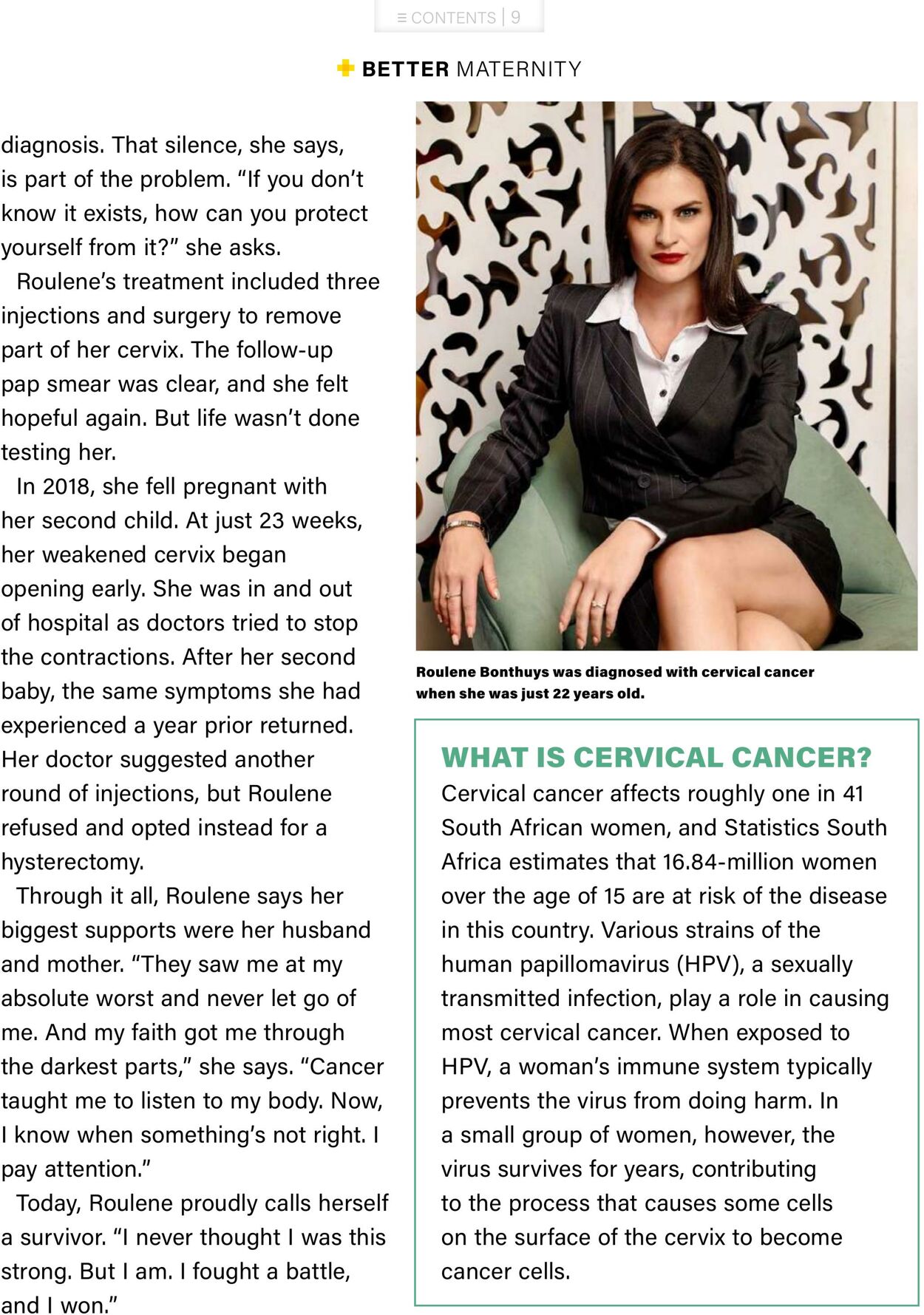
“+ BETTER MATERNITY diagnosis. That silence, she says, is part of the problem. “If you don't know it exists, how can you protect yourself from it?” she asks. Roulene’s treatment included three injections and surgery to remove part of her cervix. The follow-up pap smear was clear, and she felt hopeful again. But life wasn't done testing her. In 2018, she fell pregnant with her second child. At just 23 weeks, her weakened cervix began opening early. She was in and out of hospital as doctors tried to stop the contractions. After her second baby, the same symptoms she had experienced a year prior returned. Her doctor suggested another round of injections, but Roulene refused and opted instead for a hysterectomy. Through it all, Roulene says her biggest supports were her husband and mother. “They saw me at my absolute worst and never let go of me. And my faith got me through the darkest parts,” she says. “Cancer taught me to listen to my body. Now, | know when something's not right. | pay attention.” Today, Roulene proudly calls herself a survivor. “| never thought | was this strong. But | am. | fought a battle, and | won.” a* Roulene Bonthuys was diagnosed with cervical cancer when she was just 22 years old. WHAT IS CERVICAL CANCER? Cervical cancer affects roughly one in 41 South African women, and Statistics South Africa estimates that 16.84-million women over the age of 15 are at risk of the disease in this country. Various strains of the human papillomavirus (HPV), a sexually transmitted infection, play a role in causing most cervical cancer. When exposed to HPV, a woman's immune system typically prevents the virus from doing harm. In a small group of women, however, the virus survives for years, contributing to the process that causes some cells on the surface of the cervix to become cancer cells.


Latest specials

Advertisement
“+ BETTER MATERNITY diagnosis. That silence, she says, is part of the problem. “If you don't know it exists, how can you protect yourself from it?” she asks. Roulene’s treatment included three injections and surgery to remove part of her cervix. The follow-up pap smear was clear, and she felt hopeful again. But life wasn't done testing her. In 2018, she fell pregnant with her second child. At just 23 weeks, her weakened cervix began opening early. She was in and out of hospital as doctors tried to stop the contractions. After her second baby, the same symptoms she had experienced a year prior returned. Her doctor suggested another round of injections, but Roulene refused and opted instead for a hysterectomy. Through it all, Roulene says her biggest supports were her husband and mother. “They saw me at my absolute worst and never let go of me. And my faith got me through the darkest parts,” she says. “Cancer taught me to listen to my body. Now, | know when something's not right. | pay attention.” Today, Roulene proudly calls herself a survivor. “| never thought | was this strong. But | am. | fought a battle, and | won.” a* Roulene Bonthuys was diagnosed with cervical cancer when she was just 22 years old. WHAT IS CERVICAL CANCER? Cervical cancer affects roughly one in 41 South African women, and Statistics South Africa estimates that 16.84-million women over the age of 15 are at risk of the disease in this country. Various strains of the human papillomavirus (HPV), a sexually transmitted infection, play a role in causing most cervical cancer. When exposed to HPV, a woman's immune system typically prevents the virus from doing harm. In a small group of women, however, the virus survives for years, contributing to the process that causes some cells on the surface of the cervix to become cancer cells.

Advertisement
Advertisement

If you continue to browse this website, you accept the use of cookies.

Name Details