The query has to be between 2 and 50 characters

Advertisement
Advertisement

Current special Baby City - Valid from 01.09 to 30.09 - Page nb 40

Advertisement
Advertisement
Advertisement
Advertisement
Special Baby City 01.09.2025 - 30.09.2025
Special Boxer - Atlyn Mall Liquor Grand Opening 25 May, 2026 - 7 Jun, 2026
Boxer - Atlyn Mall Liquor Grand Opening
25 May, 2026 - 7 Jun, 2026
Special Boxer - Atlyn Mall Liquor Grand Opening 22 May, 2026 - 7 Jun, 2026
Boxer - Atlyn Mall Liquor Grand Opening
22 May, 2026 - 7 Jun, 2026
Special Game - Game Cellular : 56 Years In The Game (21 April - 06 June 2026) — www.guzzle.co.za 21 Apr, 2026 - 6 Jun, 2026
Game - Game Cellular : 56 Years In The Game (21 April - 06 June 2026) — www.guzzle.co.za
21 Apr, 2026 - 6 Jun, 2026
Special Boxer - Atlyn Mall Liquor Grand Opening 22 May, 2026 - 7 Jun, 2026
Boxer - Atlyn Mall Liquor Grand Opening
22 May, 2026 - 7 Jun, 2026
See next flyer
Advertisement
Advertisement
Advertisement

Products in this catalogue

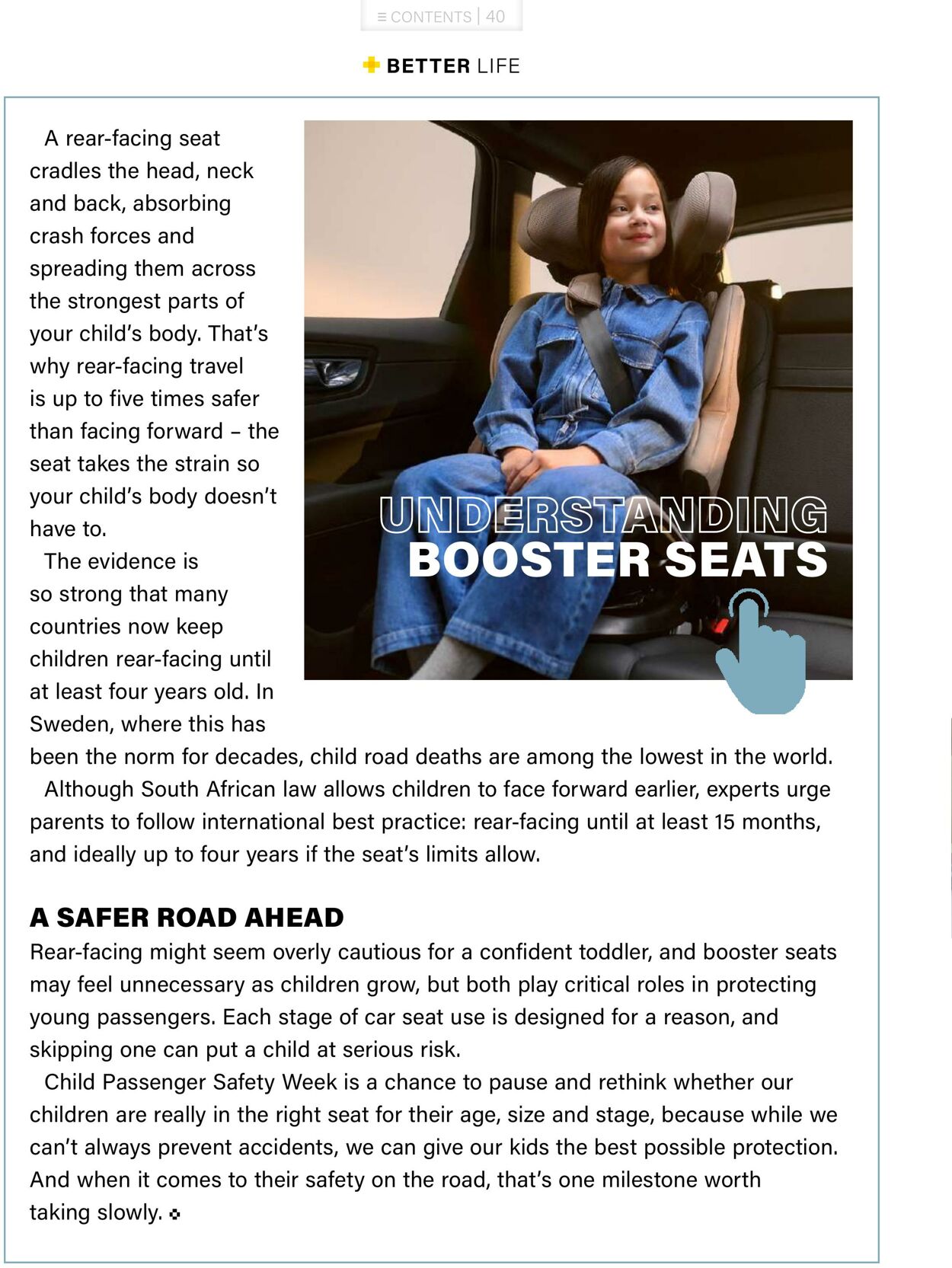
’» BETTER LIFE A rear-facing seat cradles the head, neck and back, absorbing crash forces and spreading them across the strongest parts of your child's body. That’s why rear-facing travel is up to five times safer than facing forward - the seat takes the strain so merous corte ar AN The evidence is BOOSTER A>) EATS (@) so strong that many countries now keep children rear-facing until at least four years old. In Sweden, where this has been the norm for decades, child road deaths are among the lowest in the world. Although South African law allows children to face forward earlier, experts urge parents to follow international best practice: rear-facing until at least 15 months, and ideally up to four years if the seat's limits allow. A SAFER ROAD AHEAD Rear-facing might seem overly cautious for a confident toddler, and booster seats may feel unnecessary as children grow, but both play critical roles in protecting young passengers. Each stage of car seat use is designed for a reason, and skipping one can put a child at serious risk. Child Passenger Safety Week is a chance to pause and rethink whether our children are really in the right seat for their age, size and stage, because while we can't always prevent accidents, we can give our kids the best possible protection. And when it comes to their safety on the road, that's one milestone worth taking slowly. +


Latest specials

Advertisement
’» BETTER LIFE A rear-facing seat cradles the head, neck and back, absorbing crash forces and spreading them across the strongest parts of your child's body. That’s why rear-facing travel is up to five times safer than facing forward - the seat takes the strain so merous corte ar AN The evidence is BOOSTER A>) EATS (@) so strong that many countries now keep children rear-facing until at least four years old. In Sweden, where this has been the norm for decades, child road deaths are among the lowest in the world. Although South African law allows children to face forward earlier, experts urge parents to follow international best practice: rear-facing until at least 15 months, and ideally up to four years if the seat's limits allow. A SAFER ROAD AHEAD Rear-facing might seem overly cautious for a confident toddler, and booster seats may feel unnecessary as children grow, but both play critical roles in protecting young passengers. Each stage of car seat use is designed for a reason, and skipping one can put a child at serious risk. Child Passenger Safety Week is a chance to pause and rethink whether our children are really in the right seat for their age, size and stage, because while we can't always prevent accidents, we can give our kids the best possible protection. And when it comes to their safety on the road, that's one milestone worth taking slowly. +

Advertisement
Advertisement

If you continue to browse this website, you accept the use of cookies.

Name Details