The query has to be between 2 and 50 characters

Advertisement
Advertisement

Current special Baby City - Valid from 01.11 to 30.11 - Page nb 36

Advertisement
Advertisement
Advertisement
Advertisement
Special Baby City 01.11.2025 - 30.11.2025
Special Boxer - Atlyn Mall Liquor Grand Opening 25 May, 2026 - 7 Jun, 2026
Boxer - Atlyn Mall Liquor Grand Opening
25 May, 2026 - 7 Jun, 2026
Special Boxer - Atlyn Mall Liquor Grand Opening 22 May, 2026 - 7 Jun, 2026
Boxer - Atlyn Mall Liquor Grand Opening
22 May, 2026 - 7 Jun, 2026
Special Boxer - Atlyn Mall Liquor Grand Opening 22 May, 2026 - 7 Jun, 2026
Boxer - Atlyn Mall Liquor Grand Opening
22 May, 2026 - 7 Jun, 2026
Special Spar - SuperSpar - Valid until 07 Jun, SA only 25 May, 2026 - 7 Jun, 2026
Spar - SuperSpar - Valid until 07 Jun, SA only
25 May, 2026 - 7 Jun, 2026
See next flyer
Advertisement
Advertisement
Advertisement

Products in this catalogue

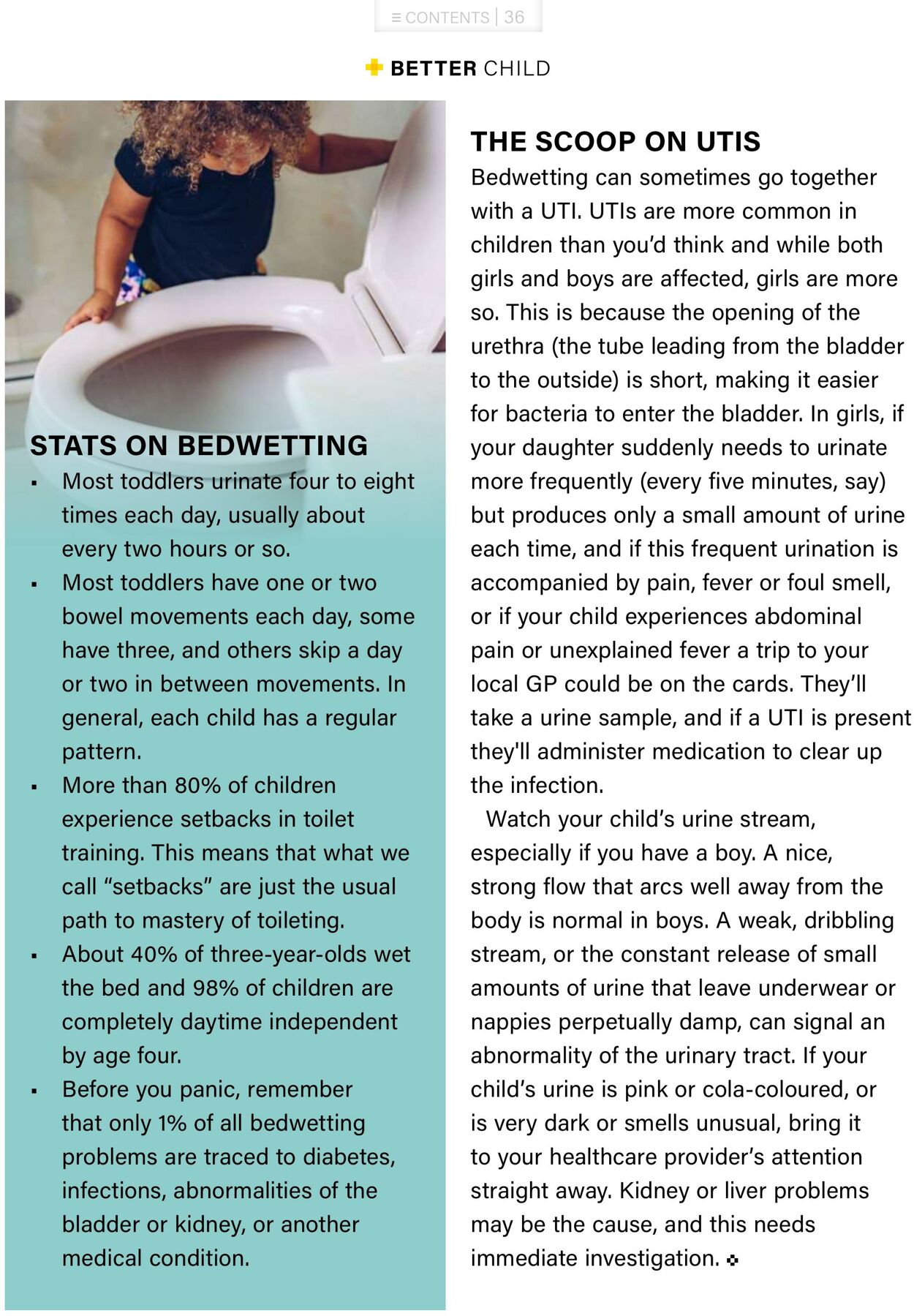
STATS ON BEDWETTING *» BETTER CHILD Most toddlers urinate four to eight times each day, usually about every two hours or so. Most toddlers have one or two bowel movements each day, some have three, and others skip a day or two in between movements. In general, each child has a regular pattern. More than 80% of children experience setbacks in toilet training. This means that what we call “setbacks” are just the usual path to mastery of toileting. About 40% of three-year-olds wet the bed and 98% of children are completely daytime independent by age four. Before you panic, remember that only 1% of all bedwetting problems are traced to diabetes, infections, abnormalities of the bladder or kidney, or another medical condition. THE SCOOP ON UTIS Bedwetting can sometimes go together with a UTI. UTIs are more common in children than you'd think and while both girls and boys are affected, girls are more so. This is because the opening of the urethra (the tube leading from the bladder to the outside) is short, making it easier for bacteria to enter the bladder. In girls, if your daughter suddenly needs to urinate more frequently (every five minutes, say) but produces only a small amount of urine each time, and if this frequent urination is accompanied by pain, fever or foul smell, or if your child experiences abdominal pain or unexplained fever a trip to your local GP could be on the cards. They'll take a urine sample, and if a UTI is present they'll administer medication to clear up the infection. Watch your child’s urine stream, especially if you have a boy. A nice, strong flow that arcs well away from the body is normal in boys. A weak, dribbling stream, or the constant release of small amounts of urine that leave underwear or nappies perpetually damp, can signal an abnormality of the urinary tract. If your child’s urine is pink or cola-coloured, or is very dark or smells unusual, bring it to your healthcare provider's attention straight away. Kidney or liver problems may be the cause, and this needs immediate investigation. =


Latest specials

Advertisement
STATS ON BEDWETTING *» BETTER CHILD Most toddlers urinate four to eight times each day, usually about every two hours or so. Most toddlers have one or two bowel movements each day, some have three, and others skip a day or two in between movements. In general, each child has a regular pattern. More than 80% of children experience setbacks in toilet training. This means that what we call “setbacks” are just the usual path to mastery of toileting. About 40% of three-year-olds wet the bed and 98% of children are completely daytime independent by age four. Before you panic, remember that only 1% of all bedwetting problems are traced to diabetes, infections, abnormalities of the bladder or kidney, or another medical condition. THE SCOOP ON UTIS Bedwetting can sometimes go together with a UTI. UTIs are more common in children than you'd think and while both girls and boys are affected, girls are more so. This is because the opening of the urethra (the tube leading from the bladder to the outside) is short, making it easier for bacteria to enter the bladder. In girls, if your daughter suddenly needs to urinate more frequently (every five minutes, say) but produces only a small amount of urine each time, and if this frequent urination is accompanied by pain, fever or foul smell, or if your child experiences abdominal pain or unexplained fever a trip to your local GP could be on the cards. They'll take a urine sample, and if a UTI is present they'll administer medication to clear up the infection. Watch your child’s urine stream, especially if you have a boy. A nice, strong flow that arcs well away from the body is normal in boys. A weak, dribbling stream, or the constant release of small amounts of urine that leave underwear or nappies perpetually damp, can signal an abnormality of the urinary tract. If your child’s urine is pink or cola-coloured, or is very dark or smells unusual, bring it to your healthcare provider's attention straight away. Kidney or liver problems may be the cause, and this needs immediate investigation. =

Advertisement
Advertisement

If you continue to browse this website, you accept the use of cookies.

Name Details