The query has to be between 2 and 50 characters

Advertisement
Advertisement

Current special Baby City - Valid from 01.11 to 30.11 - Page nb 23

Advertisement
Advertisement
Advertisement
Advertisement
Special Baby City 01.11.2025 - 30.11.2025
Special Boxer - Atlyn Mall Liquor Grand Opening 25 May, 2026 - 7 Jun, 2026
Boxer - Atlyn Mall Liquor Grand Opening
25 May, 2026 - 7 Jun, 2026
Special Boxer - GP May ME 25 May, 2026 - 7 Jun, 2026
Boxer - GP May ME
25 May, 2026 - 7 Jun, 2026
Special Game - Game : The Game Changer (25 May - 20 July 2026) — www.guzzle.co.za 25 May, 2026 - 20 Jul, 2026
Game - Game : The Game Changer (25 May - 20 July 2026) — www.guzzle.co.za
25 May, 2026 - 20 Jul, 2026
Special Boxer - GP May ME Liquor 25 May, 2026 - 7 Jun, 2026
Boxer - GP May ME Liquor
25 May, 2026 - 7 Jun, 2026
See next flyer
Advertisement
Advertisement
Advertisement

Products in this catalogue

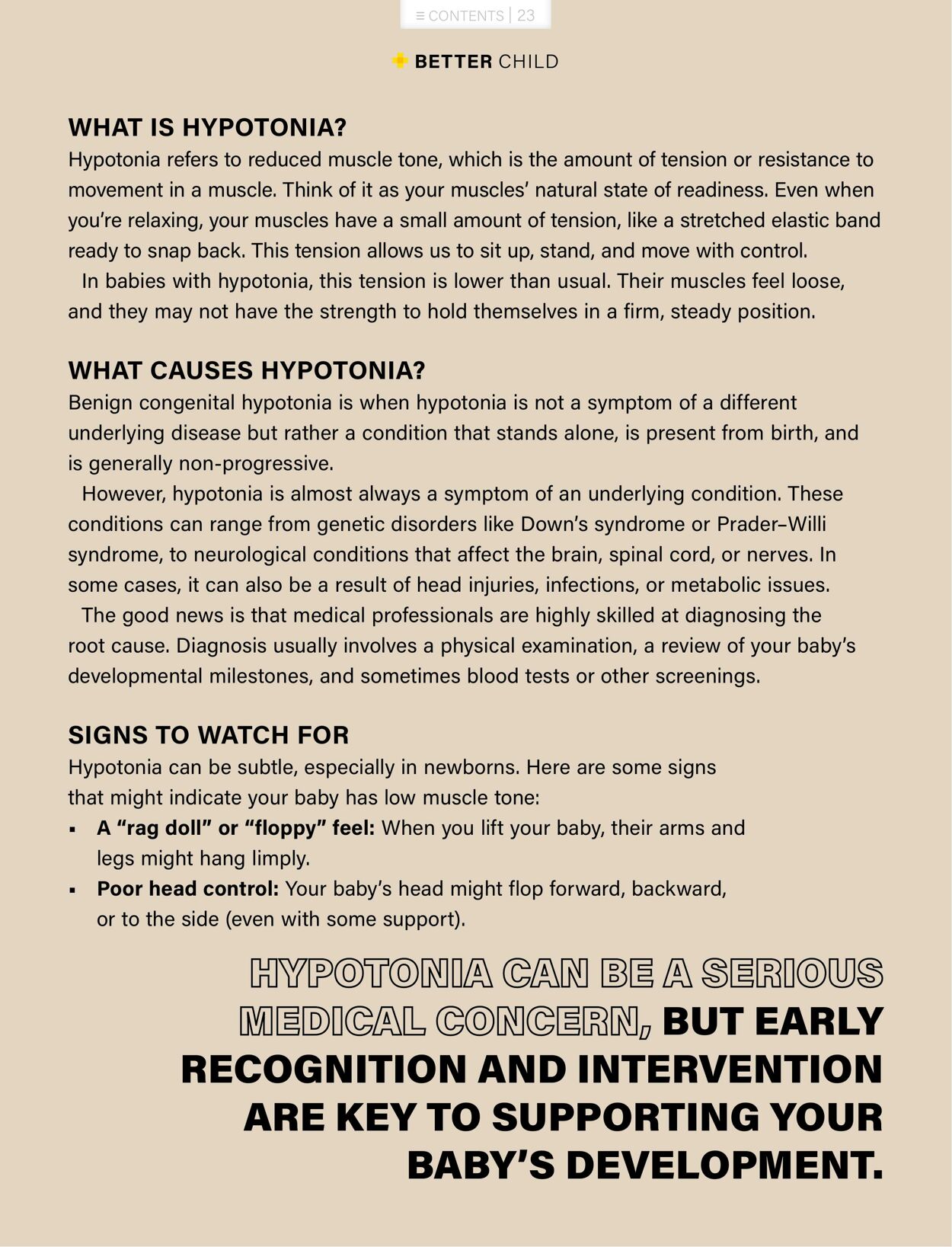
~ BETTER CHILD WHAT IS HYPOTONIA? Hypotonia refers to reduced muscle tone, which is the amount of tension or resistance to movement in a muscle. Think of it as your muscles’ natural state of readiness. Even when you're relaxing, your muscles have a small amount of tension, like a stretched elastic band ready to snap back. This tension allows us to sit up, stand, and move with control. In babies with hypotonia, this tension is lower than usual. Their muscles feel loose, and they may not have the strength to hold themselves in a firm, steady position. WHAT CAUSES HYPOTONIA? Benign congenital hypotonia is when hypotonia is not a symptom of a different underlying disease but rather a condition that stands alone, is present from birth, and is generally non-progressive. However, hypotonia is almost always a symptom of an underlying condition. These conditions can range from genetic disorders like Down's syndrome or Prader-Willi syndrome, to neurological conditions that affect the brain, spinal cord, or nerves. In some cases, it can also be a result of head injuries, infections, or metabolic issues. The good news is that medical professionals are highly skilled at diagnosing the root cause. Diagnosis usually involves a physical examination, a review of your baby’s developmental milestones, and sometimes blood tests or other screenings. SIGNS TO WATCH FOR Hypotonia can be subtle, especially in newborns. Here are some signs that might indicate your baby has low muscle tone: » A"“rag doll” or “floppy” feel: When you lift your baby, their arms and legs might hang limply. « Poor head control: Your baby’s head might flop forward, backward, or to the side (even with some support). hYPOTONIA CAN BE A SERIOUS MEDICAL CONCERN, BUT EARLY RECOGNITION AND INTERVENTION ARE KEY TO SUPPORTING YOUR BABY’'S DEVELOPMENT.


Latest specials

Advertisement
~ BETTER CHILD WHAT IS HYPOTONIA? Hypotonia refers to reduced muscle tone, which is the amount of tension or resistance to movement in a muscle. Think of it as your muscles’ natural state of readiness. Even when you're relaxing, your muscles have a small amount of tension, like a stretched elastic band ready to snap back. This tension allows us to sit up, stand, and move with control. In babies with hypotonia, this tension is lower than usual. Their muscles feel loose, and they may not have the strength to hold themselves in a firm, steady position. WHAT CAUSES HYPOTONIA? Benign congenital hypotonia is when hypotonia is not a symptom of a different underlying disease but rather a condition that stands alone, is present from birth, and is generally non-progressive. However, hypotonia is almost always a symptom of an underlying condition. These conditions can range from genetic disorders like Down's syndrome or Prader-Willi syndrome, to neurological conditions that affect the brain, spinal cord, or nerves. In some cases, it can also be a result of head injuries, infections, or metabolic issues. The good news is that medical professionals are highly skilled at diagnosing the root cause. Diagnosis usually involves a physical examination, a review of your baby’s developmental milestones, and sometimes blood tests or other screenings. SIGNS TO WATCH FOR Hypotonia can be subtle, especially in newborns. Here are some signs that might indicate your baby has low muscle tone: » A"“rag doll” or “floppy” feel: When you lift your baby, their arms and legs might hang limply. « Poor head control: Your baby’s head might flop forward, backward, or to the side (even with some support). hYPOTONIA CAN BE A SERIOUS MEDICAL CONCERN, BUT EARLY RECOGNITION AND INTERVENTION ARE KEY TO SUPPORTING YOUR BABY’'S DEVELOPMENT.

Advertisement
Advertisement

If you continue to browse this website, you accept the use of cookies.

Name Details