The query has to be between 2 and 50 characters
Advertisement
Advertisement

Current special Baby City - Valid from 18.12 to 18.01 - Page nb 25

Advertisement
Advertisement
Advertisement
Advertisement
Special Baby City 18.12.2025 - 18.01.2026
Special Boxer - GP May ME 25 May, 2026 - 7 Jun, 2026
Boxer - GP May ME
25 May, 2026 - 7 Jun, 2026
Special Boxer - Atlyn Mall Liquor Grand Opening 25 May, 2026 - 7 Jun, 2026
Boxer - Atlyn Mall Liquor Grand Opening
25 May, 2026 - 7 Jun, 2026
Special Boxer - Atlyn Mall Liquor Grand Opening 25 May, 2026 - 7 Jun, 2026
Boxer - Atlyn Mall Liquor Grand Opening
25 May, 2026 - 7 Jun, 2026
Special Boxer - Atlyn Mall Liquor Grand Opening 25 May, 2026 - 7 Jun, 2026
Boxer - Atlyn Mall Liquor Grand Opening
25 May, 2026 - 7 Jun, 2026
See next flyer
Advertisement
Advertisement
Advertisement

Products in this catalogue

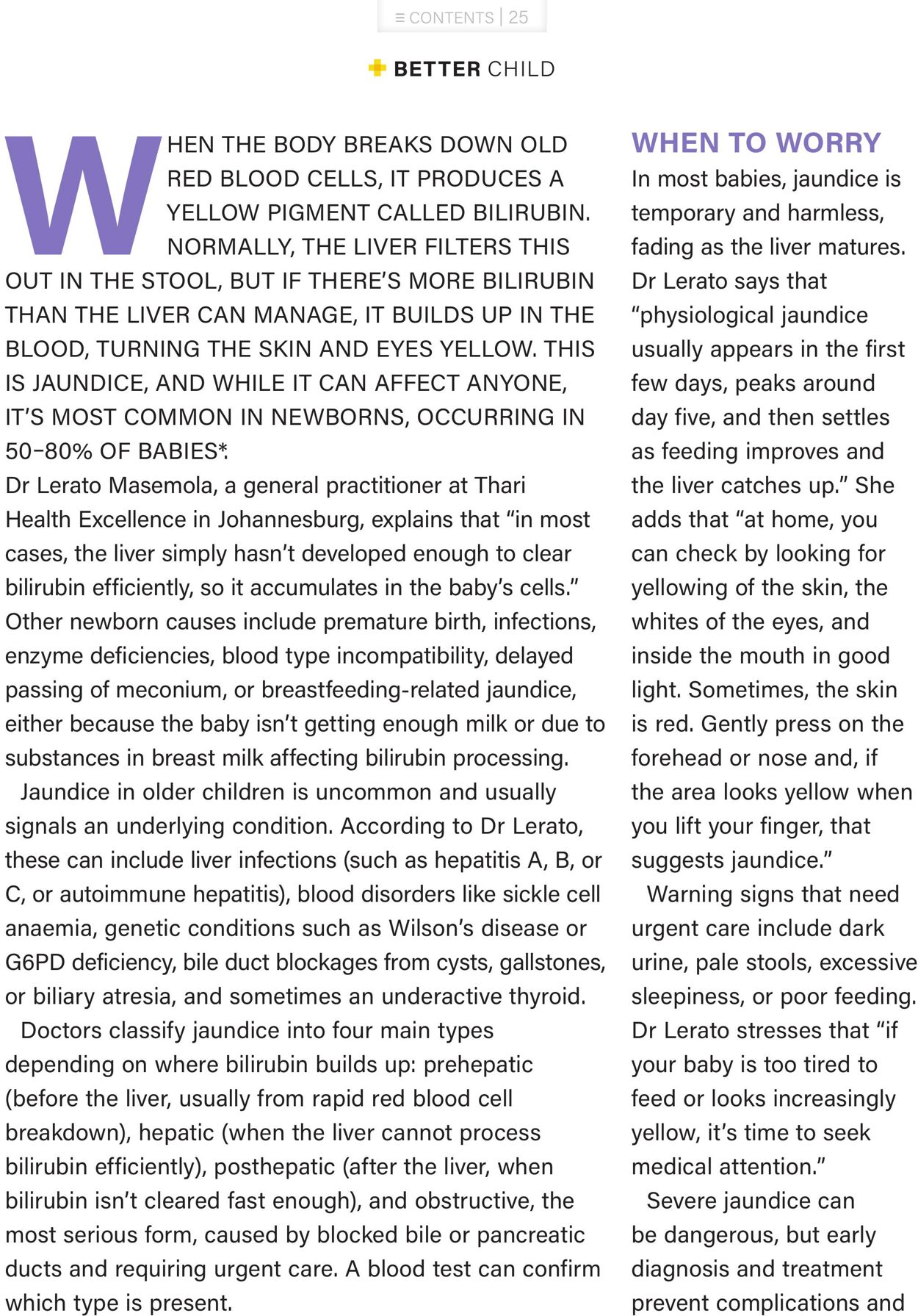
“ BETTER CHILD HEN THE BODY BREAKS DOWN OLD RED BLOOD CELLS, IT PRODUCES A YELLOW PIGMENT CALLED BILIRUBIN. NORMALLY, THE LIVER FILTERS THIS OUT IN THE STOOL, BUT IF THERE'S MORE BILIRUBIN THAN THE LIVER CAN MANAGE, IT BUILDS UP IN THE BLOOD, TURNING THE SKIN AND EYES YELLOW. THIS IS JAUNDICE, AND WHILE IT CAN AFFECT ANYONE, IT'S MOST COMMON IN NEWBORNS, OCCURRING IN 50-80% OF BABIES* Dr Lerato Masemola, a general practitioner at Thari Health Excellence in Johannesburg, explains that “in most cases, the liver simply hasn’t developed enough to clear bilirubin efficiently, so it accumulates in the baby’s cells.” Other newborn causes include premature birth, infections, enzyme deficiencies, blood type incompatibility, delayed passing of meconium, or breastfeeding-related jaundice, either because the baby isn’t getting enough milk or due to substances in breast milk affecting bilirubin processing. Jaundice in older children is uncommon and usually signals an underlying condition. According to Dr Lerato, these can include liver infections (such as hepatitis A, B, or C, or autoimmune hepatitis), blood disorders like sickle cell anaemia, genetic conditions such as Wilson's disease or G6PD deficiency, bile duct blockages from cysts, gallstones, or biliary atresia, and sometimes an underactive thyroid. Doctors classify jaundice into four main types depending on where bilirubin builds up: prehepatic (before the liver, usually from rapid red blood cell breakdown), hepatic (when the liver cannot process bilirubin efficiently), posthepatic (after the liver, when bilirubin isn't cleared fast enough), and obstructive, the most serious form, caused by blocked bile or pancreatic ducts and requiring urgent care. A blood test can confirm which type is present. WHEN TO WORRY In most babies, jaundice is temporary and harmless, fading as the liver matures. Dr Lerato says that “physiological jaundice usually appears in the first few days, peaks around day five, and then settles as feeding improves and the liver catches up.” She adds that “at home, you can check by looking for yellowing of the skin, the whites of the eyes, and inside the mouth in good light. Sometimes, the skin is red. Gently press on the forehead or nose and, if the area looks yellow when you lift your finger, that suggests jaundice.” Warning signs that need urgent care include dark urine, pale stools, excessive sleepiness, or poor feeding. Dr Lerato stresses that “if your baby is too tired to feed or looks increasingly yellow, it's time to seek medical attention.” Severe jaundice can be dangerous, but early diagnosis and treatment prevent complications and


Latest specials

Advertisement
“ BETTER CHILD HEN THE BODY BREAKS DOWN OLD RED BLOOD CELLS, IT PRODUCES A YELLOW PIGMENT CALLED BILIRUBIN. NORMALLY, THE LIVER FILTERS THIS OUT IN THE STOOL, BUT IF THERE'S MORE BILIRUBIN THAN THE LIVER CAN MANAGE, IT BUILDS UP IN THE BLOOD, TURNING THE SKIN AND EYES YELLOW. THIS IS JAUNDICE, AND WHILE IT CAN AFFECT ANYONE, IT'S MOST COMMON IN NEWBORNS, OCCURRING IN 50-80% OF BABIES* Dr Lerato Masemola, a general practitioner at Thari Health Excellence in Johannesburg, explains that “in most cases, the liver simply hasn’t developed enough to clear bilirubin efficiently, so it accumulates in the baby’s cells.” Other newborn causes include premature birth, infections, enzyme deficiencies, blood type incompatibility, delayed passing of meconium, or breastfeeding-related jaundice, either because the baby isn’t getting enough milk or due to substances in breast milk affecting bilirubin processing. Jaundice in older children is uncommon and usually signals an underlying condition. According to Dr Lerato, these can include liver infections (such as hepatitis A, B, or C, or autoimmune hepatitis), blood disorders like sickle cell anaemia, genetic conditions such as Wilson's disease or G6PD deficiency, bile duct blockages from cysts, gallstones, or biliary atresia, and sometimes an underactive thyroid. Doctors classify jaundice into four main types depending on where bilirubin builds up: prehepatic (before the liver, usually from rapid red blood cell breakdown), hepatic (when the liver cannot process bilirubin efficiently), posthepatic (after the liver, when bilirubin isn't cleared fast enough), and obstructive, the most serious form, caused by blocked bile or pancreatic ducts and requiring urgent care. A blood test can confirm which type is present. WHEN TO WORRY In most babies, jaundice is temporary and harmless, fading as the liver matures. Dr Lerato says that “physiological jaundice usually appears in the first few days, peaks around day five, and then settles as feeding improves and the liver catches up.” She adds that “at home, you can check by looking for yellowing of the skin, the whites of the eyes, and inside the mouth in good light. Sometimes, the skin is red. Gently press on the forehead or nose and, if the area looks yellow when you lift your finger, that suggests jaundice.” Warning signs that need urgent care include dark urine, pale stools, excessive sleepiness, or poor feeding. Dr Lerato stresses that “if your baby is too tired to feed or looks increasingly yellow, it's time to seek medical attention.” Severe jaundice can be dangerous, but early diagnosis and treatment prevent complications and

Advertisement
Advertisement

If you continue to browse this website, you accept the use of cookies.

Name Details