The query has to be between 2 and 50 characters

Advertisement
Advertisement

Current special Baby City - Valid from 01.09 to 30.09 - Page nb 32

Advertisement
Advertisement
Advertisement
Advertisement
Special Baby City 01.09.2025 - 30.09.2025
Special Boxer - GP May ME Special Stores 25 May, 2026 - 7 Jun, 2026
Boxer - GP May ME Special Stores
25 May, 2026 - 7 Jun, 2026
Special Boxer - GP May ME Liquor 25 May, 2026 - 7 Jun, 2026
Boxer - GP May ME Liquor
25 May, 2026 - 7 Jun, 2026
Special Boxer - Atlyn Mall Liquor Grand Opening 22 May, 2026 - 7 Jun, 2026
Boxer - Atlyn Mall Liquor Grand Opening
22 May, 2026 - 7 Jun, 2026
Special Boxer - Atlyn Mall Liquor Grand Opening 25 May, 2026 - 7 Jun, 2026
Boxer - Atlyn Mall Liquor Grand Opening
25 May, 2026 - 7 Jun, 2026
See next flyer
Advertisement
Advertisement
Advertisement

Products in this catalogue

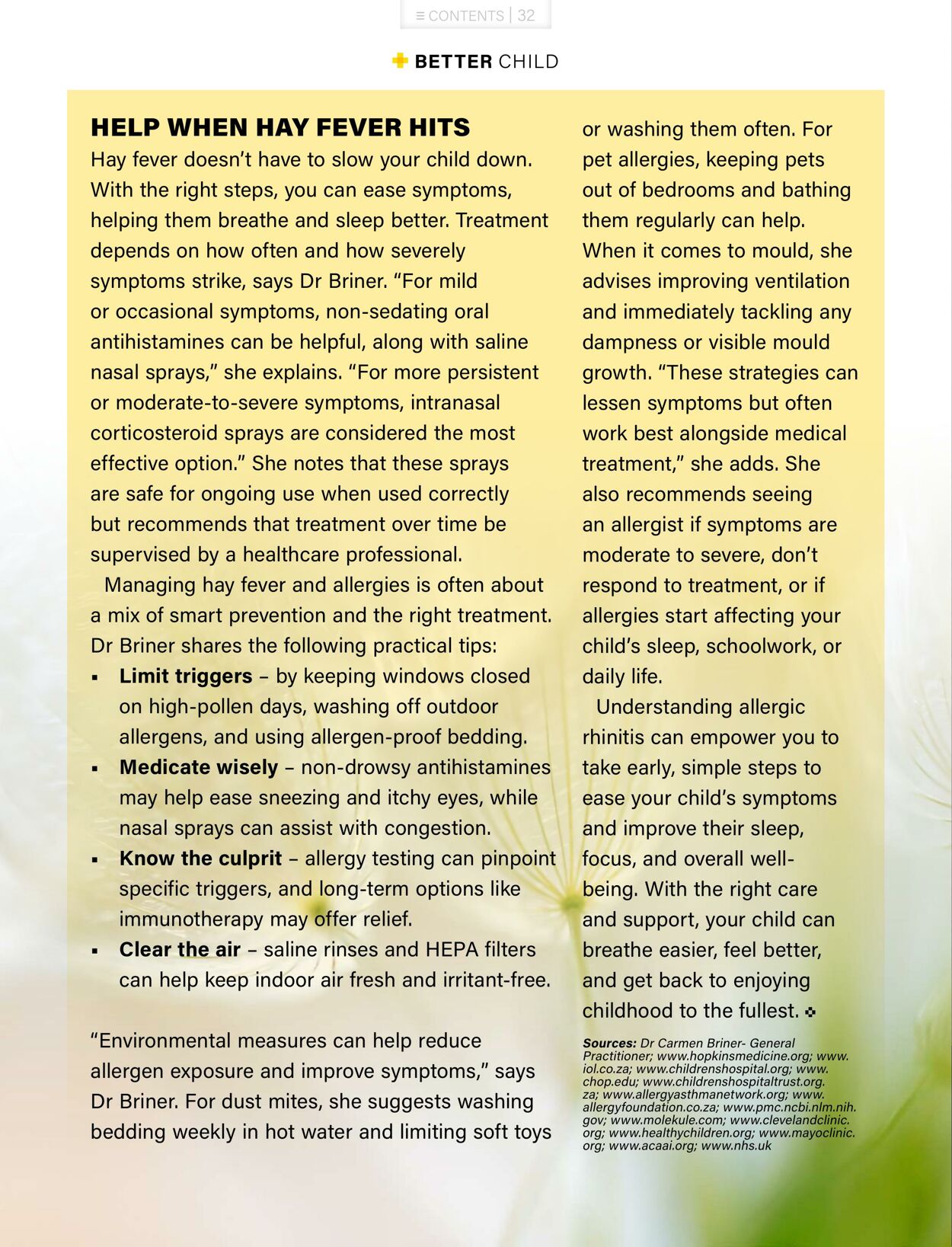
“© BETTER CHILD HELP WHEN HAY FEVER HITS Hay fever doesn't have to slow your child down. With the right steps, you can ease symptoms, helping them breathe and sleep better. Treatment depends on how often and how severely symptoms strike, says Dr Briner. “For mild or occasional symptoms, non-sedating oral antihistamines can be helpful, along with saline nasal sprays,” she explains. “For more persistent or moderate-to-severe symptoms, intranasal corticosteroid sprays are considered the most effective option.” She notes that these sprays are safe for ongoing use when used correctly but recommends that treatment over time be supervised by a healthcare professional. Managing hay fever and allergies is often about a mix of smart prevention and the right treatment. Dr Briner shares the following practical tips: » Limit triggers - by keeping windows closed on high-pollen days, washing off outdoor allergens, and using allergen-proof bedding. « Medicate wisely - non-drowsy antihistamines may help ease sneezing and itchy eyes, while nasal sprays can assist with congestion. + Know the culprit - allergy testing can pinpoint specific triggers, and long-term options like immunotherapy mayer relief. « Clear the air - saline rinses and HEPA filters can help keep indoor air fresh and irritant-free. “Environmental measures can help reduce allergen exposure and improve symptoms,” says Dr Briner. For dust mites, she suggests washing bedding weekly in hot water and limiting soft toys or washing them often. For pet allergies, keeping pets out of bedrooms and bathing them regularly can help. When it comes to mould, she advises improving ventilation and immediately tackling any dampness or visible mould growth. “These strategies can lessen symptoms but often work best alongside medical treatment,” she adds. She also recommends seeing an allergist if symptoms are moderate to severe, don’t respond to treatment, or if allergies start affecting your child’s sleep, schoolwork, or daily life. Understanding allergic rhinitis can empower you to take early, simple steps to ease your child’s symptoms and improve their sleep, focus, and overall well- being. With the right care and support, your child can breathe easier, feel better, and get back to enjoying childhood to the fullest. = Sources: Dr Carmen Briner- General Practitioner; www.hopkinsmedicine.org; iol.co.za; w che Or za; wwwallergyasthmanetwork.org; WW¥ allergyfoundation.co.za; www.pmc.nebi. gov; www.molekule ww.clevelan le. org; www.healthychildren.org; www.mi org; www.acaai.org; www.nhs.uk


Latest specials

Advertisement
“© BETTER CHILD HELP WHEN HAY FEVER HITS Hay fever doesn't have to slow your child down. With the right steps, you can ease symptoms, helping them breathe and sleep better. Treatment depends on how often and how severely symptoms strike, says Dr Briner. “For mild or occasional symptoms, non-sedating oral antihistamines can be helpful, along with saline nasal sprays,” she explains. “For more persistent or moderate-to-severe symptoms, intranasal corticosteroid sprays are considered the most effective option.” She notes that these sprays are safe for ongoing use when used correctly but recommends that treatment over time be supervised by a healthcare professional. Managing hay fever and allergies is often about a mix of smart prevention and the right treatment. Dr Briner shares the following practical tips: » Limit triggers - by keeping windows closed on high-pollen days, washing off outdoor allergens, and using allergen-proof bedding. « Medicate wisely - non-drowsy antihistamines may help ease sneezing and itchy eyes, while nasal sprays can assist with congestion. + Know the culprit - allergy testing can pinpoint specific triggers, and long-term options like immunotherapy mayer relief. « Clear the air - saline rinses and HEPA filters can help keep indoor air fresh and irritant-free. “Environmental measures can help reduce allergen exposure and improve symptoms,” says Dr Briner. For dust mites, she suggests washing bedding weekly in hot water and limiting soft toys or washing them often. For pet allergies, keeping pets out of bedrooms and bathing them regularly can help. When it comes to mould, she advises improving ventilation and immediately tackling any dampness or visible mould growth. “These strategies can lessen symptoms but often work best alongside medical treatment,” she adds. She also recommends seeing an allergist if symptoms are moderate to severe, don’t respond to treatment, or if allergies start affecting your child’s sleep, schoolwork, or daily life. Understanding allergic rhinitis can empower you to take early, simple steps to ease your child’s symptoms and improve their sleep, focus, and overall well- being. With the right care and support, your child can breathe easier, feel better, and get back to enjoying childhood to the fullest. = Sources: Dr Carmen Briner- General Practitioner; www.hopkinsmedicine.org; iol.co.za; w che Or za; wwwallergyasthmanetwork.org; WW¥ allergyfoundation.co.za; www.pmc.nebi. gov; www.molekule ww.clevelan le. org; www.healthychildren.org; www.mi org; www.acaai.org; www.nhs.uk

Advertisement
Advertisement

If you continue to browse this website, you accept the use of cookies.

Name Details