The query has to be between 2 and 50 characters
Advertisement
Advertisement

Current special Baby City - Valid from 22.08 to 22.09 - Page nb 42

Advertisement
Advertisement
Advertisement
Advertisement
Special Baby City 22.08.2025 - 22.09.2025
Special Game - Game Cellular : 56 Years In The Game (21 April - 06 June 2026) — www.guzzle.co.za 21 Apr, 2026 - 6 Jun, 2026
Game - Game Cellular : 56 Years In The Game (21 April - 06 June 2026) — www.guzzle.co.za
21 Apr, 2026 - 6 Jun, 2026
Special Boxer - Atlyn Mall Liquor Grand Opening 22 May, 2026 - 7 Jun, 2026
Boxer - Atlyn Mall Liquor Grand Opening
22 May, 2026 - 7 Jun, 2026
Special Game - Game : More 4 Less (01 May - 31 July 2026) — www.guzzle.co.za 1 May, 2026 - 31 Jul, 2026
Game - Game : More 4 Less (01 May - 31 July 2026) — www.guzzle.co.za
1 May, 2026 - 31 Jul, 2026
Special Boxer - GP May ME Liquor 25 May, 2026 - 7 Jun, 2026
Boxer - GP May ME Liquor
25 May, 2026 - 7 Jun, 2026
See next flyer
Advertisement
Advertisement
Advertisement

Products in this catalogue

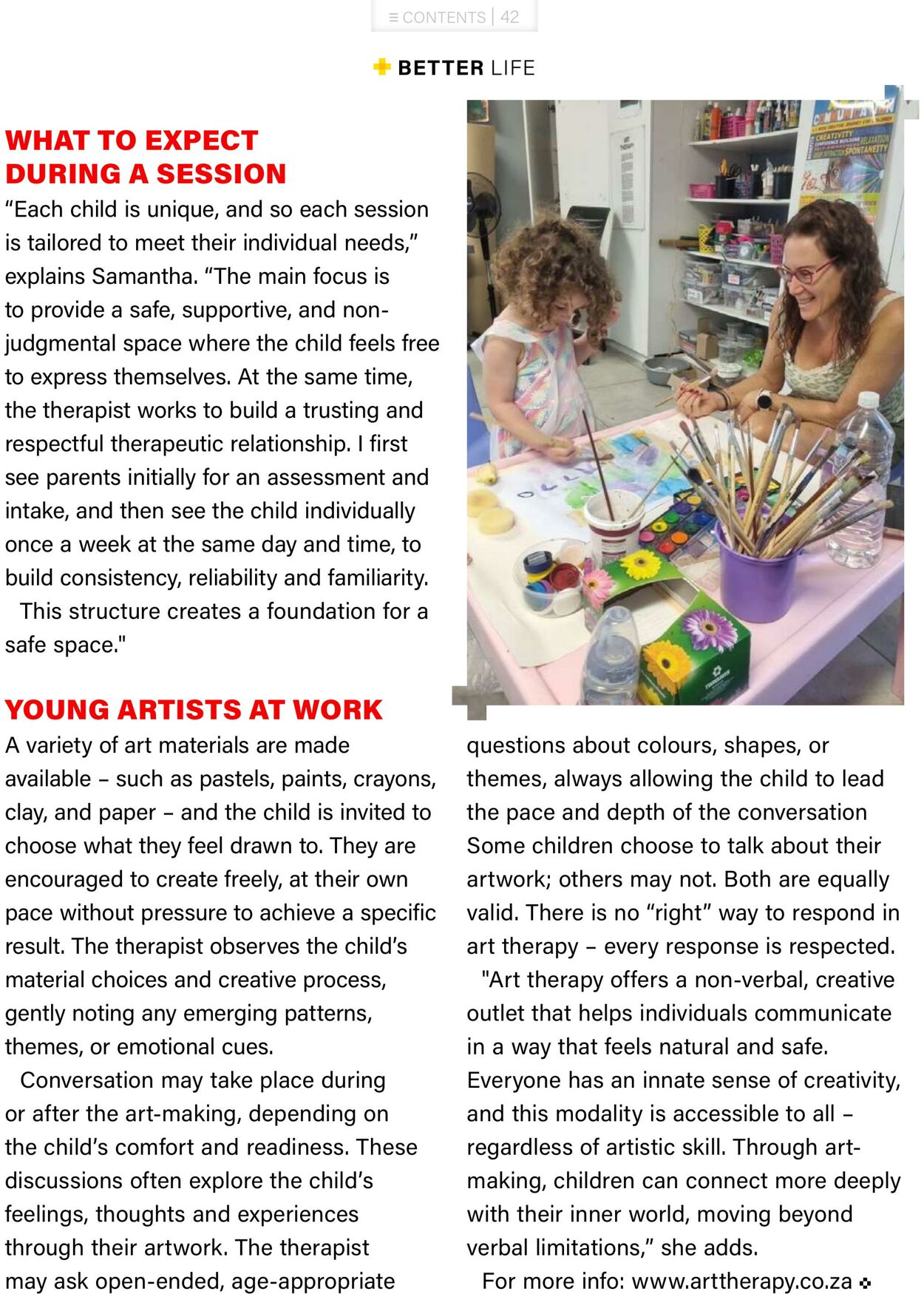
>» BETTER LIFE WHAT TO EXPECT DURING A SESSION “Each child is unique, and so each session is tailored to meet their individual needs,” explains Samantha. “The main focus is to provide a safe, supportive, and non- judgmental space where the child feels free to express themselves. At the same time, the therapist works to build a trusting and respectful therapeutic relationship. | first see parents initially for an assessment and intake, and then see the child individually once a week at the same day and time, to build consistency, reliability and familiarity. This structure creates a foundation for a safe space." YOUNG ARTISTS AT WORK A variety of art materials are made available - such as pastels, paints, crayons, clay, and paper - and the child is invited to choose what they feel drawn to. They are encouraged to create freely, at their own pace without pressure to achieve a specific result. The therapist observes the child's material choices and creative process, gently noting any emerging patterns, themes, or emotional cues. Conversation may take place during or after the art-making, depending on the child's comfort and readiness. These discussions often explore the child's feelings, thoughts and experiences through their artwork. The therapist may ask open-ended, age-appropriate s - questions about colours, shapes, or themes, always allowing the child to lead the pace and depth of the conversation Some children choose to talk about their artwork; others may not. Both are equally valid. There is no “right” way to respond in art therapy - every response is respected. "Art therapy offers a non-verbal, creative outlet that helps individuals communicate in a way that feels natural and safe. Everyone has an innate sense of creativity, and this modality is accessible to all - regardless of artistic skill. Through art- making, children can connect more deeply with their inner world, moving beyond verbal limitations,” she adds. For more info: www.arttherapy.co.za =


Latest specials

Advertisement
>» BETTER LIFE WHAT TO EXPECT DURING A SESSION “Each child is unique, and so each session is tailored to meet their individual needs,” explains Samantha. “The main focus is to provide a safe, supportive, and non- judgmental space where the child feels free to express themselves. At the same time, the therapist works to build a trusting and respectful therapeutic relationship. | first see parents initially for an assessment and intake, and then see the child individually once a week at the same day and time, to build consistency, reliability and familiarity. This structure creates a foundation for a safe space." YOUNG ARTISTS AT WORK A variety of art materials are made available - such as pastels, paints, crayons, clay, and paper - and the child is invited to choose what they feel drawn to. They are encouraged to create freely, at their own pace without pressure to achieve a specific result. The therapist observes the child's material choices and creative process, gently noting any emerging patterns, themes, or emotional cues. Conversation may take place during or after the art-making, depending on the child's comfort and readiness. These discussions often explore the child's feelings, thoughts and experiences through their artwork. The therapist may ask open-ended, age-appropriate s - questions about colours, shapes, or themes, always allowing the child to lead the pace and depth of the conversation Some children choose to talk about their artwork; others may not. Both are equally valid. There is no “right” way to respond in art therapy - every response is respected. "Art therapy offers a non-verbal, creative outlet that helps individuals communicate in a way that feels natural and safe. Everyone has an innate sense of creativity, and this modality is accessible to all - regardless of artistic skill. Through art- making, children can connect more deeply with their inner world, moving beyond verbal limitations,” she adds. For more info: www.arttherapy.co.za =

Advertisement
Advertisement

If you continue to browse this website, you accept the use of cookies.

Name Details