The query has to be between 2 and 50 characters

Advertisement
Advertisement

Current special Baby City - Valid from 22.08 to 22.09 - Page nb 37

Advertisement
Advertisement
Advertisement
Advertisement
Special Baby City 22.08.2025 - 22.09.2025
Special Boxer - GP May ME Liquor Special Stores 25 May, 2026 - 7 Jun, 2026
Boxer - GP May ME Liquor Special Stores
25 May, 2026 - 7 Jun, 2026
Special Boxer - Atlyn Mall Liquor Grand Opening 25 May, 2026 - 7 Jun, 2026
Boxer - Atlyn Mall Liquor Grand Opening
25 May, 2026 - 7 Jun, 2026
Special Boxer - Atlyn Mall Liquor Grand Opening 22 May, 2026 - 7 Jun, 2026
Boxer - Atlyn Mall Liquor Grand Opening
22 May, 2026 - 7 Jun, 2026
Special Boxer - GP May ME Special Stores 25 May, 2026 - 7 Jun, 2026
Boxer - GP May ME Special Stores
25 May, 2026 - 7 Jun, 2026
See next flyer
Advertisement
Advertisement
Advertisement

Products in this catalogue

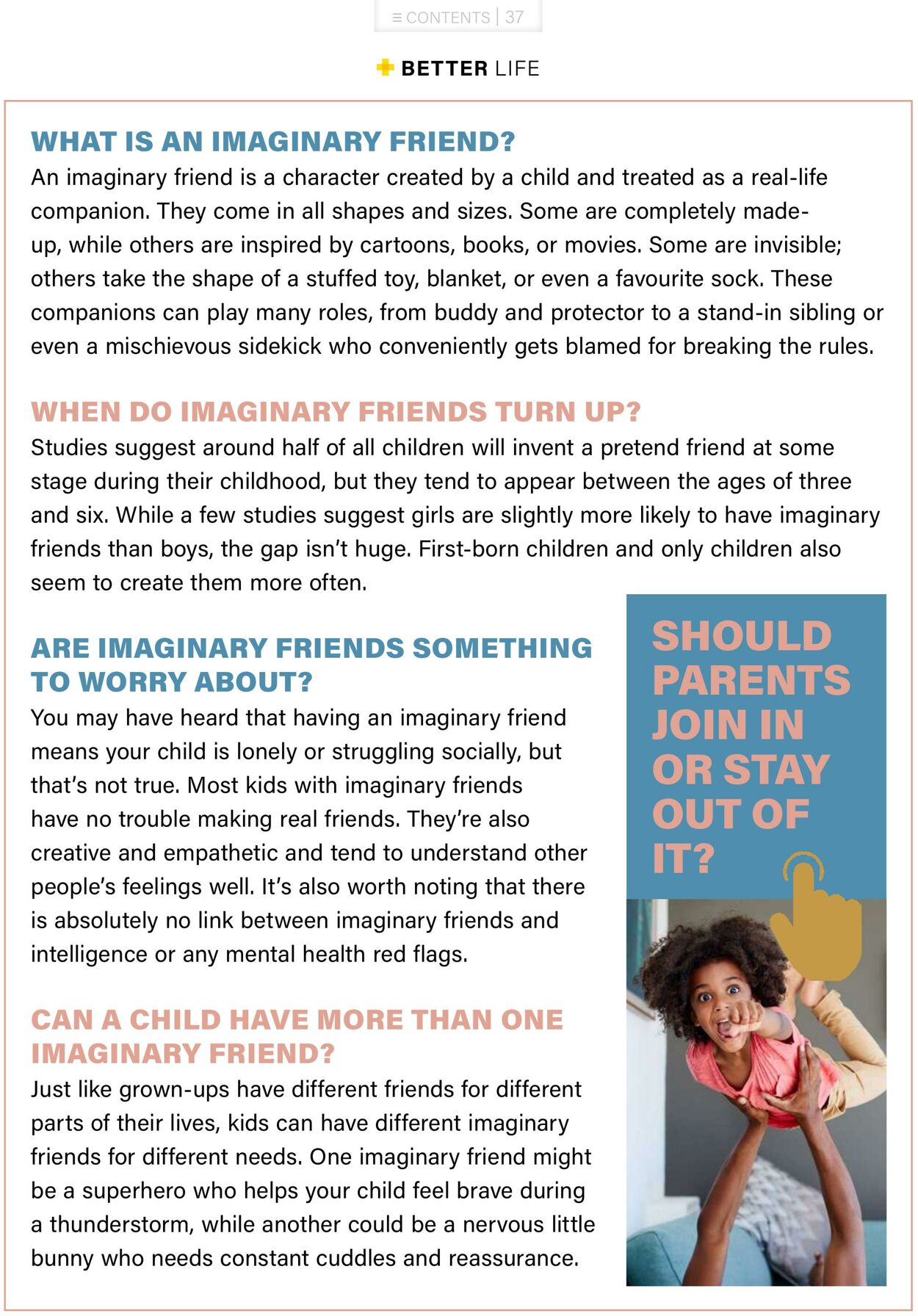
*» BETTER LIFE WHAT IS AN IMAGINARY FRIEND? An imaginary friend is a character created by a child and treated as a real-life companion. They come in all shapes and sizes. Some are completely made- up, while others are inspired by cartoons, books, or movies. Some are invisible; others take the shape of a stuffed toy, blanket, or even a favourite sock. These companions can play many roles, from buddy and protector to a stand-in sibling or even a mischievous sidekick who conveniently gets blamed for breaking the rules. WHEN DO IMAGINARY FRIENDS TURN UP? Studies suggest around half of all children will invent a pretend friend at some stage during their childhood, but they tend to appear between the ages of three and six. While a few studies suggest girls are slightly more likely to have imaginary friends than boys, the gap isn't huge. First-born children and only children also seem to create them more often. ARE IMAGINARY FRIENDS SOMETHING TO WORRY ABOUT? You may have heard that having an imaginary friend means your child is lonely or struggling socially, but that’s not true. Most kids with imaginary friends have no trouble making real friends. They're also creative and empathetic and tend to understand other people's feelings well. It’s also worth noting that there is absolutely no link between imaginary friends and intelligence or any mental health red flags. CAN A CHILD HAVE MORE THAN ONE IMAGINARY FRIEND? Just like grown-ups have different friends for different parts of their lives, kids can have different imaginary friends for different needs. One imaginary friend might be a superhero who helps your child feel brave during a thunderstorm, while another could be a nervous little bunny who needs constant cuddles and reassurance.


Latest specials

Advertisement
*» BETTER LIFE WHAT IS AN IMAGINARY FRIEND? An imaginary friend is a character created by a child and treated as a real-life companion. They come in all shapes and sizes. Some are completely made- up, while others are inspired by cartoons, books, or movies. Some are invisible; others take the shape of a stuffed toy, blanket, or even a favourite sock. These companions can play many roles, from buddy and protector to a stand-in sibling or even a mischievous sidekick who conveniently gets blamed for breaking the rules. WHEN DO IMAGINARY FRIENDS TURN UP? Studies suggest around half of all children will invent a pretend friend at some stage during their childhood, but they tend to appear between the ages of three and six. While a few studies suggest girls are slightly more likely to have imaginary friends than boys, the gap isn't huge. First-born children and only children also seem to create them more often. ARE IMAGINARY FRIENDS SOMETHING TO WORRY ABOUT? You may have heard that having an imaginary friend means your child is lonely or struggling socially, but that’s not true. Most kids with imaginary friends have no trouble making real friends. They're also creative and empathetic and tend to understand other people's feelings well. It’s also worth noting that there is absolutely no link between imaginary friends and intelligence or any mental health red flags. CAN A CHILD HAVE MORE THAN ONE IMAGINARY FRIEND? Just like grown-ups have different friends for different parts of their lives, kids can have different imaginary friends for different needs. One imaginary friend might be a superhero who helps your child feel brave during a thunderstorm, while another could be a nervous little bunny who needs constant cuddles and reassurance.

Advertisement
Advertisement

If you continue to browse this website, you accept the use of cookies.

Name Details