The query has to be between 2 and 50 characters

Advertisement
Advertisement

Current special Baby City - Valid from 22.08 to 22.09 - Page nb 17

Advertisement
Advertisement
Advertisement
Advertisement
Special Baby City 22.08.2025 - 22.09.2025
Special Boxer - GP May ME Special Stores 25 May, 2026 - 7 Jun, 2026
Boxer - GP May ME Special Stores
25 May, 2026 - 7 Jun, 2026
Special Boxer - GP May ME Special Stores 25 May, 2026 - 7 Jun, 2026
Boxer - GP May ME Special Stores
25 May, 2026 - 7 Jun, 2026
Special Game - Game : The Game Changer (25 May - 20 July 2026) — www.guzzle.co.za 25 May, 2026 - 20 Jul, 2026
Game - Game : The Game Changer (25 May - 20 July 2026) — www.guzzle.co.za
25 May, 2026 - 20 Jul, 2026
Special Boxer - GP May ME Liquor 25 May, 2026 - 7 Jun, 2026
Boxer - GP May ME Liquor
25 May, 2026 - 7 Jun, 2026
See next flyer
Advertisement
Advertisement
Advertisement

Products in this catalogue

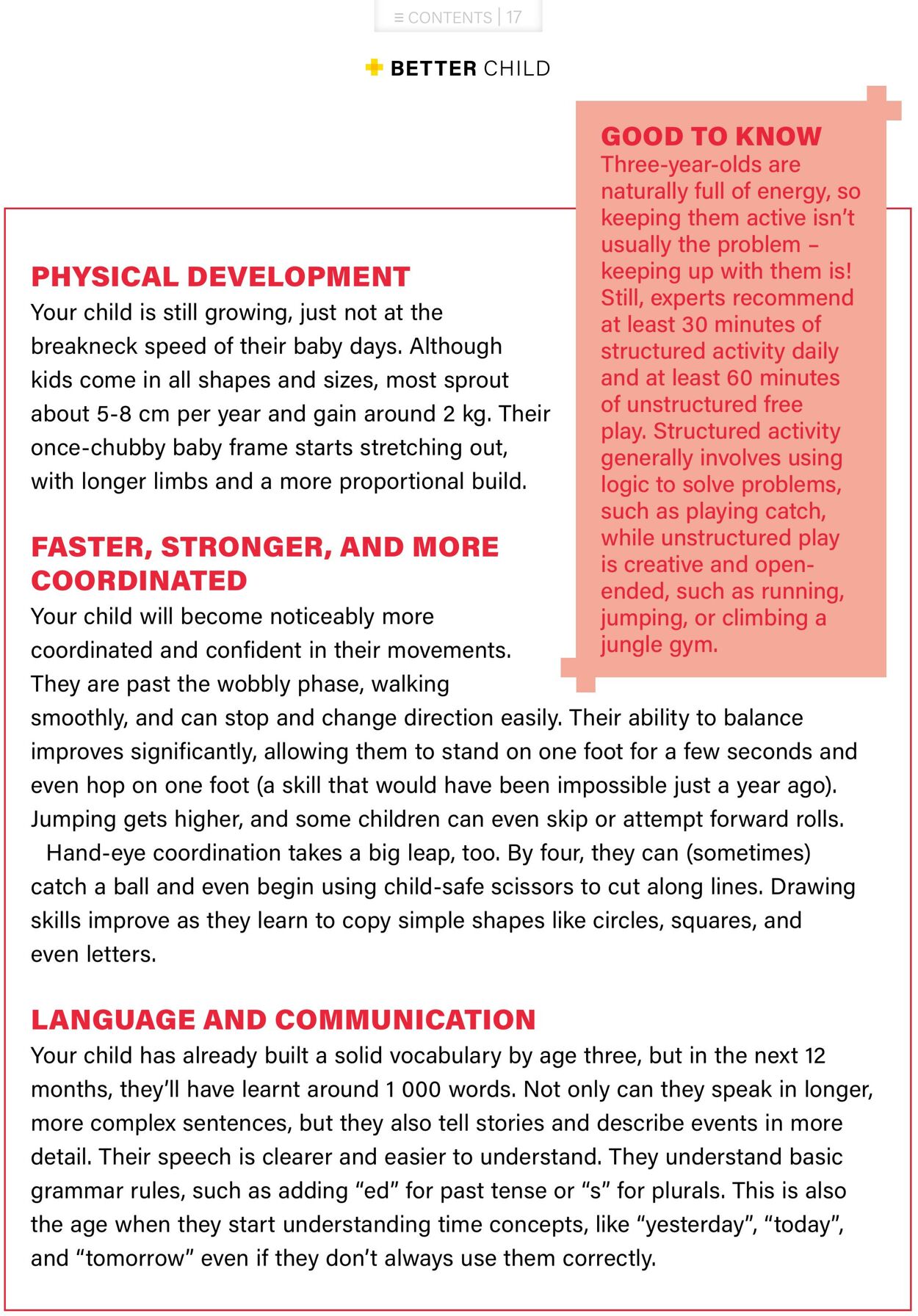
*» BETTER CHILD PHYSICAL DEVELOPMENT Your child is still growing, just not at the breakneck speed of their baby days. Although kids come in all shapes and sizes, most sprout about 5-8 cm per year and gain around 2 kg. Their once-chubby baby frame starts stretching out, with longer limbs and a more proportional build. FASTER, STRONGER, AND MORE COORDINATED Your child will become noticeably more coordinated and confident in their movements. They are past the wobbly phase, walking smoothly, and can stop and change direction easily. Their ability to balance improves significantly, allowing them to stand on one foot for a few seconds and even hop on one foot (a skill that would have been impossible just a year ago). Jumping gets higher, and some children can even skip or attempt forward rolls. Hand-eye coordination takes a big leap, too. By four, they can (sometimes) catch a ball and even begin using child-safe scissors to cut along lines. Drawing skills improve as they learn to copy simple shapes like circles, squares, and even letters. LANGUAGE AND COMMUNICATION Your child has already built a solid vocabulary by age three, but in the next 12 months, they'll have learnt around 1 000 words. Not only can they speak in longer, more complex sentences, but they also tell stories and describe events in more detail. Their speech is clearer and easier to understand. They understand basic grammar rules, such as adding “ed” for past tense or “s” for plurals. This is also the age when they start understanding time concepts, like “yesterday”, “today”, and “tomorrow” even if they don’t always use them correctly.


Latest specials

Advertisement
*» BETTER CHILD PHYSICAL DEVELOPMENT Your child is still growing, just not at the breakneck speed of their baby days. Although kids come in all shapes and sizes, most sprout about 5-8 cm per year and gain around 2 kg. Their once-chubby baby frame starts stretching out, with longer limbs and a more proportional build. FASTER, STRONGER, AND MORE COORDINATED Your child will become noticeably more coordinated and confident in their movements. They are past the wobbly phase, walking smoothly, and can stop and change direction easily. Their ability to balance improves significantly, allowing them to stand on one foot for a few seconds and even hop on one foot (a skill that would have been impossible just a year ago). Jumping gets higher, and some children can even skip or attempt forward rolls. Hand-eye coordination takes a big leap, too. By four, they can (sometimes) catch a ball and even begin using child-safe scissors to cut along lines. Drawing skills improve as they learn to copy simple shapes like circles, squares, and even letters. LANGUAGE AND COMMUNICATION Your child has already built a solid vocabulary by age three, but in the next 12 months, they'll have learnt around 1 000 words. Not only can they speak in longer, more complex sentences, but they also tell stories and describe events in more detail. Their speech is clearer and easier to understand. They understand basic grammar rules, such as adding “ed” for past tense or “s” for plurals. This is also the age when they start understanding time concepts, like “yesterday”, “today”, and “tomorrow” even if they don’t always use them correctly.

Advertisement
Advertisement

If you continue to browse this website, you accept the use of cookies.

Name Details