The query has to be between 2 and 50 characters

Advertisement
Advertisement

Current special Baby City - Valid from 01.06 to 30.06 - Page nb 43

Advertisement
Advertisement
Advertisement
Advertisement
Special Baby City 01.06.2025 - 30.06.2025
Special Game - Game : Winter Warmers (21 April - 31 July 2026) — www.guzzle.co.za 21 Apr, 2026 - 31 Jul, 2026
Game - Game : Winter Warmers (21 April - 31 July 2026) — www.guzzle.co.za
21 Apr, 2026 - 31 Jul, 2026
Special Boxer - GP May ME Liquor 25 May, 2026 - 7 Jun, 2026
Boxer - GP May ME Liquor
25 May, 2026 - 7 Jun, 2026
Special Boxer - Atlyn Mall Liquor Grand Opening 25 May, 2026 - 7 Jun, 2026
Boxer - Atlyn Mall Liquor Grand Opening
25 May, 2026 - 7 Jun, 2026
Special Boxer - Atlyn Mall Liquor Grand Opening 22 May, 2026 - 7 Jun, 2026
Boxer - Atlyn Mall Liquor Grand Opening
22 May, 2026 - 7 Jun, 2026
See next flyer
Advertisement
Advertisement
Advertisement

Products in this catalogue

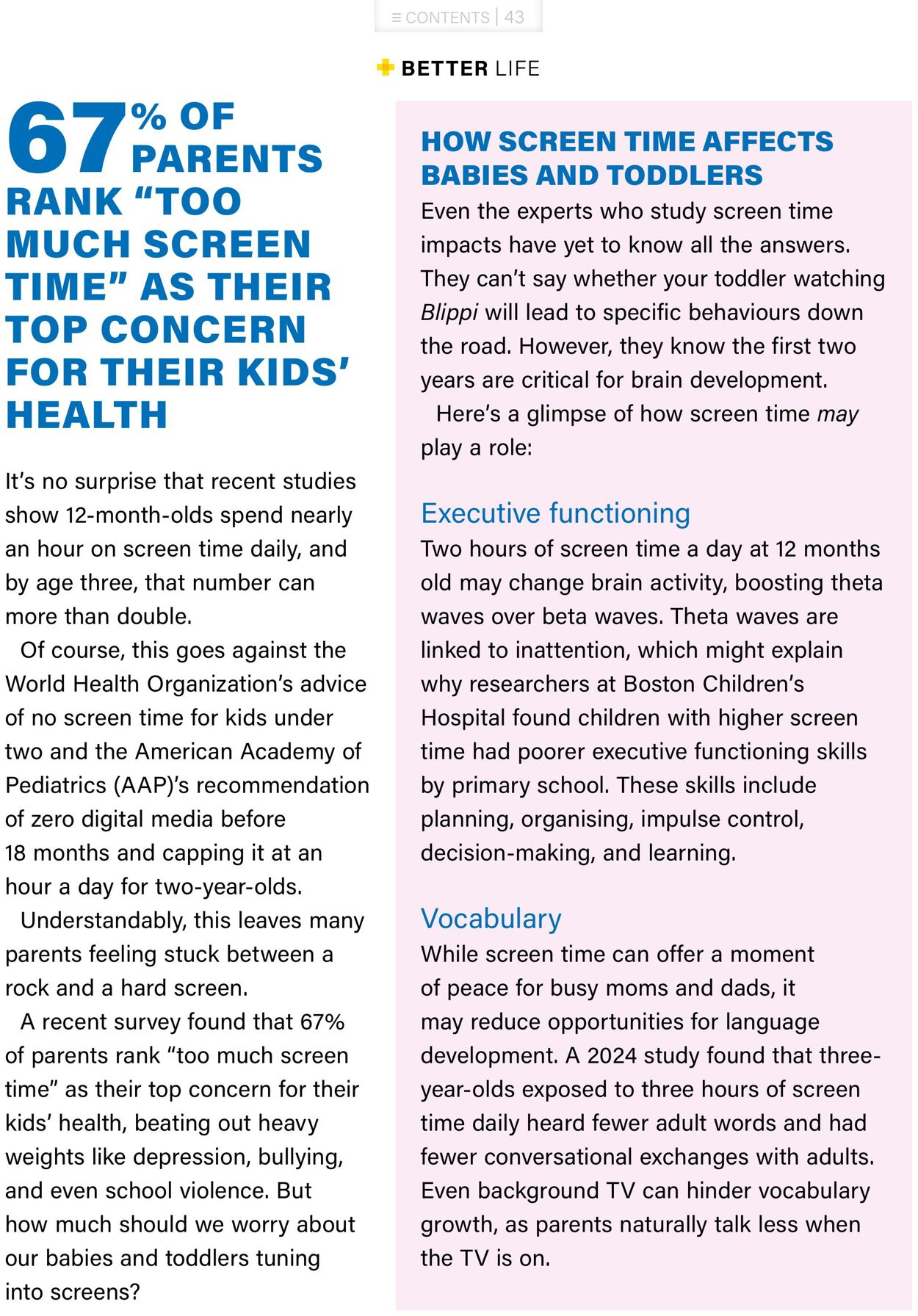
67; OF PARENTS RANK “TOO MUCH SCREEN TIME” AS THEIR TOP CONCERN FOR THEIR KIDS’ HEALTH It's no surprise that recent studies show 12-month-olds spend nearly an hour on screen time daily, and by age three, that number can more than double. Of course, this goes against the World Health Organization's advice of no screen time for kids under two and the American Academy of Pediatrics (AAP)'s recommendation of zero digital media before 18 months and capping it at an hour a day for two-year-olds. Understandably, this leaves many parents feeling stuck between a rock and a hard screen. A recent survey found that 67% of parents rank “too much screen time” as their top concern for their kids’ health, beating out heavy weights like depression, bullying, and even school violence. But how much should we worry about our babies and toddlers tuning into screens? “» BETTER LIFE HOW SCREEN TIME AFFECTS BABIES AND TODDLERS Even the experts who study screen time impacts have yet to know all the answers. They can’t say whether your toddler watching Blippi will lead to specific behaviours down the road. However, they know the first two years are critical for brain development. Here's a glimpse of how screen time may play a role: Executive functioning Two hours of screen time a day at 12 months old may change brain activity, boosting theta waves over beta waves. Theta waves are linked to inattention, which might explain why researchers at Boston Children’s Hospital found children with higher screen time had poorer executive functioning skills by primary school. These skills include planning, organising, impulse control, decision-making, and learning. Vocabulary While screen time can offer a moment of peace for busy moms and dads, it may reduce opportunities for language development. A 2024 study found that three- year-olds exposed to three hours of screen time daily heard fewer adult words and had fewer conversational exchanges with adults. Even background TV can hinder vocabulary growth, as parents naturally talk less when the TV is on.


Latest specials

Advertisement
67; OF PARENTS RANK “TOO MUCH SCREEN TIME” AS THEIR TOP CONCERN FOR THEIR KIDS’ HEALTH It's no surprise that recent studies show 12-month-olds spend nearly an hour on screen time daily, and by age three, that number can more than double. Of course, this goes against the World Health Organization's advice of no screen time for kids under two and the American Academy of Pediatrics (AAP)'s recommendation of zero digital media before 18 months and capping it at an hour a day for two-year-olds. Understandably, this leaves many parents feeling stuck between a rock and a hard screen. A recent survey found that 67% of parents rank “too much screen time” as their top concern for their kids’ health, beating out heavy weights like depression, bullying, and even school violence. But how much should we worry about our babies and toddlers tuning into screens? “» BETTER LIFE HOW SCREEN TIME AFFECTS BABIES AND TODDLERS Even the experts who study screen time impacts have yet to know all the answers. They can’t say whether your toddler watching Blippi will lead to specific behaviours down the road. However, they know the first two years are critical for brain development. Here's a glimpse of how screen time may play a role: Executive functioning Two hours of screen time a day at 12 months old may change brain activity, boosting theta waves over beta waves. Theta waves are linked to inattention, which might explain why researchers at Boston Children’s Hospital found children with higher screen time had poorer executive functioning skills by primary school. These skills include planning, organising, impulse control, decision-making, and learning. Vocabulary While screen time can offer a moment of peace for busy moms and dads, it may reduce opportunities for language development. A 2024 study found that three- year-olds exposed to three hours of screen time daily heard fewer adult words and had fewer conversational exchanges with adults. Even background TV can hinder vocabulary growth, as parents naturally talk less when the TV is on.

Advertisement
Advertisement

If you continue to browse this website, you accept the use of cookies.

Name Details