The query has to be between 2 and 50 characters
Advertisement
Advertisement

Current special Baby City - Valid from 01.06 to 30.06 - Page nb 18

Advertisement
Advertisement
Advertisement
Advertisement
Special Baby City 01.06.2025 - 30.06.2025
Special Boxer - GP May ME Special Stores 25 May, 2026 - 7 Jun, 2026
Boxer - GP May ME Special Stores
25 May, 2026 - 7 Jun, 2026
Special Boxer - Atlyn Mall Liquor Grand Opening 22 May, 2026 - 7 Jun, 2026
Boxer - Atlyn Mall Liquor Grand Opening
22 May, 2026 - 7 Jun, 2026
Special Boxer - GP May ME Liquor 25 May, 2026 - 7 Jun, 2026
Boxer - GP May ME Liquor
25 May, 2026 - 7 Jun, 2026
Special Boxer - Atlyn Mall Liquor Grand Opening 22 May, 2026 - 7 Jun, 2026
Boxer - Atlyn Mall Liquor Grand Opening
22 May, 2026 - 7 Jun, 2026
See next flyer
Advertisement
Advertisement
Advertisement

Products in this catalogue

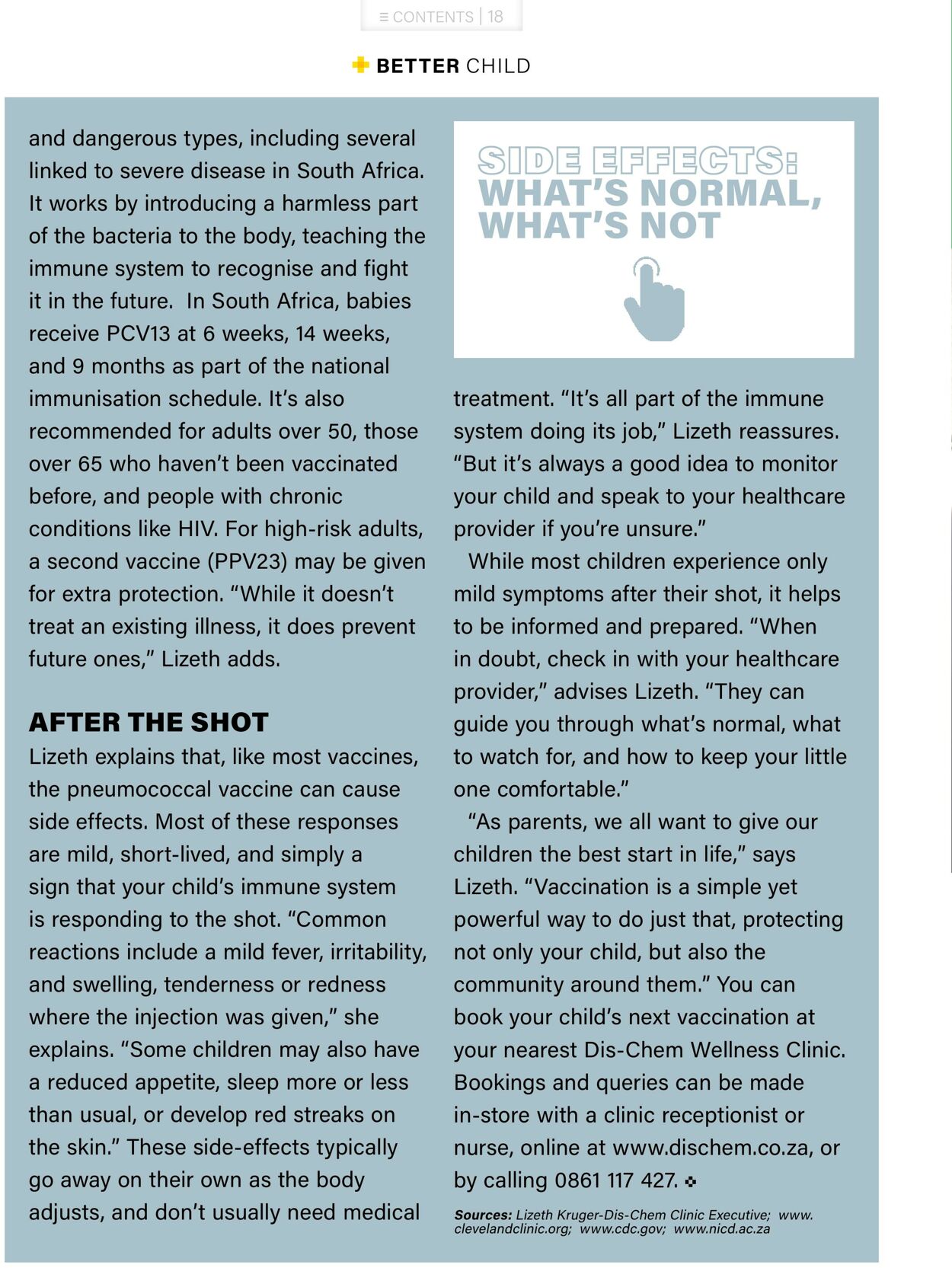
*» BETTER CHILD and dangerous types, including several linked to severe disease in South Africa. It works by introducing a harmless part of the bacteria to the body, teaching the immune system to recognise and fight it in the future. In South Africa, babies receive PCV13 at 6 weeks, 14 weeks, and 9 months as part of the national immunisation schedule. It's also recommended for adults over 50, those over 65 who haven't been vaccinated before, and people with chronic conditions like HIV. For high-risk adults, a second vaccine (PPV23) may be given for extra protection. “While it doesn’t treat an existing illness, it does prevent future ones,” Lizeth adds. AFTER THE SHOT Lizeth explains that, like most vaccines, the pneumococcal vaccine can cause side effects. Most of these responses are mild, short-lived, and simply a sign that your child's immune system is responding to the shot. “Common reactions include a mild fever, irritability, and swelling, tenderness or redness where the injection was given,” she explains. “Some children may also have a reduced appetite, sleep more or less than usual, or develop red streaks on the skin.” These side-effects typically go away on their own as the body adjusts, and don’t usually need medical treatment. “It's all part of the immune system doing its job,” Lizeth reassures. “But it’s always a good idea to monitor your child and speak to your healthcare provider if you're unsure.” While most children experience only mild symptoms after their shot, it helps to be informed and prepared. “When in doubt, check in with your healthcare provider,” advises Lizeth. “They can guide you through what's normal, what to watch for, and how to keep your little one comfortable.” “As parents, we all want to give our children the best start in life,” says Lizeth. “Vaccination is a simple yet powerful way to do just that, protecting not only your child, but also the community around them.” You can book your child's next vaccination at your nearest Dis-Chem Wellness Clinic. Bookings and queries can be made in-store with a clinic receptionist or nurse, online at www.dischem.co.za, or by calling 0861 117 427. + Sources: Lizeth Kruger-Dis-Chem Clinic Executive; www. clevelandclinic.org; www.cde.gov; www.nicd.ac.za


Latest specials

Advertisement
*» BETTER CHILD and dangerous types, including several linked to severe disease in South Africa. It works by introducing a harmless part of the bacteria to the body, teaching the immune system to recognise and fight it in the future. In South Africa, babies receive PCV13 at 6 weeks, 14 weeks, and 9 months as part of the national immunisation schedule. It's also recommended for adults over 50, those over 65 who haven't been vaccinated before, and people with chronic conditions like HIV. For high-risk adults, a second vaccine (PPV23) may be given for extra protection. “While it doesn’t treat an existing illness, it does prevent future ones,” Lizeth adds. AFTER THE SHOT Lizeth explains that, like most vaccines, the pneumococcal vaccine can cause side effects. Most of these responses are mild, short-lived, and simply a sign that your child's immune system is responding to the shot. “Common reactions include a mild fever, irritability, and swelling, tenderness or redness where the injection was given,” she explains. “Some children may also have a reduced appetite, sleep more or less than usual, or develop red streaks on the skin.” These side-effects typically go away on their own as the body adjusts, and don’t usually need medical treatment. “It's all part of the immune system doing its job,” Lizeth reassures. “But it’s always a good idea to monitor your child and speak to your healthcare provider if you're unsure.” While most children experience only mild symptoms after their shot, it helps to be informed and prepared. “When in doubt, check in with your healthcare provider,” advises Lizeth. “They can guide you through what's normal, what to watch for, and how to keep your little one comfortable.” “As parents, we all want to give our children the best start in life,” says Lizeth. “Vaccination is a simple yet powerful way to do just that, protecting not only your child, but also the community around them.” You can book your child's next vaccination at your nearest Dis-Chem Wellness Clinic. Bookings and queries can be made in-store with a clinic receptionist or nurse, online at www.dischem.co.za, or by calling 0861 117 427. + Sources: Lizeth Kruger-Dis-Chem Clinic Executive; www. clevelandclinic.org; www.cde.gov; www.nicd.ac.za

Advertisement
Advertisement

If you continue to browse this website, you accept the use of cookies.

Name Details