The query has to be between 2 and 50 characters

Advertisement
Advertisement

Current special Baby City - Valid from 01.07 to 31.07 - Page nb 21

Advertisement
Advertisement
Advertisement
Advertisement
Special Baby City 01.07.2025 - 31.07.2025
Special Boxer - Atlyn Mall Liquor Grand Opening 22 May, 2026 - 7 Jun, 2026
Boxer - Atlyn Mall Liquor Grand Opening
22 May, 2026 - 7 Jun, 2026
Special Boxer - Atlyn Mall Liquor Grand Opening 22 May, 2026 - 7 Jun, 2026
Boxer - Atlyn Mall Liquor Grand Opening
22 May, 2026 - 7 Jun, 2026
Special Boxer - GP May ME Special Stores 25 May, 2026 - 7 Jun, 2026
Boxer - GP May ME Special Stores
25 May, 2026 - 7 Jun, 2026
Special Boxer - Atlyn Mall Liquor Grand Opening 22 May, 2026 - 7 Jun, 2026
Boxer - Atlyn Mall Liquor Grand Opening
22 May, 2026 - 7 Jun, 2026
See next flyer
Advertisement
Advertisement
Advertisement

Products in this catalogue

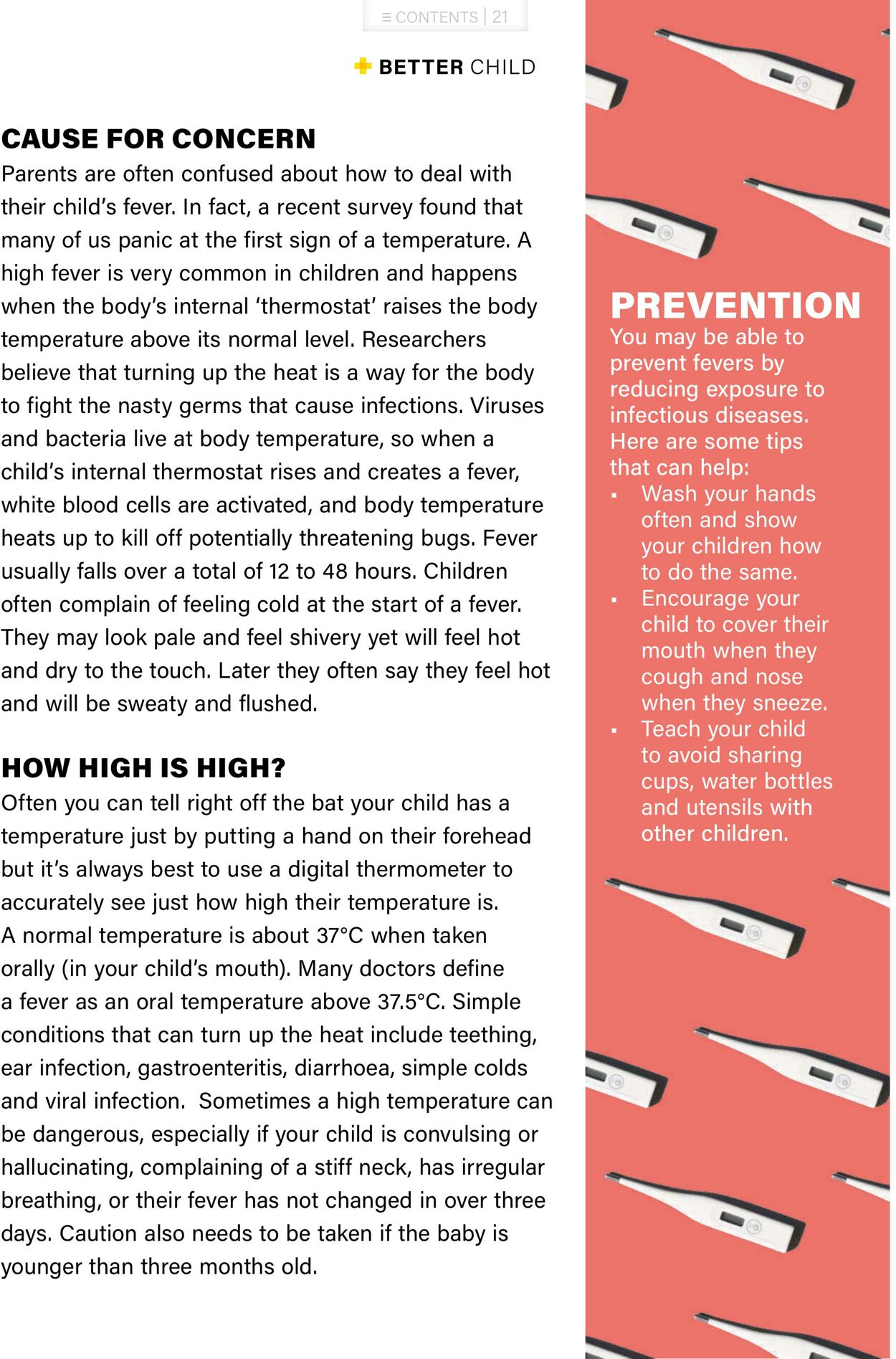
BETTER CHILD CAUSE FOR CONCERN Parents are often confused about how to deal with their child's fever. In fact, a recent survey found that many of us panic at the first sign of a temperature. A high fever is very common in children and happens when the body's internal ‘thermostat’ raises the body temperature above its normal level. Researchers believe that turning up the heat is a way for the body to fight the nasty germs that cause infections. Viruses and bacteria live at body temperature, so when a child’s internal thermostat rises and creates a fever, white blood cells are activated, and body temperature heats up to kill off potentially threatening bugs. Fever usually falls over a total of 12 to 48 hours. Children often complain of feeling cold at the start of a fever. They may look pale and feel shivery yet will feel hot and dry to the touch. Later they often say they feel hot and will be sweaty and flushed. HOW HIGH IS HIGH? Often you can tell right off the bat your child has a temperature just by putting a hand on their forehead but it's always best to use a digital thermometer to accurately see just how high their temperature is. A normal temperature is about 37°C when taken orally (in your child’s mouth). Many doctors define a fever as an oral temperature above 37.5°C. Simple conditions that can turn up the heat include teething, ear infection, gastroenteritis, diarrhoea, simple colds and viral infection. Sometimes a high temperature can be dangerous, especially if your child is convulsing or hallucinating, complaining of a stiff neck, has irregular breathing, or their fever has not changed in over three days. Caution also needs to be taken if the baby is younger than three months old. — we ~~ a, ee Mie


Latest specials

Advertisement
BETTER CHILD CAUSE FOR CONCERN Parents are often confused about how to deal with their child's fever. In fact, a recent survey found that many of us panic at the first sign of a temperature. A high fever is very common in children and happens when the body's internal ‘thermostat’ raises the body temperature above its normal level. Researchers believe that turning up the heat is a way for the body to fight the nasty germs that cause infections. Viruses and bacteria live at body temperature, so when a child’s internal thermostat rises and creates a fever, white blood cells are activated, and body temperature heats up to kill off potentially threatening bugs. Fever usually falls over a total of 12 to 48 hours. Children often complain of feeling cold at the start of a fever. They may look pale and feel shivery yet will feel hot and dry to the touch. Later they often say they feel hot and will be sweaty and flushed. HOW HIGH IS HIGH? Often you can tell right off the bat your child has a temperature just by putting a hand on their forehead but it's always best to use a digital thermometer to accurately see just how high their temperature is. A normal temperature is about 37°C when taken orally (in your child’s mouth). Many doctors define a fever as an oral temperature above 37.5°C. Simple conditions that can turn up the heat include teething, ear infection, gastroenteritis, diarrhoea, simple colds and viral infection. Sometimes a high temperature can be dangerous, especially if your child is convulsing or hallucinating, complaining of a stiff neck, has irregular breathing, or their fever has not changed in over three days. Caution also needs to be taken if the baby is younger than three months old. — we ~~ a, ee Mie

Advertisement
Advertisement

If you continue to browse this website, you accept the use of cookies.

Name Details