The query has to be between 2 and 50 characters

Advertisement
Advertisement

Current special Baby City - Valid from 19.05 to 19.06 - Page nb 45

Advertisement
Advertisement
Advertisement
Advertisement
Special Baby City 19.05.2025 - 19.06.2025
Special Boxer - GP May ME Special Stores 25 May, 2026 - 7 Jun, 2026
Boxer - GP May ME Special Stores
25 May, 2026 - 7 Jun, 2026
Special Boxer - Atlyn Mall Liquor Grand Opening 22 May, 2026 - 7 Jun, 2026
Boxer - Atlyn Mall Liquor Grand Opening
22 May, 2026 - 7 Jun, 2026
Special Boxer - GP May ME Special Stores 25 May, 2026 - 7 Jun, 2026
Boxer - GP May ME Special Stores
25 May, 2026 - 7 Jun, 2026
Special Boxer - GP May ME Liquor 25 May, 2026 - 7 Jun, 2026
Boxer - GP May ME Liquor
25 May, 2026 - 7 Jun, 2026
See next flyer
Advertisement
Advertisement
Advertisement

Products in this catalogue

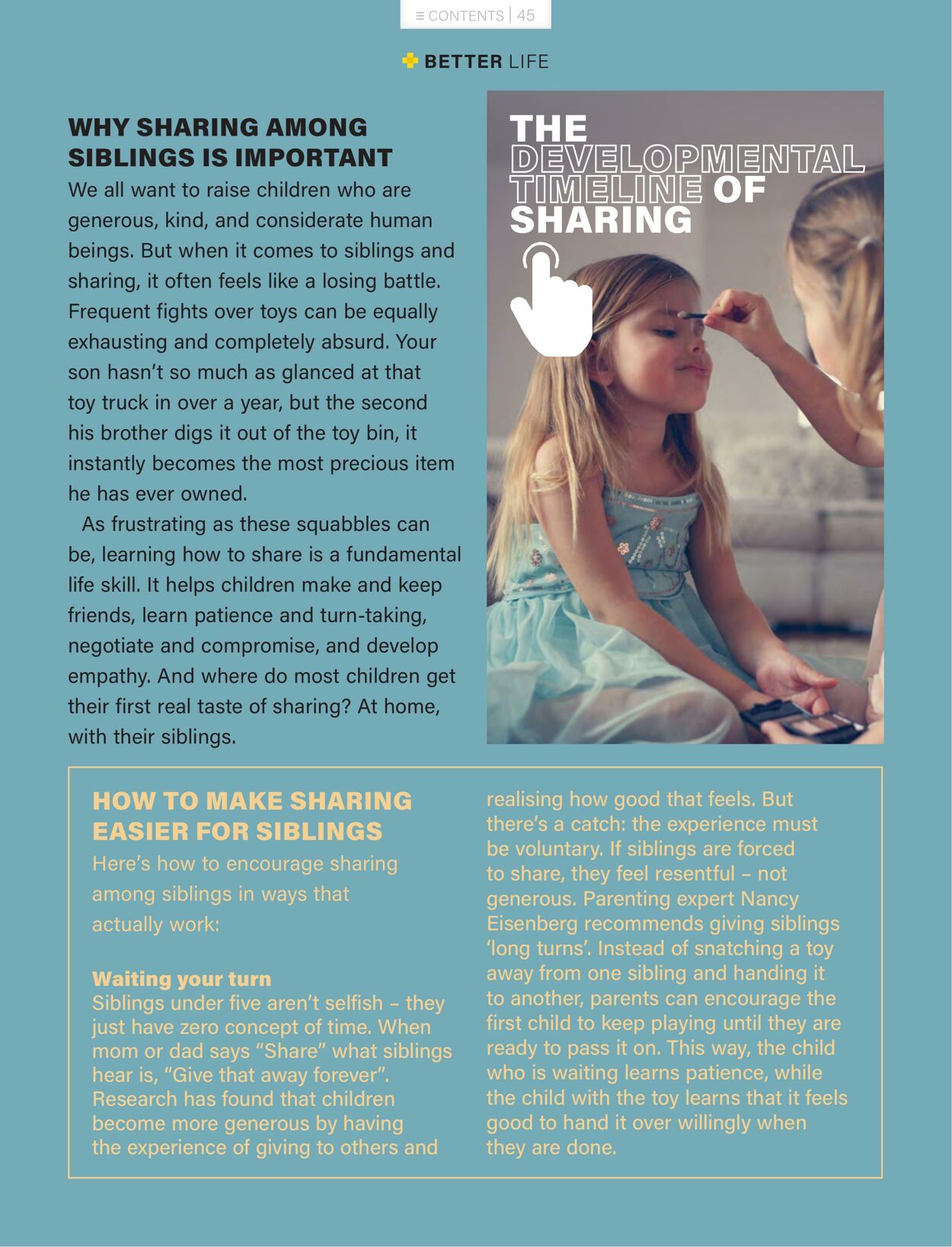
BETTER LIFE WHY SHARING AMONG SIBLINGS IS IMPORTANT We all want to raise children who are generous, kind, and considerate human beings. But when it comes to siblings and sharing, it often feels like a losing battle. Frequent fights over toys can be equally exhausting and completely absurd. Your son hasn't so much as glanced at that toy truck in over a year, but the second his brother digs it out of the toy bin, it instantly becomes the most precious item he has ever owned. As frustrating as these squabbles can be, learning how to share is a fundamental life skill. It helps children make and keep friends, learn patience and turn-taking, negotiate and compromise, and develop empathy. And where do most children get their first real taste of sharing? At home, with their siblings. HOW TO MAKE SHARING EASIER FOR SIBLINGS Here’s how to encourage sharing among siblings in ways that actually work: Waiting your turn hear is, “Give that away forever”. Research has found that children become more generous by having Siblings under five aren't selfish - they just have zero concept of time. When mom or dad says “Share” what siblings the experience of giving to others and realising how good that feels. But there's a catch: the experience must be voluntary, If siblings are forced to share, they feel resentful - not generous. Parenting expert Nancy Eisenberg recommends giving siblings ‘long turns’. Instead of snatching a toy away from one sibling and handing it to another, parents can encourage the first child to keep playing until they are ready to pass it on. This way, the child who is waiting learns patience, while the child with the toy learns that it feels good to hand it over willingly when they are done.


Latest specials

Advertisement
BETTER LIFE WHY SHARING AMONG SIBLINGS IS IMPORTANT We all want to raise children who are generous, kind, and considerate human beings. But when it comes to siblings and sharing, it often feels like a losing battle. Frequent fights over toys can be equally exhausting and completely absurd. Your son hasn't so much as glanced at that toy truck in over a year, but the second his brother digs it out of the toy bin, it instantly becomes the most precious item he has ever owned. As frustrating as these squabbles can be, learning how to share is a fundamental life skill. It helps children make and keep friends, learn patience and turn-taking, negotiate and compromise, and develop empathy. And where do most children get their first real taste of sharing? At home, with their siblings. HOW TO MAKE SHARING EASIER FOR SIBLINGS Here’s how to encourage sharing among siblings in ways that actually work: Waiting your turn hear is, “Give that away forever”. Research has found that children become more generous by having Siblings under five aren't selfish - they just have zero concept of time. When mom or dad says “Share” what siblings the experience of giving to others and realising how good that feels. But there's a catch: the experience must be voluntary, If siblings are forced to share, they feel resentful - not generous. Parenting expert Nancy Eisenberg recommends giving siblings ‘long turns’. Instead of snatching a toy away from one sibling and handing it to another, parents can encourage the first child to keep playing until they are ready to pass it on. This way, the child who is waiting learns patience, while the child with the toy learns that it feels good to hand it over willingly when they are done.

Advertisement
Advertisement

If you continue to browse this website, you accept the use of cookies.

Name Details