The query has to be between 2 and 50 characters
Advertisement
Advertisement

Current special Baby City - Valid from 19.05 to 19.06 - Page nb 29

Advertisement
Advertisement
Advertisement
Advertisement
Special Baby City 19.05.2025 - 19.06.2025
Special Game - Game : Winter Warmers (21 April - 31 July 2026) — www.guzzle.co.za 21 Apr, 2026 - 31 Jul, 2026
Game - Game : Winter Warmers (21 April - 31 July 2026) — www.guzzle.co.za
21 Apr, 2026 - 31 Jul, 2026
Special Game - Game : More 4 Less (01 May - 31 July 2026) — www.guzzle.co.za 1 May, 2026 - 31 Jul, 2026
Game - Game : More 4 Less (01 May - 31 July 2026) — www.guzzle.co.za
1 May, 2026 - 31 Jul, 2026
Special Boxer - Atlyn Mall Liquor Grand Opening 22 May, 2026 - 7 Jun, 2026
Boxer - Atlyn Mall Liquor Grand Opening
22 May, 2026 - 7 Jun, 2026
Special Boxer - Atlyn Mall Liquor Grand Opening 22 May, 2026 - 7 Jun, 2026
Boxer - Atlyn Mall Liquor Grand Opening
22 May, 2026 - 7 Jun, 2026
See next flyer
Advertisement
Advertisement
Advertisement

Products in this catalogue

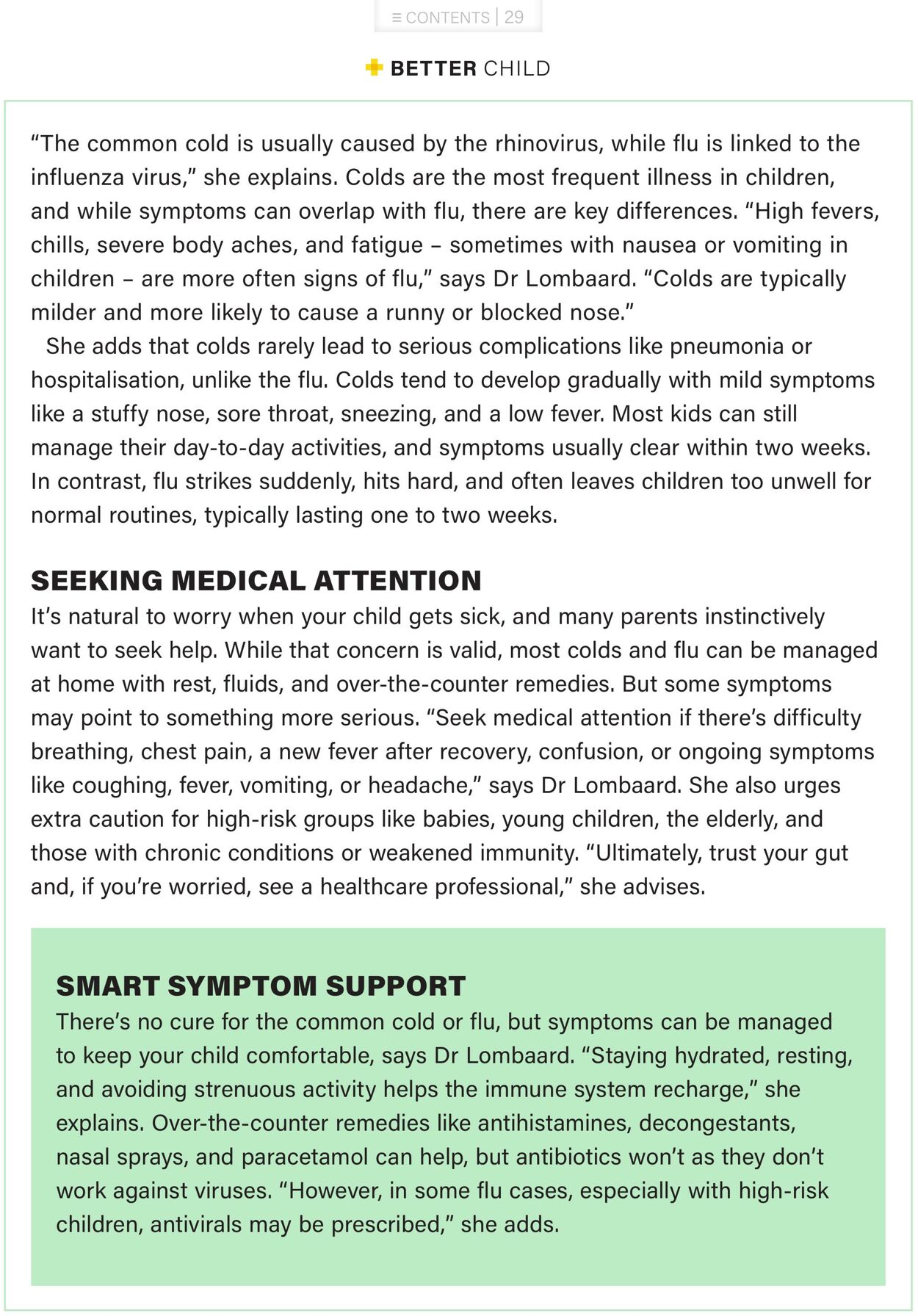
“* BETTER CHILD “The common cold is usually caused by the rhinovirus, while flu is linked to the influenza virus,” she explains. Colds are the most frequent illness in children, and while symptoms can overlap with flu, there are key differences. “High fevers, chills, severe body aches, and fatigue - sometimes with nausea or vomiting in children - are more often signs of flu,” says Dr Lombaard. “Colds are typically milder and more likely to cause a runny or blocked nose.” She adds that colds rarely lead to serious complications like pneumonia or hospitalisation, unlike the flu. Colds tend to develop gradually with mild symptoms like a stuffy nose, sore throat, sneezing, and a low fever. Most kids can still manage their day-to-day activities, and symptoms usually clear within two weeks. In contrast, flu strikes suddenly, hits hard, and often leaves children too unwell for normal routines, typically lasting one to two weeks. SEEKING MEDICAL ATTENTION It's natural to worry when your child gets sick, and many parents instinctively want to seek help. While that concern is valid, most colds and flu can be managed at home with rest, fluids, and over-the-counter remedies. But some symptoms may point to something more serious. “Seek medical attention if there’s difficulty breathing, chest pain, a new fever after recovery, confusion, or ongoing symptoms like coughing, fever, vomiting, or headache,” says Dr Lombaard. She also urges extra caution for high-risk groups like babies, young children, the elderly, and those with chronic conditions or weakened immunity. “Ultimately, trust your gut and, if you're worried, see a healthcare professional,” she advises. SMART SYMPTOM SUPPORT There's no cure for the common cold or flu, but symptoms can be managed to keep your child comfortable, says Dr Lombaard. “Staying hydrated, resting, and avoiding strenuous activity helps the immune system recharge,” she explains. Over-the-counter remedies like antihistamines, decongestants, nasal sprays, and paracetamol can help, but antibiotics won't as they don't work against viruses. “However, in some flu cases, especially with high-risk children, antivirals may be prescribed,” she adds.


Latest specials

Advertisement
“* BETTER CHILD “The common cold is usually caused by the rhinovirus, while flu is linked to the influenza virus,” she explains. Colds are the most frequent illness in children, and while symptoms can overlap with flu, there are key differences. “High fevers, chills, severe body aches, and fatigue - sometimes with nausea or vomiting in children - are more often signs of flu,” says Dr Lombaard. “Colds are typically milder and more likely to cause a runny or blocked nose.” She adds that colds rarely lead to serious complications like pneumonia or hospitalisation, unlike the flu. Colds tend to develop gradually with mild symptoms like a stuffy nose, sore throat, sneezing, and a low fever. Most kids can still manage their day-to-day activities, and symptoms usually clear within two weeks. In contrast, flu strikes suddenly, hits hard, and often leaves children too unwell for normal routines, typically lasting one to two weeks. SEEKING MEDICAL ATTENTION It's natural to worry when your child gets sick, and many parents instinctively want to seek help. While that concern is valid, most colds and flu can be managed at home with rest, fluids, and over-the-counter remedies. But some symptoms may point to something more serious. “Seek medical attention if there’s difficulty breathing, chest pain, a new fever after recovery, confusion, or ongoing symptoms like coughing, fever, vomiting, or headache,” says Dr Lombaard. She also urges extra caution for high-risk groups like babies, young children, the elderly, and those with chronic conditions or weakened immunity. “Ultimately, trust your gut and, if you're worried, see a healthcare professional,” she advises. SMART SYMPTOM SUPPORT There's no cure for the common cold or flu, but symptoms can be managed to keep your child comfortable, says Dr Lombaard. “Staying hydrated, resting, and avoiding strenuous activity helps the immune system recharge,” she explains. Over-the-counter remedies like antihistamines, decongestants, nasal sprays, and paracetamol can help, but antibiotics won't as they don't work against viruses. “However, in some flu cases, especially with high-risk children, antivirals may be prescribed,” she adds.

Advertisement
Advertisement

If you continue to browse this website, you accept the use of cookies.

Name Details