The query has to be between 2 and 50 characters

Advertisement
Advertisement

Current special Baby City - Valid from 01.11 to 30.11 - Page nb 31

Advertisement
Advertisement
Advertisement
Advertisement
Special Baby City 01.11.2025 - 30.11.2025
Special Boxer - GP May ME 25 May, 2026 - 7 Jun, 2026
Boxer - GP May ME
25 May, 2026 - 7 Jun, 2026
Special Game - Game : The Game Changer (25 May - 20 July 2026) — www.guzzle.co.za 25 May, 2026 - 20 Jul, 2026
Game - Game : The Game Changer (25 May - 20 July 2026) — www.guzzle.co.za
25 May, 2026 - 20 Jul, 2026
Special Boxer - GP May ME Liquor 25 May, 2026 - 7 Jun, 2026
Boxer - GP May ME Liquor
25 May, 2026 - 7 Jun, 2026
Special Boxer - Atlyn Mall Liquor Grand Opening 25 May, 2026 - 7 Jun, 2026
Boxer - Atlyn Mall Liquor Grand Opening
25 May, 2026 - 7 Jun, 2026
See next flyer
Advertisement
Advertisement
Advertisement

Products in this catalogue

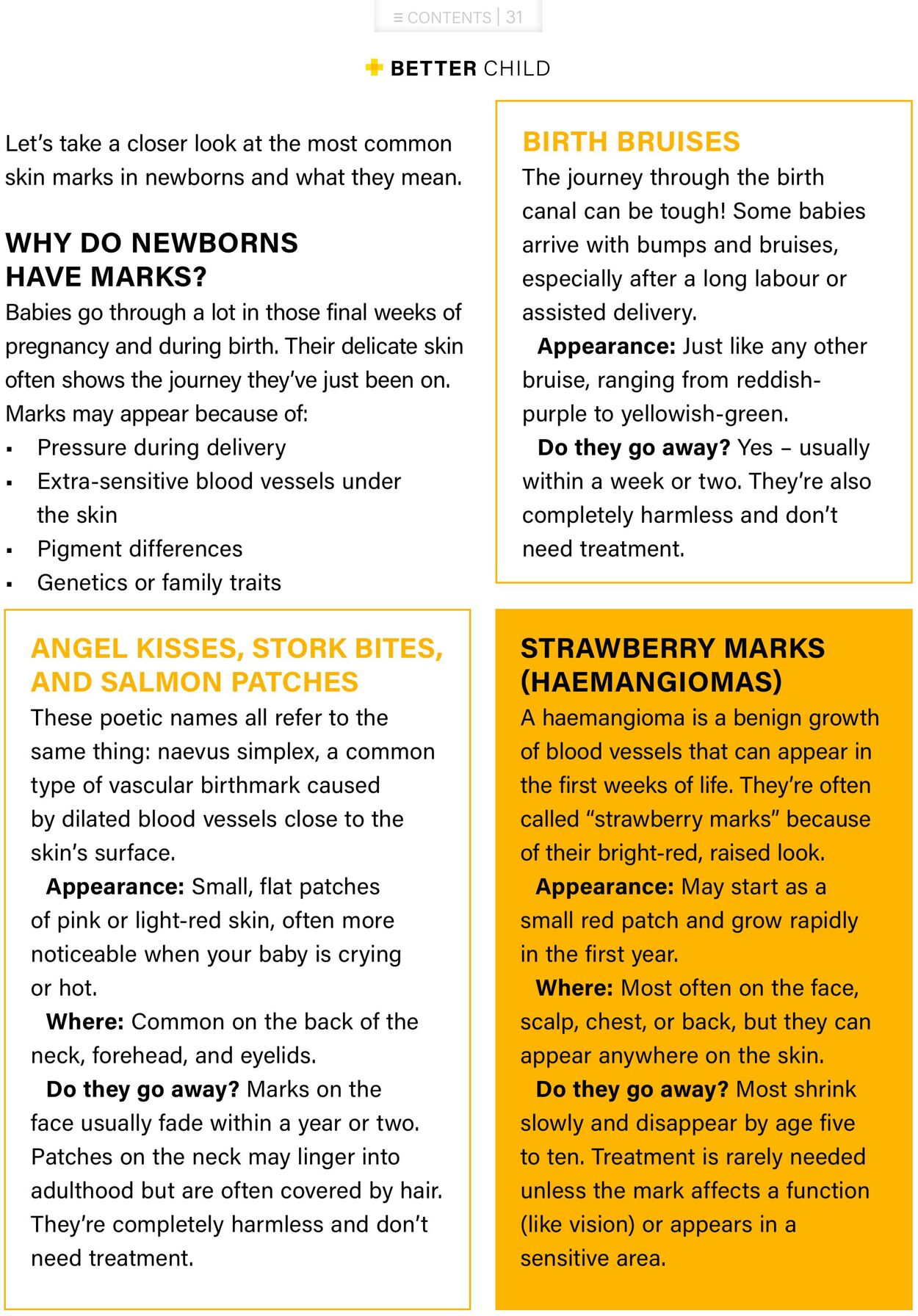
BETTER CHILD Let's take a closer look at the most common skin marks in newborns and what they mean. WHY DO NEWBORNS HAVE MARKS? Babies go through a lot in those final weeks of pregnancy and during birth. Their delicate skin often shows the journey they've just been on. Marks may appear because of: Pressure during delivery Extra-sensitive blood vessels under the skin Pigment differences Genetics or family traits These poetic names all refer to the same thing: naevus simplex, a common type of vascular birthmark caused by dilated blood vessels close to the skin's surface. Appearance: Small, flat patches of pink or light-red skin, often more noticeable when your baby is crying or hot. Where: Common on the back of the neck, forehead, and eyelids. Do they go away? Marks on the face usually fade within a year or two. Patches on the neck may linger into adulthood but are often covered by hair. They're completely harmless and don't need treatment. The journey through the birth canal can be tough! Some babies arrive with bumps and bruises, especially after a long labour or assisted delivery. Appearance: Just like any other bruise, ranging from reddish- purple to yellowish-green. Do they go away? Yes - usually within a week or two. They're also completely harmless and don't need treatment. STRAWBERRY MARKS (HAEMANGIOMAS) A haemangioma is a benign growth of blood vessels that can appear in the first weeks of life. They're often called “strawberry marks” because of their bright-red, raised look. Appearance: May start as a small red patch and grow rapidly in the first year. Where: Most often on the face, scalp, chest, or back, but they can appear anywhere on the skin. Do they go away? Most shrink slowly and disappear by age five to ten. Treatment is rarely needed unless the mark affects a function (like vision) or appears in a sensitive area.


Latest specials

Advertisement
BETTER CHILD Let's take a closer look at the most common skin marks in newborns and what they mean. WHY DO NEWBORNS HAVE MARKS? Babies go through a lot in those final weeks of pregnancy and during birth. Their delicate skin often shows the journey they've just been on. Marks may appear because of: Pressure during delivery Extra-sensitive blood vessels under the skin Pigment differences Genetics or family traits These poetic names all refer to the same thing: naevus simplex, a common type of vascular birthmark caused by dilated blood vessels close to the skin's surface. Appearance: Small, flat patches of pink or light-red skin, often more noticeable when your baby is crying or hot. Where: Common on the back of the neck, forehead, and eyelids. Do they go away? Marks on the face usually fade within a year or two. Patches on the neck may linger into adulthood but are often covered by hair. They're completely harmless and don't need treatment. The journey through the birth canal can be tough! Some babies arrive with bumps and bruises, especially after a long labour or assisted delivery. Appearance: Just like any other bruise, ranging from reddish- purple to yellowish-green. Do they go away? Yes - usually within a week or two. They're also completely harmless and don't need treatment. STRAWBERRY MARKS (HAEMANGIOMAS) A haemangioma is a benign growth of blood vessels that can appear in the first weeks of life. They're often called “strawberry marks” because of their bright-red, raised look. Appearance: May start as a small red patch and grow rapidly in the first year. Where: Most often on the face, scalp, chest, or back, but they can appear anywhere on the skin. Do they go away? Most shrink slowly and disappear by age five to ten. Treatment is rarely needed unless the mark affects a function (like vision) or appears in a sensitive area.

Advertisement
Advertisement

If you continue to browse this website, you accept the use of cookies.

Name Details