The query has to be between 2 and 50 characters

Advertisement
Advertisement

Current special Baby City - Valid from 01.10 to 31.10 - Page nb 10

Advertisement
Advertisement
Advertisement
Advertisement
Special Baby City 01.10.2025 - 31.10.2025
Special Boxer - GP May ME Liquor Special Stores 25 May, 2026 - 7 Jun, 2026
Boxer - GP May ME Liquor Special Stores
25 May, 2026 - 7 Jun, 2026
Special Game - Game : Winter Warmers (21 April - 31 July 2026) — www.guzzle.co.za 21 Apr, 2026 - 31 Jul, 2026
Game - Game : Winter Warmers (21 April - 31 July 2026) — www.guzzle.co.za
21 Apr, 2026 - 31 Jul, 2026
Special Spar - SuperSpar - Valid until 07 Jun, SA only 25 May, 2026 - 7 Jun, 2026
Spar - SuperSpar - Valid until 07 Jun, SA only
25 May, 2026 - 7 Jun, 2026
Special Boxer - GP May ME 25 May, 2026 - 7 Jun, 2026
Boxer - GP May ME
25 May, 2026 - 7 Jun, 2026
See next flyer
Advertisement
Advertisement
Advertisement

Products in this catalogue

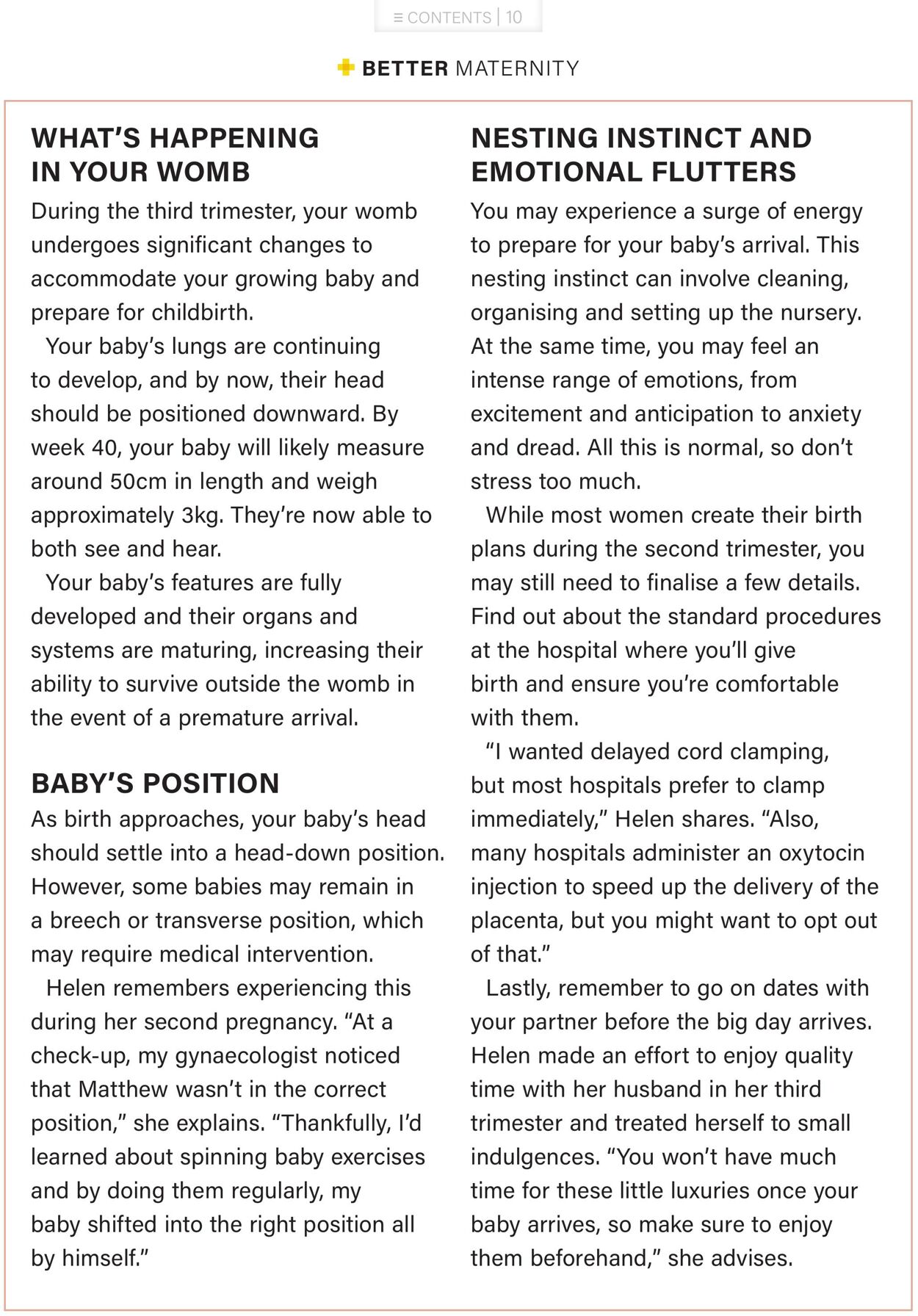
“» BETTER MATERNITY WHAT'S HAPPENING IN YOUR WOMB During the third trimester, your womb undergoes significant changes to accommodate your growing baby and prepare for childbirth. Your baby’s lungs are continuing to develop, and by now, their head should be positioned downward. By week 40, your baby will likely measure around 50cm in length and weigh approximately 3kg. They’re now able to both see and hear. Your baby’s features are fully developed and their organs and systems are maturing, increasing their ability to survive outside the womb in the event of a premature arrival. BABY’S POSITION As birth approaches, your baby’s head should settle into a head-down position. However, some babies may remain in a breech or transverse position, which may require medical intervention. Helen remembers experiencing this during her second pregnancy. “At a check-up, my gynaecologist noticed that Matthew wasn’t in the correct position,” she explains. “Thankfully, I'd learned about spinning baby exercises and by doing them regularly, my baby shifted into the right position all by himself.” NESTING INSTINCT AND EMOTIONAL FLUTTERS You may experience a surge of energy to prepare for your baby’s arrival. This nesting instinct can involve cleaning, organising and setting up the nursery. At the same time, you may feel an intense range of emotions, from excitement and anticipation to anxiety and dread. All this is normal, so don't stress too much. While most women create their birth plans during the second trimester, you may still need to finalise a few details. Find out about the standard procedures at the hospital where you'll give birth and ensure you're comfortable with them. “| wanted delayed cord clamping, but most hospitals prefer to clamp immediately,” Helen shares. “Also, many hospitals administer an oxytocin injection to speed up the delivery of the placenta, but you might want to opt out of that.” Lastly, remember to go on dates with your partner before the big day arrives. Helen made an effort to enjoy quality time with her husband in her third trimester and treated herself to small indulgences. “You won't have much time for these little luxuries once your baby arrives, so make sure to enjoy them beforehand,” she advises.


Latest specials

Advertisement
“» BETTER MATERNITY WHAT'S HAPPENING IN YOUR WOMB During the third trimester, your womb undergoes significant changes to accommodate your growing baby and prepare for childbirth. Your baby’s lungs are continuing to develop, and by now, their head should be positioned downward. By week 40, your baby will likely measure around 50cm in length and weigh approximately 3kg. They’re now able to both see and hear. Your baby’s features are fully developed and their organs and systems are maturing, increasing their ability to survive outside the womb in the event of a premature arrival. BABY’S POSITION As birth approaches, your baby’s head should settle into a head-down position. However, some babies may remain in a breech or transverse position, which may require medical intervention. Helen remembers experiencing this during her second pregnancy. “At a check-up, my gynaecologist noticed that Matthew wasn’t in the correct position,” she explains. “Thankfully, I'd learned about spinning baby exercises and by doing them regularly, my baby shifted into the right position all by himself.” NESTING INSTINCT AND EMOTIONAL FLUTTERS You may experience a surge of energy to prepare for your baby’s arrival. This nesting instinct can involve cleaning, organising and setting up the nursery. At the same time, you may feel an intense range of emotions, from excitement and anticipation to anxiety and dread. All this is normal, so don't stress too much. While most women create their birth plans during the second trimester, you may still need to finalise a few details. Find out about the standard procedures at the hospital where you'll give birth and ensure you're comfortable with them. “| wanted delayed cord clamping, but most hospitals prefer to clamp immediately,” Helen shares. “Also, many hospitals administer an oxytocin injection to speed up the delivery of the placenta, but you might want to opt out of that.” Lastly, remember to go on dates with your partner before the big day arrives. Helen made an effort to enjoy quality time with her husband in her third trimester and treated herself to small indulgences. “You won't have much time for these little luxuries once your baby arrives, so make sure to enjoy them beforehand,” she advises.

Advertisement
Advertisement

If you continue to browse this website, you accept the use of cookies.

Name Details