The query has to be between 2 and 50 characters

Advertisement
Advertisement

Current special Baby City - Valid from 01.10 to 31.10 - Page nb 7

Advertisement
Advertisement
Advertisement
Advertisement
Special Baby City 01.10.2025 - 31.10.2025
Special Boxer - Atlyn Mall Liquor Grand Opening 22 May, 2026 - 7 Jun, 2026
Boxer - Atlyn Mall Liquor Grand Opening
22 May, 2026 - 7 Jun, 2026
Special Boxer - Atlyn Mall Liquor Grand Opening 25 May, 2026 - 7 Jun, 2026
Boxer - Atlyn Mall Liquor Grand Opening
25 May, 2026 - 7 Jun, 2026
Special Game - Game : The Game Changer (25 May - 20 July 2026) — www.guzzle.co.za 25 May, 2026 - 20 Jul, 2026
Game - Game : The Game Changer (25 May - 20 July 2026) — www.guzzle.co.za
25 May, 2026 - 20 Jul, 2026
Special Boxer - Atlyn Mall Liquor Grand Opening 22 May, 2026 - 7 Jun, 2026
Boxer - Atlyn Mall Liquor Grand Opening
22 May, 2026 - 7 Jun, 2026
See next flyer
Advertisement
Advertisement
Advertisement

Products in this catalogue

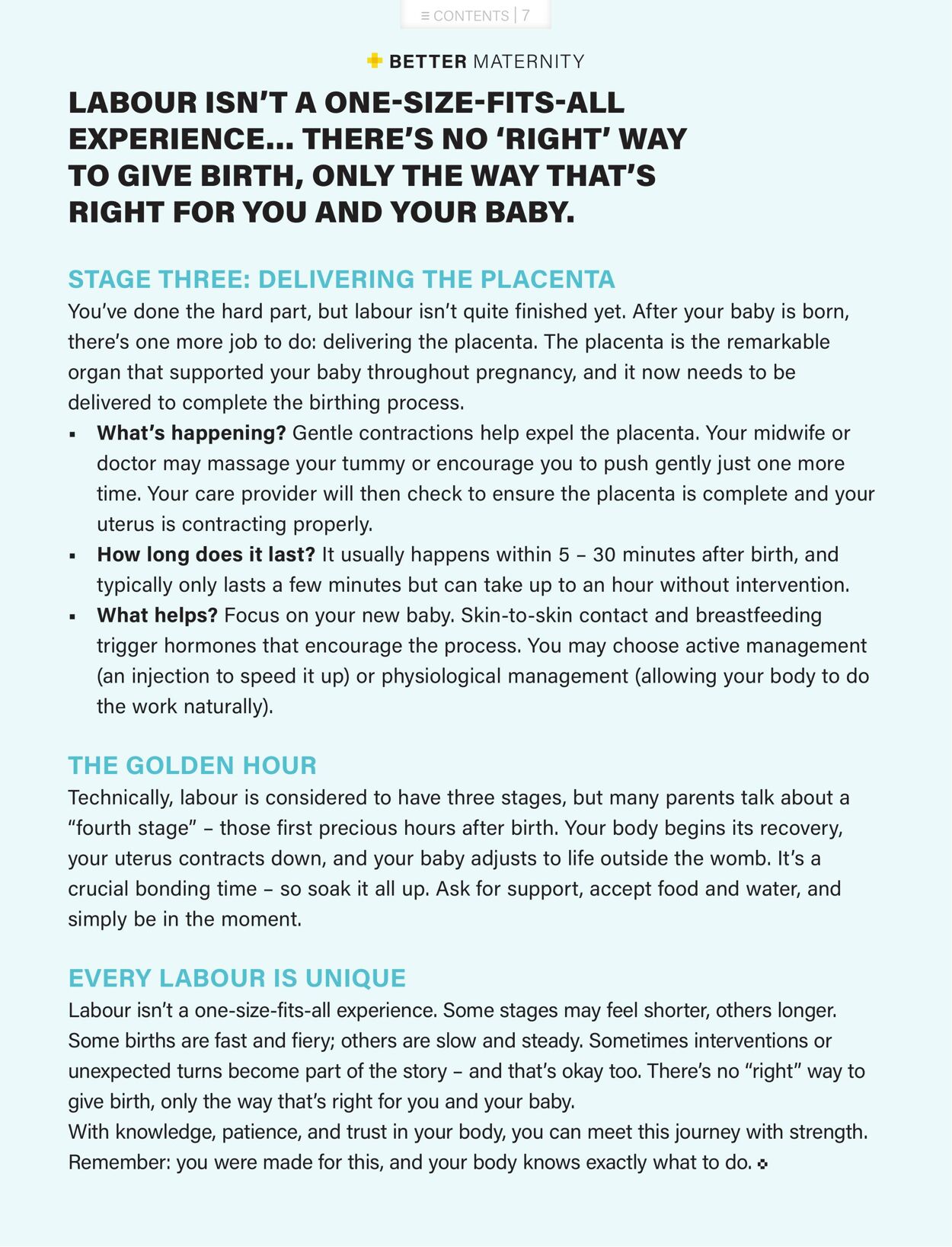
“» BETTER MATERNITY LABOUR ISN'T A ONE-SIZE-FITS-ALL EXPERIENCE... THERE’S NO ‘RIGHT’ WAY TO GIVE BIRTH, ONLY THE WAY THAT’S RIGHT FOR YOU AND YOUR BABY. STAGE THREE: DELIVERING THE PLACENTA You've done the hard part, but labour isn’t quite finished yet. After your baby is born, there's one more job to do: delivering the placenta. The placenta is the remarkable organ that supported your baby throughout pregnancy, and it now needs to be delivered to complete the birthing process. » What's happening? Gentle contractions help expel the placenta. Your midwife or doctor may massage your tummy or encourage you to push gently just one more time. Your care provider will then check to ensure the placenta is complete and your uterus is contracting properly. » How long does it last? It usually happens within 5 - 30 minutes after birth, and typically only lasts a few minutes but can take up to an hour without intervention. » What helps? Focus on your new baby. Skin-to-skin contact and breastfeeding trigger hormones that encourage the process. You may choose active management (an injection to speed it up) or physiological management (allowing your body to do the work naturally). THE GOLDEN HOUR Technically, labour is considered to have three stages, but many parents talk about a “fourth stage” - those first precious hours after birth. Your body begins its recovery, your uterus contracts down, and your baby adjusts to life outside the womb. It’s a crucial bonding time - so soak it all up. Ask for support, accept food and water, and simply be in the moment. EVERY LABOUR IS UNIQUE Labour isn’t a one-size-fits-all experience. Some stages may feel shorter, others longer. Some births are fast and fiery; others are slow and steady. Sometimes interventions or unexpected turns become part of the story - and that's okay too. There's no “right” way to give birth, only the way that’s right for you and your baby. With knowledge, patience, and trust in your body, you can meet this journey with strength. Remember: you were made for this, and your body knows exactly what to do. =


Latest specials

Advertisement
“» BETTER MATERNITY LABOUR ISN'T A ONE-SIZE-FITS-ALL EXPERIENCE... THERE’S NO ‘RIGHT’ WAY TO GIVE BIRTH, ONLY THE WAY THAT’S RIGHT FOR YOU AND YOUR BABY. STAGE THREE: DELIVERING THE PLACENTA You've done the hard part, but labour isn’t quite finished yet. After your baby is born, there's one more job to do: delivering the placenta. The placenta is the remarkable organ that supported your baby throughout pregnancy, and it now needs to be delivered to complete the birthing process. » What's happening? Gentle contractions help expel the placenta. Your midwife or doctor may massage your tummy or encourage you to push gently just one more time. Your care provider will then check to ensure the placenta is complete and your uterus is contracting properly. » How long does it last? It usually happens within 5 - 30 minutes after birth, and typically only lasts a few minutes but can take up to an hour without intervention. » What helps? Focus on your new baby. Skin-to-skin contact and breastfeeding trigger hormones that encourage the process. You may choose active management (an injection to speed it up) or physiological management (allowing your body to do the work naturally). THE GOLDEN HOUR Technically, labour is considered to have three stages, but many parents talk about a “fourth stage” - those first precious hours after birth. Your body begins its recovery, your uterus contracts down, and your baby adjusts to life outside the womb. It’s a crucial bonding time - so soak it all up. Ask for support, accept food and water, and simply be in the moment. EVERY LABOUR IS UNIQUE Labour isn’t a one-size-fits-all experience. Some stages may feel shorter, others longer. Some births are fast and fiery; others are slow and steady. Sometimes interventions or unexpected turns become part of the story - and that's okay too. There's no “right” way to give birth, only the way that’s right for you and your baby. With knowledge, patience, and trust in your body, you can meet this journey with strength. Remember: you were made for this, and your body knows exactly what to do. =

Advertisement
Advertisement

If you continue to browse this website, you accept the use of cookies.

Name Details