The query has to be between 2 and 50 characters

Advertisement
Advertisement

Current special Baby City - Valid from 01.06 to 30.06 - Page nb 25

Advertisement
Advertisement
Advertisement
Advertisement
Special Baby City 01.06.2025 - 30.06.2025
Special Boxer - GP May ME Liquor Special Stores 25 May, 2026 - 7 Jun, 2026
Boxer - GP May ME Liquor Special Stores
25 May, 2026 - 7 Jun, 2026
Special Boxer - GP May ME Special Stores 25 May, 2026 - 7 Jun, 2026
Boxer - GP May ME Special Stores
25 May, 2026 - 7 Jun, 2026
Special Game - Game : Winter Warmers (21 April - 31 July 2026) — www.guzzle.co.za 21 Apr, 2026 - 31 Jul, 2026
Game - Game : Winter Warmers (21 April - 31 July 2026) — www.guzzle.co.za
21 Apr, 2026 - 31 Jul, 2026
Special Boxer - GP May ME Liquor 25 May, 2026 - 7 Jun, 2026
Boxer - GP May ME Liquor
25 May, 2026 - 7 Jun, 2026
See next flyer
Advertisement
Advertisement
Advertisement

Products in this catalogue

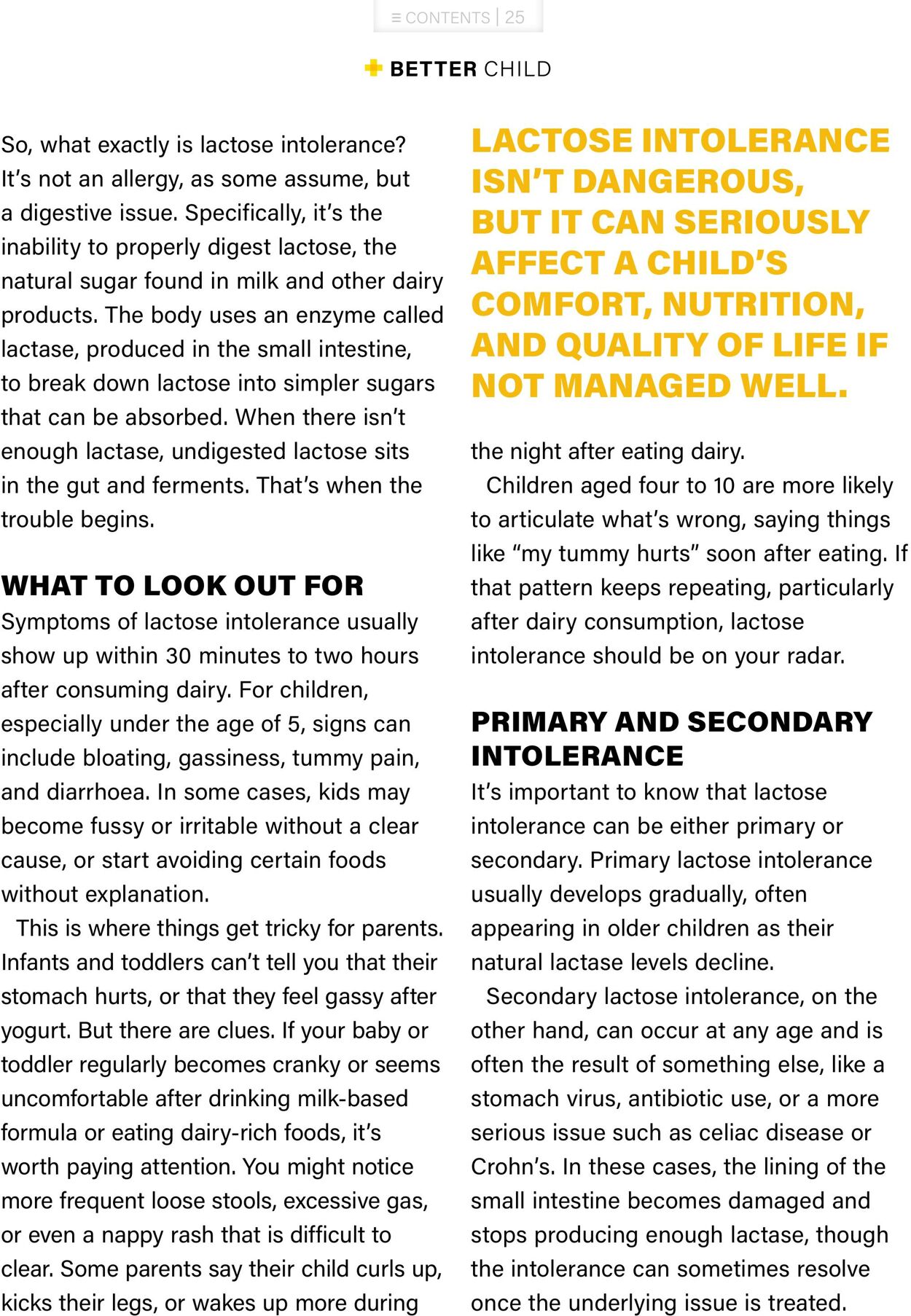
*» BETTER CHILD So, what exactly is lactose intolerance? It's not an allergy, as some assume, but a digestive issue. Specifically, it’s the inability to properly digest lactose, the natural sugar found in milk and other dairy products. The body uses an enzyme called lactase, produced in the small intestine, to break down lactose into simpler sugars that can be absorbed. When there isn't enough lactase, undigested lactose sits in the gut and ferments. That's when the trouble begins. WHAT TO LOOK OUT FOR Symptoms of lactose intolerance usually show up within 30 minutes to two hours after consuming dairy. For children, especially under the age of 5, signs can include bloating, gassiness, tummy pain, and diarrhoea. In some cases, kids may become fussy or irritable without a clear cause, or start avoiding certain foods without explanation. This is where things get tricky for parents. Infants and toddlers can't tell you that their stomach hurts, or that they feel gassy after yogurt. But there are clues. If your baby or toddler regularly becomes cranky or seems uncomfortable after drinking milk-based formula or eating dairy-rich foods, it's worth paying attention. You might notice more frequent loose stools, excessive gas, or even a nappy rash that is difficult to clear. Some parents say their child curls up, kicks their legs, or wakes up more during LACTOSE INTOLERANCE ISN’T DANGEROUS, BUT IT CAN SERIOUSLY AFFECT A CHILD’S COMFORT, NUTRITION, AND QUALITY OF LIFE IF NOT MANAGED WELL. the night after eating dairy. Children aged four to 10 are more likely to articulate what’s wrong, saying things like “my tummy hurts” soon after eating. If that pattern keeps repeating, particularly after dairy consumption, lactose intolerance should be on your radar. PRIMARY AND SECONDARY INTOLERANCE It's important to know that lactose intolerance can be either primary or secondary. Primary lactose intolerance usually develops gradually, often appearing in older children as their natural lactase levels decline. Secondary lactose intolerance, on the other hand, can occur at any age and is often the result of something else, like a stomach virus, antibiotic use, or a more serious issue such as celiac disease or Crohn's. In these cases, the lining of the small intestine becomes damaged and stops producing enough lactase, though the intolerance can sometimes resolve once the underlying issue is treated.


Latest specials

Advertisement
*» BETTER CHILD So, what exactly is lactose intolerance? It's not an allergy, as some assume, but a digestive issue. Specifically, it’s the inability to properly digest lactose, the natural sugar found in milk and other dairy products. The body uses an enzyme called lactase, produced in the small intestine, to break down lactose into simpler sugars that can be absorbed. When there isn't enough lactase, undigested lactose sits in the gut and ferments. That's when the trouble begins. WHAT TO LOOK OUT FOR Symptoms of lactose intolerance usually show up within 30 minutes to two hours after consuming dairy. For children, especially under the age of 5, signs can include bloating, gassiness, tummy pain, and diarrhoea. In some cases, kids may become fussy or irritable without a clear cause, or start avoiding certain foods without explanation. This is where things get tricky for parents. Infants and toddlers can't tell you that their stomach hurts, or that they feel gassy after yogurt. But there are clues. If your baby or toddler regularly becomes cranky or seems uncomfortable after drinking milk-based formula or eating dairy-rich foods, it's worth paying attention. You might notice more frequent loose stools, excessive gas, or even a nappy rash that is difficult to clear. Some parents say their child curls up, kicks their legs, or wakes up more during LACTOSE INTOLERANCE ISN’T DANGEROUS, BUT IT CAN SERIOUSLY AFFECT A CHILD’S COMFORT, NUTRITION, AND QUALITY OF LIFE IF NOT MANAGED WELL. the night after eating dairy. Children aged four to 10 are more likely to articulate what’s wrong, saying things like “my tummy hurts” soon after eating. If that pattern keeps repeating, particularly after dairy consumption, lactose intolerance should be on your radar. PRIMARY AND SECONDARY INTOLERANCE It's important to know that lactose intolerance can be either primary or secondary. Primary lactose intolerance usually develops gradually, often appearing in older children as their natural lactase levels decline. Secondary lactose intolerance, on the other hand, can occur at any age and is often the result of something else, like a stomach virus, antibiotic use, or a more serious issue such as celiac disease or Crohn's. In these cases, the lining of the small intestine becomes damaged and stops producing enough lactase, though the intolerance can sometimes resolve once the underlying issue is treated.

Advertisement
Advertisement

If you continue to browse this website, you accept the use of cookies.

Name Details