The query has to be between 2 and 50 characters

Advertisement
Advertisement

Current special Baby City - Valid from 19.05 to 19.06 - Page nb 53

Advertisement
Advertisement
Advertisement
Advertisement
Special Baby City 19.05.2025 - 19.06.2025
Special Boxer - GP May ME Liquor Special Stores 25 May, 2026 - 7 Jun, 2026
Boxer - GP May ME Liquor Special Stores
25 May, 2026 - 7 Jun, 2026
Special Spar - SuperSpar - Valid until 07 Jun, SA only 25 May, 2026 - 7 Jun, 2026
Spar - SuperSpar - Valid until 07 Jun, SA only
25 May, 2026 - 7 Jun, 2026
Special Boxer - GP May ME 25 May, 2026 - 7 Jun, 2026
Boxer - GP May ME
25 May, 2026 - 7 Jun, 2026
Special Boxer - GP May ME Liquor 25 May, 2026 - 7 Jun, 2026
Boxer - GP May ME Liquor
25 May, 2026 - 7 Jun, 2026
See next flyer
Advertisement
Advertisement
Advertisement

Products in this catalogue

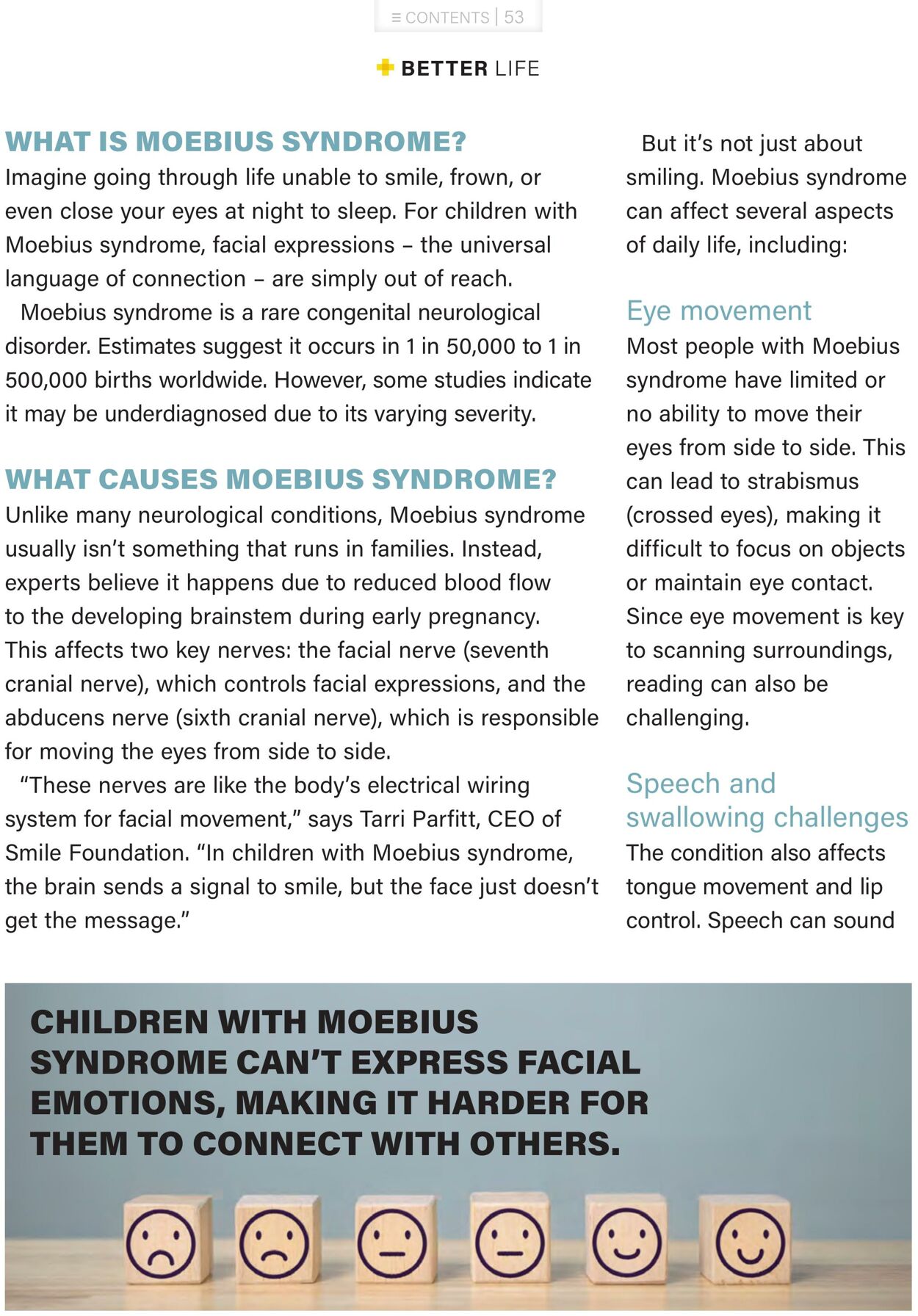
BETTER LIFE WHAT IS MOEBIUS SYNDROME? Imagine going through life unable to smile, frown, or even close your eyes at night to sleep. For children with Moebius syndrome, facial expressions - the universal language of connection - are simply out of reach. Moebius syndrome is a rare congenital neurological disorder. Estimates suggest it occurs in 1 in 50,000 to 1 in 500,000 births worldwide. However, some studies indicate it may be underdiagnosed due to its varying severity. WHAT CAUSES MOEBIUS SYNDROME? Unlike many neurological conditions, Moebius syndrome usually isn't something that runs in families. Instead, experts believe it happens due to reduced blood flow to the developing brainstem during early pregnancy. This affects two key nerves: the facial nerve (seventh cranial nerve), which controls facial expressions, and the abducens nerve (sixth cranial nerve), which is responsible for moving the eyes from side to side. “These nerves are like the body’s electrical wiring system for facial movement,” says Tarri Parfitt, CEO of Smile Foundation. “In children with Moebius syndrome, the brain sends a signal to smile, but the face just doesn't get the message.” But it's not just about smiling. Moebius syndrome can affect several aspects of daily life, including: Eye movement Most people with Moebius syndrome have limited or no ability to move their eyes from side to side. This can lead to strabismus (crossed eyes), making it difficult to focus on objects or maintain eye contact. Since eye movement is key to scanning surroundings, reading can also be challenging. Speech and swallowing challenges The condition also affects tongue movement and lip control. Speech can sound


Latest specials

Advertisement
BETTER LIFE WHAT IS MOEBIUS SYNDROME? Imagine going through life unable to smile, frown, or even close your eyes at night to sleep. For children with Moebius syndrome, facial expressions - the universal language of connection - are simply out of reach. Moebius syndrome is a rare congenital neurological disorder. Estimates suggest it occurs in 1 in 50,000 to 1 in 500,000 births worldwide. However, some studies indicate it may be underdiagnosed due to its varying severity. WHAT CAUSES MOEBIUS SYNDROME? Unlike many neurological conditions, Moebius syndrome usually isn't something that runs in families. Instead, experts believe it happens due to reduced blood flow to the developing brainstem during early pregnancy. This affects two key nerves: the facial nerve (seventh cranial nerve), which controls facial expressions, and the abducens nerve (sixth cranial nerve), which is responsible for moving the eyes from side to side. “These nerves are like the body’s electrical wiring system for facial movement,” says Tarri Parfitt, CEO of Smile Foundation. “In children with Moebius syndrome, the brain sends a signal to smile, but the face just doesn't get the message.” But it's not just about smiling. Moebius syndrome can affect several aspects of daily life, including: Eye movement Most people with Moebius syndrome have limited or no ability to move their eyes from side to side. This can lead to strabismus (crossed eyes), making it difficult to focus on objects or maintain eye contact. Since eye movement is key to scanning surroundings, reading can also be challenging. Speech and swallowing challenges The condition also affects tongue movement and lip control. Speech can sound

Advertisement
Advertisement

If you continue to browse this website, you accept the use of cookies.

Name Details