The query has to be between 2 and 50 characters

Advertisement
Advertisement

Current special Baby City - Valid from 19.05 to 19.06 - Page nb 5

Advertisement
Advertisement
Advertisement
Advertisement
Special Baby City 19.05.2025 - 19.06.2025
Special Game - Game : More 4 Less (01 May - 31 July 2026) — www.guzzle.co.za 1 May, 2026 - 31 Jul, 2026
Game - Game : More 4 Less (01 May - 31 July 2026) — www.guzzle.co.za
1 May, 2026 - 31 Jul, 2026
Special Boxer - GP May ME Liquor 25 May, 2026 - 7 Jun, 2026
Boxer - GP May ME Liquor
25 May, 2026 - 7 Jun, 2026
Special Boxer - GP May ME Liquor 25 May, 2026 - 7 Jun, 2026
Boxer - GP May ME Liquor
25 May, 2026 - 7 Jun, 2026
Special Spar - SuperSpar - Valid until 07 Jun, SA only 25 May, 2026 - 7 Jun, 2026
Spar - SuperSpar - Valid until 07 Jun, SA only
25 May, 2026 - 7 Jun, 2026
See next flyer
Advertisement
Advertisement
Advertisement

Products in this catalogue

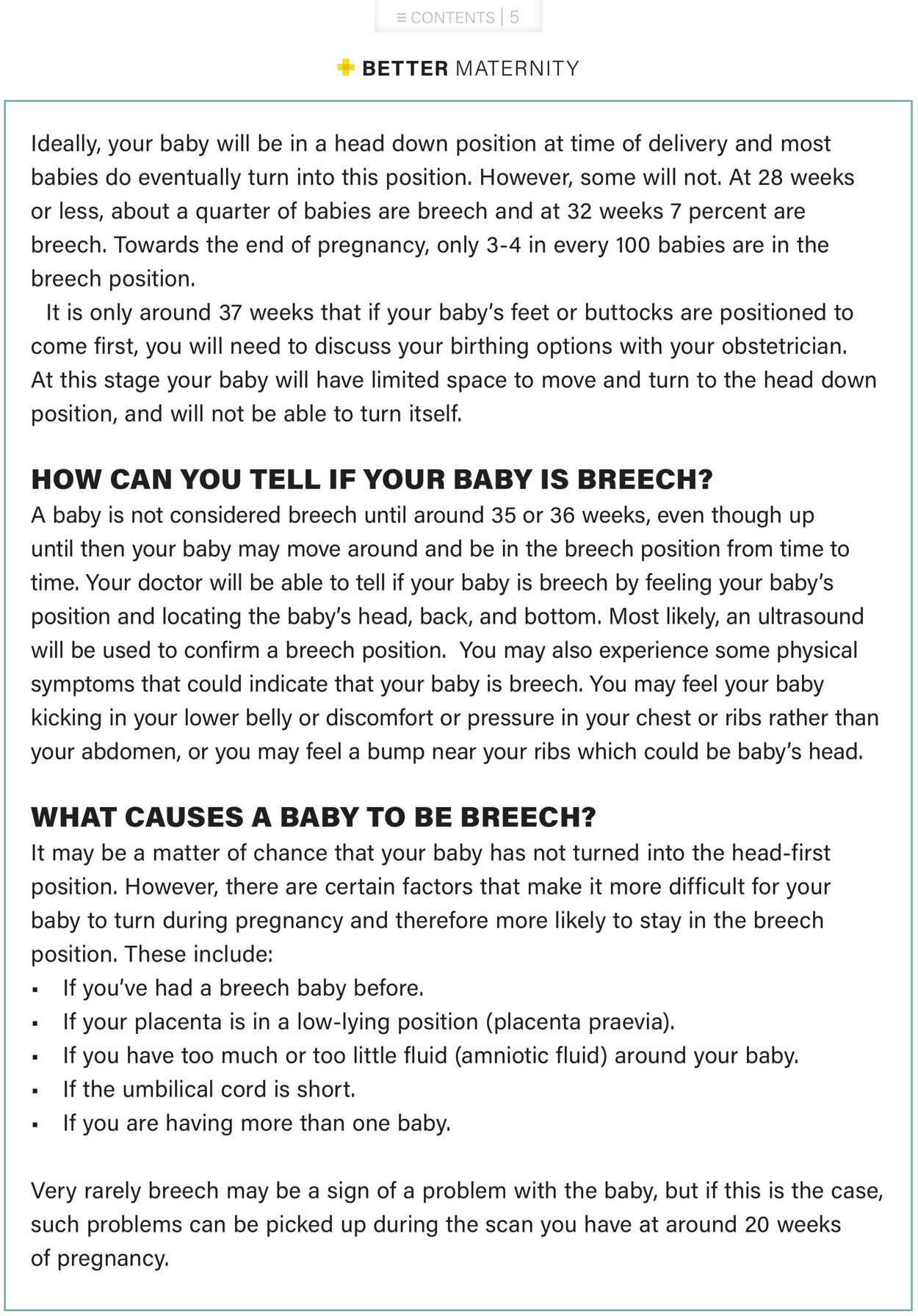
* BETTER MATERNITY Ideally, your baby will be in a head down position at time of delivery and most babies do eventually turn into this position. However, some will not. At 28 weeks or less, about a quarter of babies are breech and at 32 weeks 7 percent are breech. Towards the end of pregnancy, only 3-4 in every 100 babies are in the breech position. It is only around 37 weeks that if your baby's feet or buttocks are positioned to come first, you will need to discuss your birthing options with your obstetrician. At this stage your baby will have limited space to move and turn to the head down position, and will not be able to turn itself. HOW CAN YOU TELL IF YOUR BABY IS BREECH? A baby is not considered breech until around 35 or 36 weeks, even though up until then your baby may move around and be in the breech position from time to time. Your doctor will be able to tell if your baby is breech by feeling your baby’s position and locating the baby’s head, back, and bottom. Most likely, an ultrasound will be used to confirm a breech position. You may also experience some physical symptoms that could indicate that your baby is breech. You may feel your baby kicking in your lower belly or discomfort or pressure in your chest or ribs rather than your abdomen, or you may feel a bump near your ribs which could be baby’s head. WHAT CAUSES A BABY TO BE BREECH? It may be a matter of chance that your baby has not turned into the head-first position. However, there are certain factors that make it more difficult for your baby to turn during pregnancy and therefore more likely to stay in the breech position. These include: « If you've had a breech baby before. « If your placenta is in a low-lying position (placenta praevia). « If you have too much or too little fluid (amniotic fluid) around your baby. « If the umbilical cord is short. « If you are having more than one baby. Very rarely breech may be a sign of a problem with the baby, but if this is the case, such problems can be picked up during the scan you have at around 20 weeks of pregnancy.


Latest specials

Advertisement
* BETTER MATERNITY Ideally, your baby will be in a head down position at time of delivery and most babies do eventually turn into this position. However, some will not. At 28 weeks or less, about a quarter of babies are breech and at 32 weeks 7 percent are breech. Towards the end of pregnancy, only 3-4 in every 100 babies are in the breech position. It is only around 37 weeks that if your baby's feet or buttocks are positioned to come first, you will need to discuss your birthing options with your obstetrician. At this stage your baby will have limited space to move and turn to the head down position, and will not be able to turn itself. HOW CAN YOU TELL IF YOUR BABY IS BREECH? A baby is not considered breech until around 35 or 36 weeks, even though up until then your baby may move around and be in the breech position from time to time. Your doctor will be able to tell if your baby is breech by feeling your baby’s position and locating the baby’s head, back, and bottom. Most likely, an ultrasound will be used to confirm a breech position. You may also experience some physical symptoms that could indicate that your baby is breech. You may feel your baby kicking in your lower belly or discomfort or pressure in your chest or ribs rather than your abdomen, or you may feel a bump near your ribs which could be baby’s head. WHAT CAUSES A BABY TO BE BREECH? It may be a matter of chance that your baby has not turned into the head-first position. However, there are certain factors that make it more difficult for your baby to turn during pregnancy and therefore more likely to stay in the breech position. These include: « If you've had a breech baby before. « If your placenta is in a low-lying position (placenta praevia). « If you have too much or too little fluid (amniotic fluid) around your baby. « If the umbilical cord is short. « If you are having more than one baby. Very rarely breech may be a sign of a problem with the baby, but if this is the case, such problems can be picked up during the scan you have at around 20 weeks of pregnancy.

Advertisement
Advertisement

If you continue to browse this website, you accept the use of cookies.

Name Details