The query has to be between 2 and 50 characters

Advertisement
Advertisement

Current special Baby City - Valid from 19.05 to 19.06 - Page nb 19

Advertisement
Advertisement
Advertisement
Advertisement
Special Baby City 19.05.2025 - 19.06.2025
Special Boxer - GP May ME Liquor Special Stores 25 May, 2026 - 7 Jun, 2026
Boxer - GP May ME Liquor Special Stores
25 May, 2026 - 7 Jun, 2026
Special Boxer - Atlyn Mall Liquor Grand Opening 25 May, 2026 - 7 Jun, 2026
Boxer - Atlyn Mall Liquor Grand Opening
25 May, 2026 - 7 Jun, 2026
Special Boxer - GP May ME Liquor 25 May, 2026 - 7 Jun, 2026
Boxer - GP May ME Liquor
25 May, 2026 - 7 Jun, 2026
Special Boxer - Atlyn Mall Liquor Grand Opening 22 May, 2026 - 7 Jun, 2026
Boxer - Atlyn Mall Liquor Grand Opening
22 May, 2026 - 7 Jun, 2026
See next flyer
Advertisement
Advertisement
Advertisement

Products in this catalogue

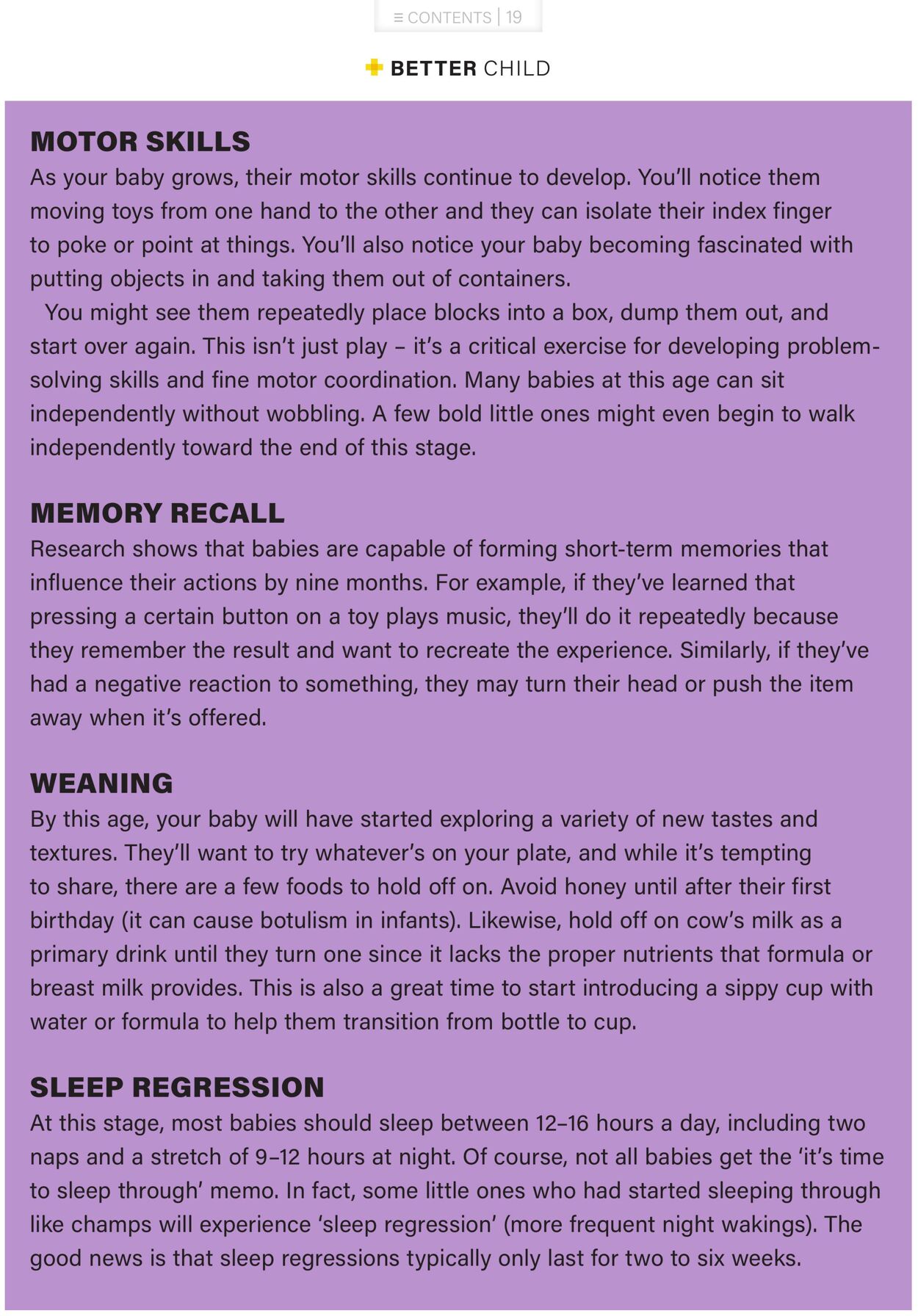
MOTOR SKILLS As your baby grows, their motor skills continue to develop. You'll notice them moving toys from one hand to the other and they can isolate their index finger to poke or point at things. You'll also notice your baby becoming fascinated with putting objects in and taking them out of containers. You might see them repeatedly place blocks into a box, dump them out, and start over again. This isn’t just play - it's a critical exercise for developing problem- solving skills and fine motor coordination. Many babies at this age can sit independently without wobbling. A few bold little ones might even begin to walk independently toward the end of this stage. MEMORY RECALL Research shows that babies are capable of forming short-term memories that influence their actions by nine months. For example, if they’ve learned that pressing a certain button on a toy plays music, they'll do it repeatedly because they remember the result and want to recreate the experience. Similarly, if they've had a negative reaction to something, they may turn their head or push the item away when it’s offered. WEANING By this age, your baby will have started exploring a variety of new tastes and textures. They'll want to try whatever's on your plate, and while it’s tempting to share, there are a few foods to hold off on. Avoid honey until after their first birthday (it can cause botulism in infants). Likewise, hold off on cow's milk as a primary drink until they turn one since it lacks the proper nutrients that formula or breast milk provides. This is also a great time to start introducing a sippy cup with water or formula to help them transition from bottle to cup. SLEEP REGRESSION At this stage, most babies should sleep between 12-16 hours a day, including two naps and a stretch of 9-12 hours at night. Of course, not all babies get the ‘it’s time to sleep through’ memo. In fact, some little ones who had started sleeping through like champs will experience ‘sleep regression’ (more frequent night wakings). The good news is that sleep regressions typically only last for two to six weeks.


Latest specials

Advertisement
MOTOR SKILLS As your baby grows, their motor skills continue to develop. You'll notice them moving toys from one hand to the other and they can isolate their index finger to poke or point at things. You'll also notice your baby becoming fascinated with putting objects in and taking them out of containers. You might see them repeatedly place blocks into a box, dump them out, and start over again. This isn’t just play - it's a critical exercise for developing problem- solving skills and fine motor coordination. Many babies at this age can sit independently without wobbling. A few bold little ones might even begin to walk independently toward the end of this stage. MEMORY RECALL Research shows that babies are capable of forming short-term memories that influence their actions by nine months. For example, if they’ve learned that pressing a certain button on a toy plays music, they'll do it repeatedly because they remember the result and want to recreate the experience. Similarly, if they've had a negative reaction to something, they may turn their head or push the item away when it’s offered. WEANING By this age, your baby will have started exploring a variety of new tastes and textures. They'll want to try whatever's on your plate, and while it’s tempting to share, there are a few foods to hold off on. Avoid honey until after their first birthday (it can cause botulism in infants). Likewise, hold off on cow's milk as a primary drink until they turn one since it lacks the proper nutrients that formula or breast milk provides. This is also a great time to start introducing a sippy cup with water or formula to help them transition from bottle to cup. SLEEP REGRESSION At this stage, most babies should sleep between 12-16 hours a day, including two naps and a stretch of 9-12 hours at night. Of course, not all babies get the ‘it’s time to sleep through’ memo. In fact, some little ones who had started sleeping through like champs will experience ‘sleep regression’ (more frequent night wakings). The good news is that sleep regressions typically only last for two to six weeks.

Advertisement
Advertisement

If you continue to browse this website, you accept the use of cookies.

Name Details