The query has to be between 2 and 50 characters

Advertisement
Advertisement

Current special Baby City - Valid from 01.11 to 30.11 - Page nb 43

Advertisement
Advertisement
Advertisement
Advertisement
Special Baby City 01.11.2025 - 30.11.2025
Special Boxer - GP May ME Special Stores 25 May, 2026 - 7 Jun, 2026
Boxer - GP May ME Special Stores
25 May, 2026 - 7 Jun, 2026
Special Boxer - Atlyn Mall Liquor Grand Opening 22 May, 2026 - 7 Jun, 2026
Boxer - Atlyn Mall Liquor Grand Opening
22 May, 2026 - 7 Jun, 2026
Special Boxer - GP May ME Liquor Special Stores 25 May, 2026 - 7 Jun, 2026
Boxer - GP May ME Liquor Special Stores
25 May, 2026 - 7 Jun, 2026
Special Boxer - GP May ME Special Stores 25 May, 2026 - 7 Jun, 2026
Boxer - GP May ME Special Stores
25 May, 2026 - 7 Jun, 2026
See next flyer
Advertisement
Advertisement
Advertisement

Products in this catalogue

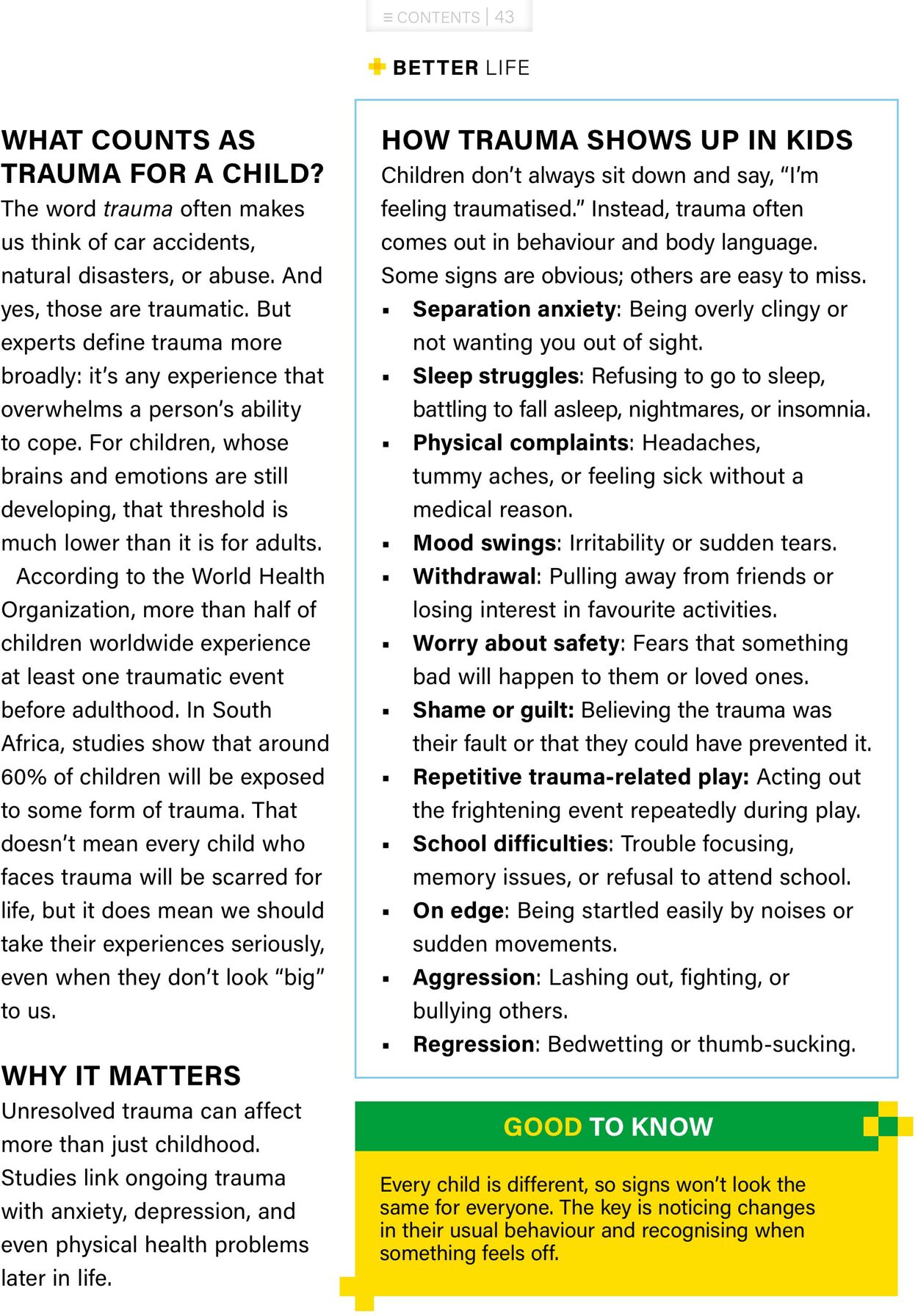
WHAT COUNTS AS TRAUMA FOR A CHILD? The word trauma often makes us think of car accidents, natural disasters, or abuse. And yes, those are traumatic. But experts define trauma more broadly: it’s any experience that overwhelms a person's ability to cope. For children, whose brains and emotions are still developing, that threshold is much lower than it is for adults. According to the World Health Organization, more than half of children worldwide experience at least one traumatic event before adulthood. In South Africa, studies show that around 60% of children will be exposed to some form of trauma. That doesn't mean every child who faces trauma will be scarred for life, but it does mean we should take their experiences seriously, even when they don't look “big” to us. WHY IT MATTERS Unresolved trauma can affect more than just childhood. Studies link ongoing trauma with anxiety, depression, and even physical health problems later in life. *» BETTER LIFE HOW TRAUMA SHOWS UP IN KIDS Children don't always sit down and say, “I’m feeling traumatised.” Instead, trauma often comes out in behaviour and body language. Some signs are obvious; others are easy to miss. « Separation anxiety: Being overly clingy or not wanting you out of sight. « Sleep struggles: Refusing to go to sleep, battling to fall asleep, nightmares, or insomnia. « Physical complaints: Headaches, tummy aches, or feeling sick without a medical reason. » Mood swings: Irritability or sudden tears. » Withdrawal: Pulling away from friends or losing interest in favourite activities. » Worry about safety: Fears that something bad will happen to them or loved ones. » Shame or guilt: Believing the trauma was their fault or that they could have prevented it. « Repetitive trauma-related play: Acting out the frightening event repeatedly during play. « School difficulties: Trouble focusing, memory issues, or refusal to attend school. « On edge: Being startled easily by noises or sudden movements. » Aggression: Lashing out, fighting, or bullying others. » Regression: Bedwetting or thumb-sucking. TO KNOW


Latest specials

Advertisement
WHAT COUNTS AS TRAUMA FOR A CHILD? The word trauma often makes us think of car accidents, natural disasters, or abuse. And yes, those are traumatic. But experts define trauma more broadly: it’s any experience that overwhelms a person's ability to cope. For children, whose brains and emotions are still developing, that threshold is much lower than it is for adults. According to the World Health Organization, more than half of children worldwide experience at least one traumatic event before adulthood. In South Africa, studies show that around 60% of children will be exposed to some form of trauma. That doesn't mean every child who faces trauma will be scarred for life, but it does mean we should take their experiences seriously, even when they don't look “big” to us. WHY IT MATTERS Unresolved trauma can affect more than just childhood. Studies link ongoing trauma with anxiety, depression, and even physical health problems later in life. *» BETTER LIFE HOW TRAUMA SHOWS UP IN KIDS Children don't always sit down and say, “I’m feeling traumatised.” Instead, trauma often comes out in behaviour and body language. Some signs are obvious; others are easy to miss. « Separation anxiety: Being overly clingy or not wanting you out of sight. « Sleep struggles: Refusing to go to sleep, battling to fall asleep, nightmares, or insomnia. « Physical complaints: Headaches, tummy aches, or feeling sick without a medical reason. » Mood swings: Irritability or sudden tears. » Withdrawal: Pulling away from friends or losing interest in favourite activities. » Worry about safety: Fears that something bad will happen to them or loved ones. » Shame or guilt: Believing the trauma was their fault or that they could have prevented it. « Repetitive trauma-related play: Acting out the frightening event repeatedly during play. « School difficulties: Trouble focusing, memory issues, or refusal to attend school. « On edge: Being startled easily by noises or sudden movements. » Aggression: Lashing out, fighting, or bullying others. » Regression: Bedwetting or thumb-sucking. TO KNOW

Advertisement
Advertisement

If you continue to browse this website, you accept the use of cookies.

Name Details