The query has to be between 2 and 50 characters

Advertisement
Advertisement

Current special Baby City - Valid from 01.11 to 30.11 - Page nb 35

Advertisement
Advertisement
Advertisement
Advertisement
Special Baby City 01.11.2025 - 30.11.2025
Special Boxer - GP May ME Special Stores 25 May, 2026 - 7 Jun, 2026
Boxer - GP May ME Special Stores
25 May, 2026 - 7 Jun, 2026
Special Boxer - GP May ME Liquor Special Stores 25 May, 2026 - 7 Jun, 2026
Boxer - GP May ME Liquor Special Stores
25 May, 2026 - 7 Jun, 2026
Special Boxer - GP May ME Liquor Special Stores 25 May, 2026 - 7 Jun, 2026
Boxer - GP May ME Liquor Special Stores
25 May, 2026 - 7 Jun, 2026
Special Boxer - GP May ME Special Stores 25 May, 2026 - 7 Jun, 2026
Boxer - GP May ME Special Stores
25 May, 2026 - 7 Jun, 2026
See next flyer
Advertisement
Advertisement
Advertisement

Products in this catalogue

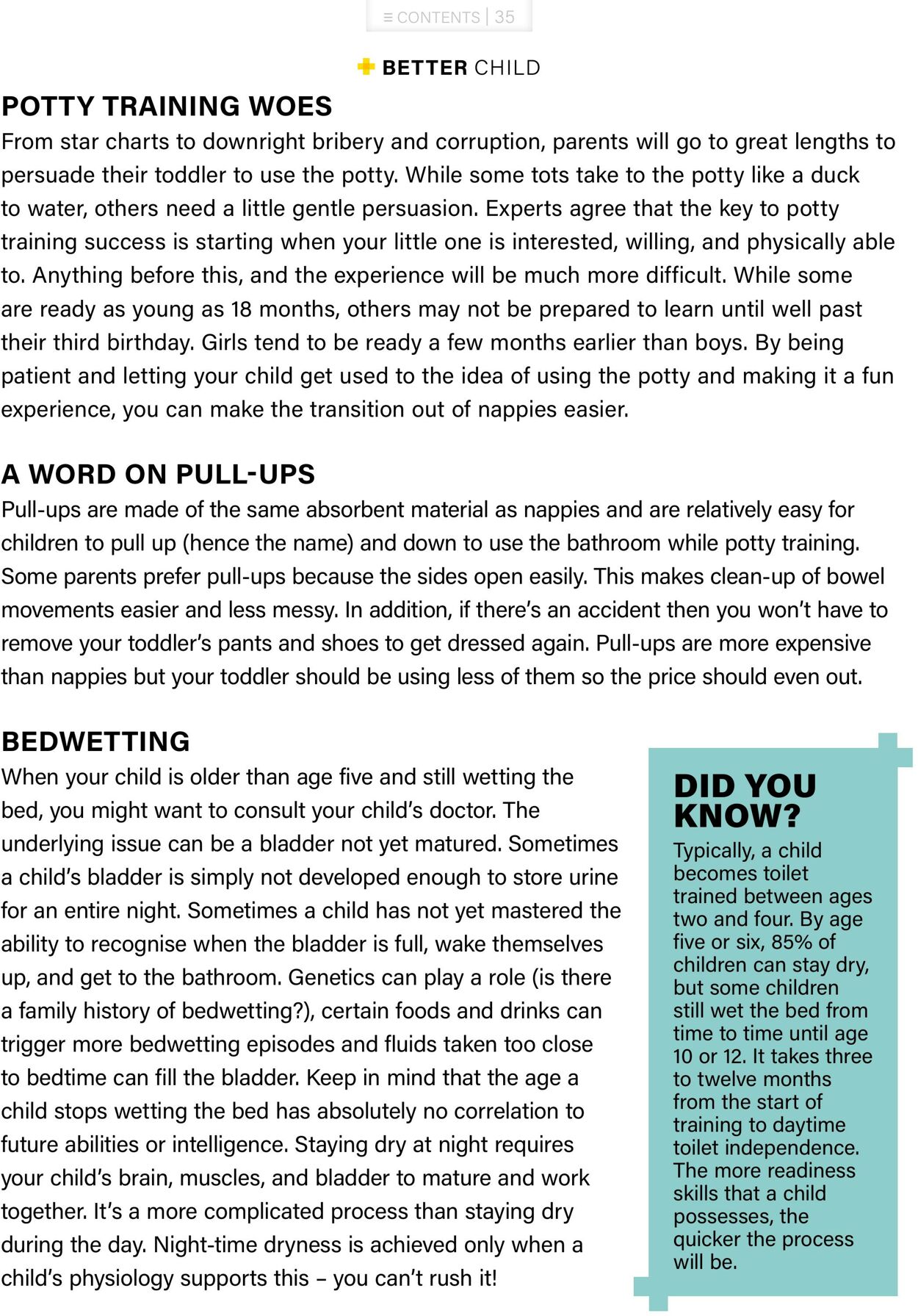
© BETTER CHILD POTTY TRAINING WOES From star charts to downright bribery and corruption, parents will go to great lengths to persuade their toddler to use the potty. While some tots take to the potty like a duck to water, others need a little gentle persuasion. Experts agree that the key to potty training success is starting when your little one is interested, willing, and physically able to. Anything before this, and the experience will be much more difficult. While some are ready as young as 18 months, others may not be prepared to learn until well past their third birthday. Girls tend to be ready a few months earlier than boys. By being patient and letting your child get used to the idea of using the potty and making it a fun experience, you can make the transition out of nappies easier. A WORD ON PULL-UPS Pull-ups are made of the same absorbent material as nappies and are relatively easy for children to pull up (hence the name) and down to use the bathroom while potty training. Some parents prefer pull-ups because the sides open easily. This makes clean-up of bowel movements easier and less messy. In addition, if there's an accident then you won't have to remove your toddler's pants and shoes to get dressed again. Pull-ups are more expensive than nappies but your toddler should be using less of them so the price should even out. BEDWETTING When your child is older than age five and still wetting the bed, you might want to consult your child’s doctor. The underlying issue can be a bladder not yet matured. Sometimes a child's bladder is simply not developed enough to store urine for an entire night. Sometimes a child has not yet mastered the ability to recognise when the bladder is full, wake themselves up, and get to the bathroom. Genetics can play a role (is there a family history of bedwetting?), certain foods and drinks can trigger more bedwetting episodes and fluids taken too close to bedtime can fill the bladder. Keep in mind that the age a child stops wetting the bed has absolutely no correlation to future abilities or intelligence. Staying dry at night requires your child's brain, muscles, and bladder to mature and work together. It's a more complicated process than staying dry during the day. Night-time dryness is achieved only when a child's physiology supports this - you can't rush it!


Latest specials

Advertisement
© BETTER CHILD POTTY TRAINING WOES From star charts to downright bribery and corruption, parents will go to great lengths to persuade their toddler to use the potty. While some tots take to the potty like a duck to water, others need a little gentle persuasion. Experts agree that the key to potty training success is starting when your little one is interested, willing, and physically able to. Anything before this, and the experience will be much more difficult. While some are ready as young as 18 months, others may not be prepared to learn until well past their third birthday. Girls tend to be ready a few months earlier than boys. By being patient and letting your child get used to the idea of using the potty and making it a fun experience, you can make the transition out of nappies easier. A WORD ON PULL-UPS Pull-ups are made of the same absorbent material as nappies and are relatively easy for children to pull up (hence the name) and down to use the bathroom while potty training. Some parents prefer pull-ups because the sides open easily. This makes clean-up of bowel movements easier and less messy. In addition, if there's an accident then you won't have to remove your toddler's pants and shoes to get dressed again. Pull-ups are more expensive than nappies but your toddler should be using less of them so the price should even out. BEDWETTING When your child is older than age five and still wetting the bed, you might want to consult your child’s doctor. The underlying issue can be a bladder not yet matured. Sometimes a child's bladder is simply not developed enough to store urine for an entire night. Sometimes a child has not yet mastered the ability to recognise when the bladder is full, wake themselves up, and get to the bathroom. Genetics can play a role (is there a family history of bedwetting?), certain foods and drinks can trigger more bedwetting episodes and fluids taken too close to bedtime can fill the bladder. Keep in mind that the age a child stops wetting the bed has absolutely no correlation to future abilities or intelligence. Staying dry at night requires your child's brain, muscles, and bladder to mature and work together. It's a more complicated process than staying dry during the day. Night-time dryness is achieved only when a child's physiology supports this - you can't rush it!

Advertisement
Advertisement

If you continue to browse this website, you accept the use of cookies.

Name Details