The query has to be between 2 and 50 characters

Advertisement
Advertisement

Current special Baby City - Valid from 22.08 to 22.09 - Page nb 25

Advertisement
Advertisement
Advertisement
Advertisement
Special Baby City 22.08.2025 - 22.09.2025
Special Boxer - GP May ME Liquor Special Stores 25 May, 2026 - 7 Jun, 2026
Boxer - GP May ME Liquor Special Stores
25 May, 2026 - 7 Jun, 2026
Special Boxer - Atlyn Mall Liquor Grand Opening 25 May, 2026 - 7 Jun, 2026
Boxer - Atlyn Mall Liquor Grand Opening
25 May, 2026 - 7 Jun, 2026
Special Boxer - GP May ME Liquor 25 May, 2026 - 7 Jun, 2026
Boxer - GP May ME Liquor
25 May, 2026 - 7 Jun, 2026
Special Boxer - GP May ME 25 May, 2026 - 7 Jun, 2026
Boxer - GP May ME
25 May, 2026 - 7 Jun, 2026
See next flyer
Advertisement
Advertisement
Advertisement

Products in this catalogue

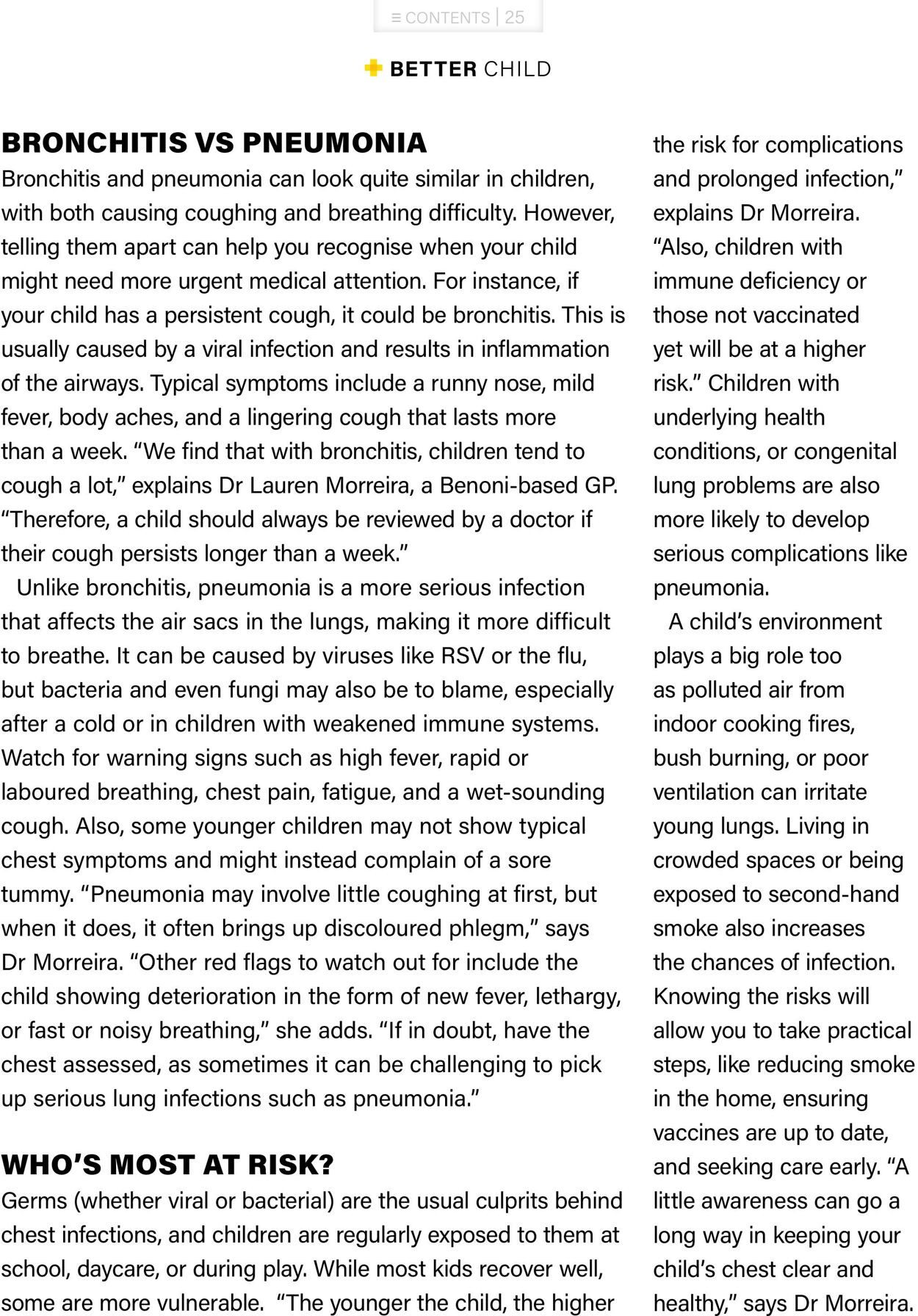
“> BETTER CHILD BRONCHITIS VS PNEUMONIA Bronchitis and pneumonia can look quite similar in children, with both causing coughing and breathing difficulty. However, telling them apart can help you recognise when your child might need more urgent medical attention. For instance, if your child has a persistent cough, it could be bronchitis. This is usually caused by a viral infection and results in inflammation of the airways. Typical symptoms include a runny nose, mild fever, body aches, and a lingering cough that lasts more than a week. “We find that with bronchitis, children tend to cough a lot,” explains Dr Lauren Morreira, a Benoni-based GP. “Therefore, a child should always be reviewed by a doctor if their cough persists longer than a week.” Unlike bronchitis, pneumonia is a more serious infection that affects the air sacs in the lungs, making it more difficult to breathe. It can be caused by viruses like RSV or the flu, but bacteria and even fungi may also be to blame, especially after a cold or in children with weakened immune systems. Watch for warning signs such as high fever, rapid or laboured breathing, chest pain, fatigue, and a wet-sounding cough. Also, some younger children may not show typical chest symptoms and might instead complain of a sore tummy. “Pneumonia may involve little coughing at first, but when it does, it often brings up discoloured phlegm,” says Dr Morreira. “Other red flags to watch out for include the child showing deterioration in the form of new fever, lethargy, or fast or noisy breathing,” she adds. “If in doubt, have the chest assessed, as sometimes it can be challenging to pick up serious lung infections such as pneumonia.” WHO’S MOST AT RISK? Germs (whether viral or bacterial) are the usual culprits behind chest infections, and children are regularly exposed to them at school, daycare, or during play. While most kids recover well, some are more vulnerable. “The younger the child, the higher the risk for complications and prolonged infection,” explains Dr Morreira. “Also, children with immune deficiency or those not vaccinated yet will be at a higher risk.” Children with underlying health conditions, or congenital lung problems are also more likely to develop serious complications like pneumonia. A child's environment plays a big role too as polluted air from indoor cooking fires, bush burning, or poor ventilation can irritate young lungs. Living in crowded spaces or being exposed to second-hand smoke also increases the chances of infection. Knowing the risks will allow you to take practical steps, like reducing smoke in the home, ensuring vaccines are up to date, and seeking care early. “A little awareness can go a long way in keeping your child's chest clear and healthy,” says Dr Morreira.


Latest specials

Advertisement
“> BETTER CHILD BRONCHITIS VS PNEUMONIA Bronchitis and pneumonia can look quite similar in children, with both causing coughing and breathing difficulty. However, telling them apart can help you recognise when your child might need more urgent medical attention. For instance, if your child has a persistent cough, it could be bronchitis. This is usually caused by a viral infection and results in inflammation of the airways. Typical symptoms include a runny nose, mild fever, body aches, and a lingering cough that lasts more than a week. “We find that with bronchitis, children tend to cough a lot,” explains Dr Lauren Morreira, a Benoni-based GP. “Therefore, a child should always be reviewed by a doctor if their cough persists longer than a week.” Unlike bronchitis, pneumonia is a more serious infection that affects the air sacs in the lungs, making it more difficult to breathe. It can be caused by viruses like RSV or the flu, but bacteria and even fungi may also be to blame, especially after a cold or in children with weakened immune systems. Watch for warning signs such as high fever, rapid or laboured breathing, chest pain, fatigue, and a wet-sounding cough. Also, some younger children may not show typical chest symptoms and might instead complain of a sore tummy. “Pneumonia may involve little coughing at first, but when it does, it often brings up discoloured phlegm,” says Dr Morreira. “Other red flags to watch out for include the child showing deterioration in the form of new fever, lethargy, or fast or noisy breathing,” she adds. “If in doubt, have the chest assessed, as sometimes it can be challenging to pick up serious lung infections such as pneumonia.” WHO’S MOST AT RISK? Germs (whether viral or bacterial) are the usual culprits behind chest infections, and children are regularly exposed to them at school, daycare, or during play. While most kids recover well, some are more vulnerable. “The younger the child, the higher the risk for complications and prolonged infection,” explains Dr Morreira. “Also, children with immune deficiency or those not vaccinated yet will be at a higher risk.” Children with underlying health conditions, or congenital lung problems are also more likely to develop serious complications like pneumonia. A child's environment plays a big role too as polluted air from indoor cooking fires, bush burning, or poor ventilation can irritate young lungs. Living in crowded spaces or being exposed to second-hand smoke also increases the chances of infection. Knowing the risks will allow you to take practical steps, like reducing smoke in the home, ensuring vaccines are up to date, and seeking care early. “A little awareness can go a long way in keeping your child's chest clear and healthy,” says Dr Morreira.

Advertisement
Advertisement

If you continue to browse this website, you accept the use of cookies.

Name Details