The query has to be between 2 and 50 characters

Advertisement
Advertisement

Current special Baby City - Valid from 01.06 to 30.06 - Page nb 38

Advertisement
Advertisement
Advertisement
Advertisement
Special Baby City 01.06.2025 - 30.06.2025
Special Boxer - GP May ME 25 May, 2026 - 7 Jun, 2026
Boxer - GP May ME
25 May, 2026 - 7 Jun, 2026
Special Boxer - Atlyn Mall Liquor Grand Opening 22 May, 2026 - 7 Jun, 2026
Boxer - Atlyn Mall Liquor Grand Opening
22 May, 2026 - 7 Jun, 2026
Special Boxer - Atlyn Mall Liquor Grand Opening 22 May, 2026 - 7 Jun, 2026
Boxer - Atlyn Mall Liquor Grand Opening
22 May, 2026 - 7 Jun, 2026
Special Game - Game : The Game Changer (25 May - 20 July 2026) — www.guzzle.co.za 25 May, 2026 - 20 Jul, 2026
Game - Game : The Game Changer (25 May - 20 July 2026) — www.guzzle.co.za
25 May, 2026 - 20 Jul, 2026
See next flyer
Advertisement
Advertisement
Advertisement

Products in this catalogue

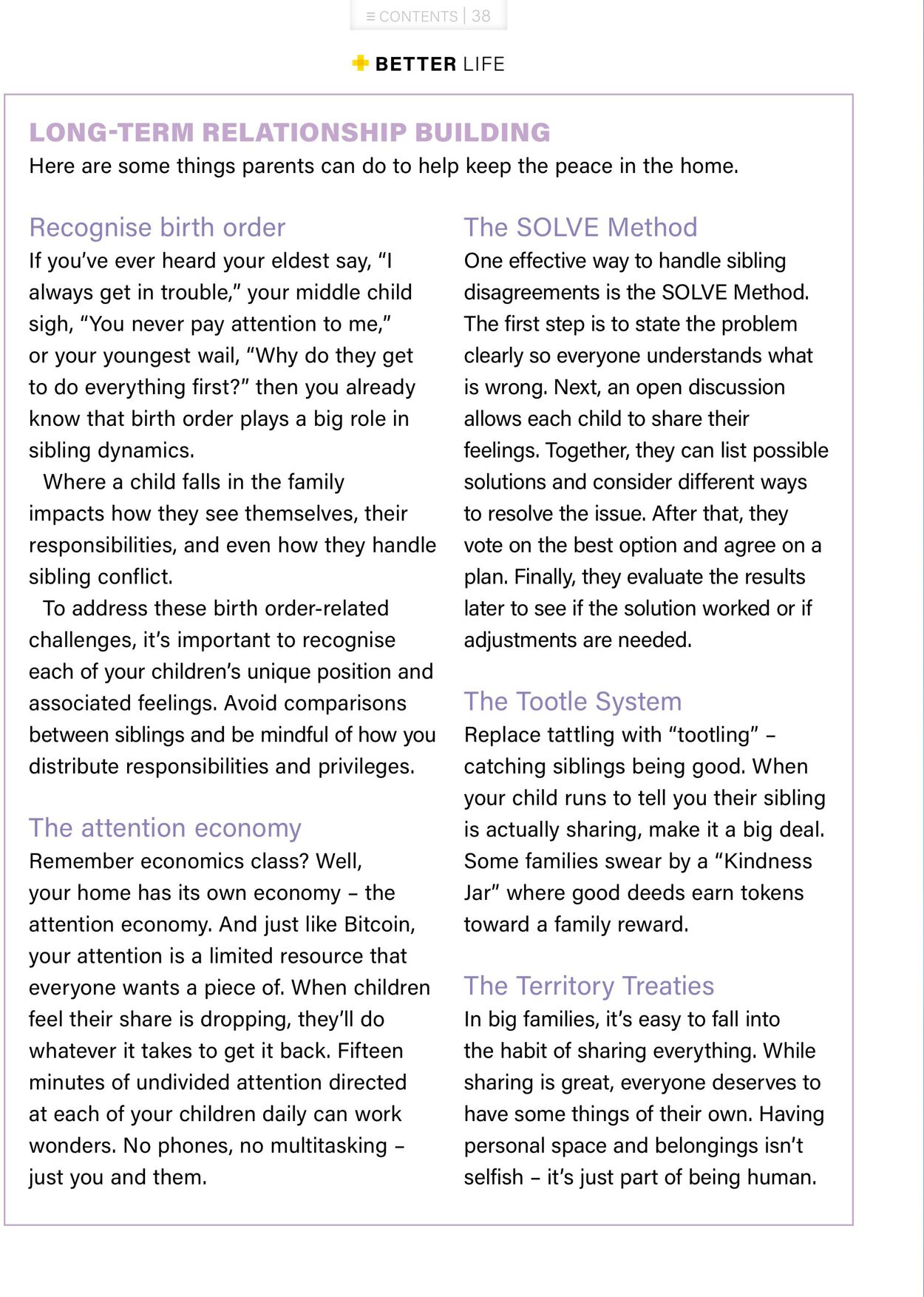
“» BETTER LIFE Here are some things parents can do to help keep the peace in the home. Recognise birth order If you've ever heard your eldest say, “I always get in trouble,” your middle child sigh, “You never pay attention to me,” or your youngest wail, “Why do they get to do everything first?” then you already know that birth order plays a big role in sibling dynamics. Where a child falls in the family impacts how they see themselves, their responsibilities, and even how they handle sibling conflict. To address these birth order-related challenges, it's important to recognise each of your children’s unique position and associated feelings. Avoid comparisons between siblings and be mindful of how you distribute responsibilities and privileges. The attention economy Remember economics class? Well, your home has its own economy - the attention economy. And just like Bitcoin, your attention is a limited resource that everyone wants a piece of. When children feel their share is dropping, they'll do whatever it takes to get it back. Fifteen minutes of undivided attention directed at each of your children daily can work wonders. No phones, no multitasking - just you and them. The SOLVE Method One effective way to handle sibling disagreements is the SOLVE Method. The first step is to state the problem clearly so everyone understands what is wrong. Next, an open discussion allows each child to share their feelings. Together, they can list possible solutions and consider different ways to resolve the issue. After that, they vote on the best option and agree ona plan. Finally, they evaluate the results later to see if the solution worked or if adjustments are needed. The Tootle System Replace tattling with “tootling” - catching siblings being good. When your child runs to tell you their sibling is actually sharing, make it a big deal. Some families swear by a “Kindness Jar” where good deeds earn tokens toward a family reward. The Territory Treaties In big families, it’s easy to fall into the habit of sharing everything. While sharing is great, everyone deserves to have some things of their own. Having personal space and belongings isn’t selfish - it’s just part of being human.


Latest specials

Advertisement
“» BETTER LIFE Here are some things parents can do to help keep the peace in the home. Recognise birth order If you've ever heard your eldest say, “I always get in trouble,” your middle child sigh, “You never pay attention to me,” or your youngest wail, “Why do they get to do everything first?” then you already know that birth order plays a big role in sibling dynamics. Where a child falls in the family impacts how they see themselves, their responsibilities, and even how they handle sibling conflict. To address these birth order-related challenges, it's important to recognise each of your children’s unique position and associated feelings. Avoid comparisons between siblings and be mindful of how you distribute responsibilities and privileges. The attention economy Remember economics class? Well, your home has its own economy - the attention economy. And just like Bitcoin, your attention is a limited resource that everyone wants a piece of. When children feel their share is dropping, they'll do whatever it takes to get it back. Fifteen minutes of undivided attention directed at each of your children daily can work wonders. No phones, no multitasking - just you and them. The SOLVE Method One effective way to handle sibling disagreements is the SOLVE Method. The first step is to state the problem clearly so everyone understands what is wrong. Next, an open discussion allows each child to share their feelings. Together, they can list possible solutions and consider different ways to resolve the issue. After that, they vote on the best option and agree ona plan. Finally, they evaluate the results later to see if the solution worked or if adjustments are needed. The Tootle System Replace tattling with “tootling” - catching siblings being good. When your child runs to tell you their sibling is actually sharing, make it a big deal. Some families swear by a “Kindness Jar” where good deeds earn tokens toward a family reward. The Territory Treaties In big families, it’s easy to fall into the habit of sharing everything. While sharing is great, everyone deserves to have some things of their own. Having personal space and belongings isn’t selfish - it’s just part of being human.

Advertisement
Advertisement

If you continue to browse this website, you accept the use of cookies.

Name Details