The query has to be between 2 and 50 characters

Advertisement
Advertisement

Current special Baby City - Valid from 01.07 to 31.07 - Page nb 18

Advertisement
Advertisement
Advertisement
Advertisement
Special Baby City 01.07.2025 - 31.07.2025
Special Boxer - GP May ME Liquor 25 May, 2026 - 7 Jun, 2026
Boxer - GP May ME Liquor
25 May, 2026 - 7 Jun, 2026
Special Boxer - Atlyn Mall Liquor Grand Opening 22 May, 2026 - 7 Jun, 2026
Boxer - Atlyn Mall Liquor Grand Opening
22 May, 2026 - 7 Jun, 2026
Special Boxer - GP May ME 25 May, 2026 - 7 Jun, 2026
Boxer - GP May ME
25 May, 2026 - 7 Jun, 2026
Special Game - Game SASSA : Get More iGroza For Your Buck (25 May - 08 June 2026) — www.guzzle.co.za 25 May, 2026 - 8 Jun, 2026
Game - Game SASSA : Get More iGroza For Your Buck (25 May - 08 June 2026) — www.guzzle.co.za
25 May, 2026 - 8 Jun, 2026
See next flyer
Advertisement
Advertisement
Advertisement

Products in this catalogue

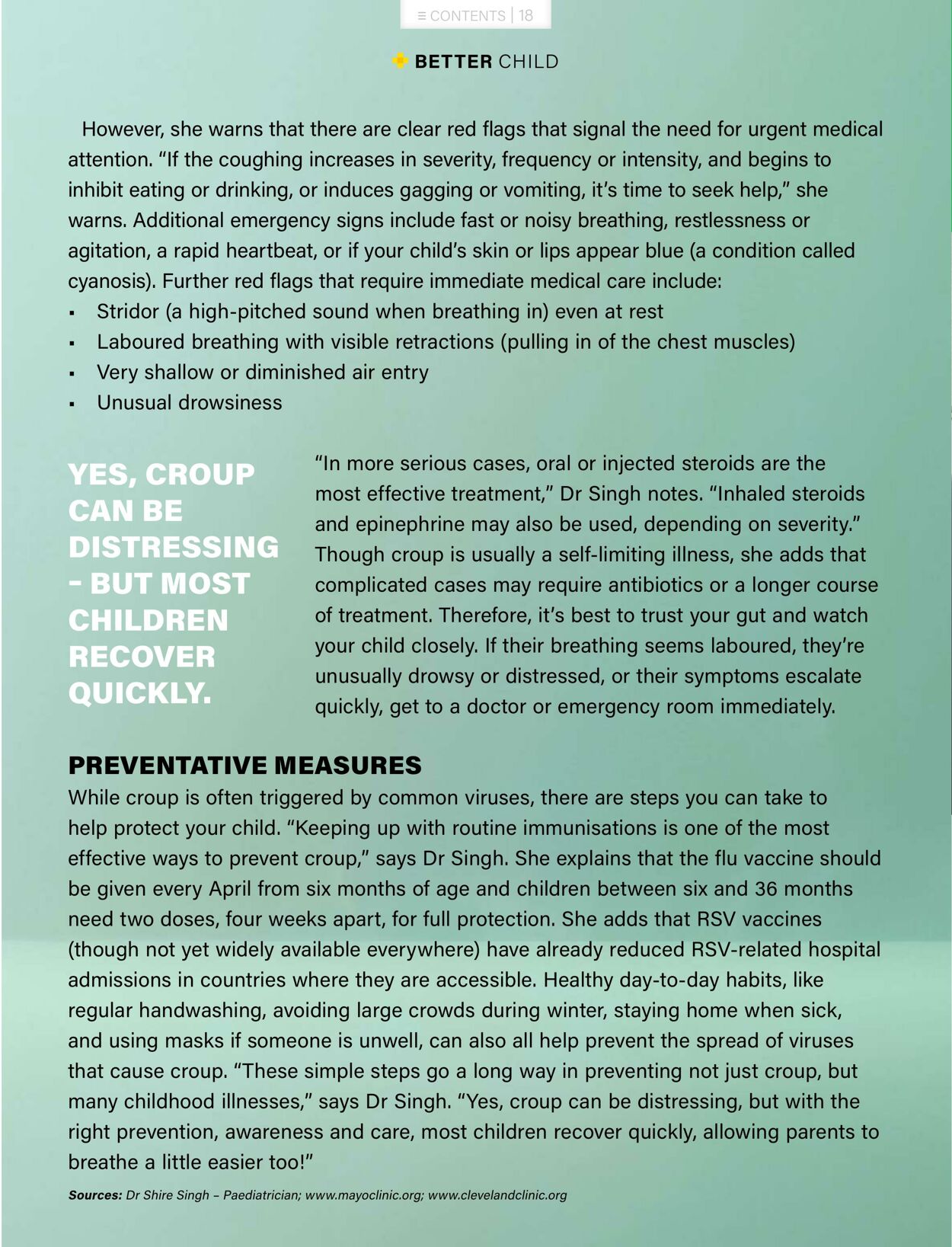
~ BETTER CHILD However, she warns that there are clear red flags that signal the need for urgent medical attention. “If the coughing increases in severity, frequency or intensity, and begins to inhibit eating or drinking, or induces gagging or vomiting, it’s time to seek help,” she warns. Additional emergency signs include fast or noisy breathing, restlessness or agitation, a rapid heartbeat, or if your child's skin or lips appear blue (a condition called cyanosis). Further red flags that require immediate medical care include: « Stridor (a high-pitched sound when breathing in) even at rest » Laboured breathing with visible retractions (pulling in of the chest muscles) Very shallow or diminished air entry Unusual drowsiness “In more serious cases, oral or injected steroids are the most effective treatment,” Dr Singh notes. “Inhaled steroids and epinephrine may also be used, depending on severity.” Though croup is usually a self-limiting illness, she adds that complicated cases may require antibiotics or a longer course of treatment. Therefore, it’s best to trust your gut and watch your child closely. If their breathing seems laboured, they're unusually drowsy or distressed, or their symptoms escalate quickly, get to a doctor or emergency room immediately. PREVENTATIVE MEASURES While croup is often triggered by common viruses, there are steps you can take to help protect your child. “Keeping up with routine immunisations is one of the most effective ways to prevent croup,” says Dr Singh. She explains that the flu vaccine should be given every April from six months of age and children between six and 36 months need two doses, four weeks apart, for full protection. She adds that RSV vaccines (though not yet widely available everywhere) have already reduced RSV-related hospital admissions in countries where they are accessible. Healthy day-to-day habits, like regular handwashing, avoiding large crowds during winter, staying home when sick, and using masks if someone is unwell, can also all help prevent the spread of viruses that cause croup. “These simple steps go a long way in preventing not just croup, but many childhood illnesses,” says Dr Singh. “Yes, croup can be distressing, but with the right prevention, awareness and care, most children recover quickly, allowing parents to breathe a little easier too!” Sources: Dr Shire Singh ~ Paediatrician; www.mayoclinic.org; www.clevelandclinic.org


Latest specials

Advertisement
~ BETTER CHILD However, she warns that there are clear red flags that signal the need for urgent medical attention. “If the coughing increases in severity, frequency or intensity, and begins to inhibit eating or drinking, or induces gagging or vomiting, it’s time to seek help,” she warns. Additional emergency signs include fast or noisy breathing, restlessness or agitation, a rapid heartbeat, or if your child's skin or lips appear blue (a condition called cyanosis). Further red flags that require immediate medical care include: « Stridor (a high-pitched sound when breathing in) even at rest » Laboured breathing with visible retractions (pulling in of the chest muscles) Very shallow or diminished air entry Unusual drowsiness “In more serious cases, oral or injected steroids are the most effective treatment,” Dr Singh notes. “Inhaled steroids and epinephrine may also be used, depending on severity.” Though croup is usually a self-limiting illness, she adds that complicated cases may require antibiotics or a longer course of treatment. Therefore, it’s best to trust your gut and watch your child closely. If their breathing seems laboured, they're unusually drowsy or distressed, or their symptoms escalate quickly, get to a doctor or emergency room immediately. PREVENTATIVE MEASURES While croup is often triggered by common viruses, there are steps you can take to help protect your child. “Keeping up with routine immunisations is one of the most effective ways to prevent croup,” says Dr Singh. She explains that the flu vaccine should be given every April from six months of age and children between six and 36 months need two doses, four weeks apart, for full protection. She adds that RSV vaccines (though not yet widely available everywhere) have already reduced RSV-related hospital admissions in countries where they are accessible. Healthy day-to-day habits, like regular handwashing, avoiding large crowds during winter, staying home when sick, and using masks if someone is unwell, can also all help prevent the spread of viruses that cause croup. “These simple steps go a long way in preventing not just croup, but many childhood illnesses,” says Dr Singh. “Yes, croup can be distressing, but with the right prevention, awareness and care, most children recover quickly, allowing parents to breathe a little easier too!” Sources: Dr Shire Singh ~ Paediatrician; www.mayoclinic.org; www.clevelandclinic.org

Advertisement
Advertisement

If you continue to browse this website, you accept the use of cookies.

Name Details